
Ashkenazi Jews ( A(H)SH-kə-NAH-zee; also known as Ashkenazic Jews, Ashkenazis, or Ashkenazim) form a distinct ethnic subdivision of the Jewish diaspora, emerging from the Jewish communities that consolidated during the 10th century in the Rhineland (western Germany) and in northern France, having migrated there from centers such as the Italian Peninsula and the Southern Levant. After numerous massacres of Jews during the Crusades (11th–13th centuries), they began a gradual eastward migration due to mounting restrictions within the Holy Roman Empire and the favorable policies of Casimir III the Great and others. This migration ramped up after the persecution during the Black Death of the 14th century, such that by the 16th century, the bulk of the Ashkenazi Jews had migrated to the Kingdom of Poland, which includes modern Poland, Lithuania, Belarus, Ukraine, and parts of Russia. This area became the main center of Ashkenazi Jewry until the Holocaust.
Ashkenazim adapted their traditions, rites and customs to Europe. They traditionally follow the German rite synagogue ritual and until the Holocaust primarily spoke Yiddish, an offshoot of Middle High German written in a variety of the Hebrew script, with significant Hebrew, Aramaic, and Slavic influence. From the late 18th century onwards, Ashkenazi communities underwent significant religious and cultural transformations, under the influence of the Haskalah (Jewish Enlightenment) and the struggle for Jewish emancipation in European states that restricted their rights. Among other things, Maskilim (adherents of the Haskalah) advocated the adoption of national languages instead of Yiddish, as well as increased study and usage of the Hebrew language, in order to modernize Jewish religious practice and identity. The Hebrew language, whose usage until then had been primarily liturgical and clerical, was progressively revived as a common language starting from the 19th century, fueled by these aspirations of both religious and national revival. The Yiddish language progressively declined in prestige, in favor of national languages and Hebrew, being stigmatized by assimilationists and later also Zionists, though it remained spoken by over 11 million people worldwide prior to the Holocaust. The Yiddishist movement, which sought to preserve and revive the language, faded through the 20th century but is enjoying a revival in the 21st, including Duolingo adding Yiddish as a language.
Starting from the 19th century, millions of Ashkenazi Jews emigrated to the United States, which houses the largest Ashkenazi community in the world. Throughout the centuries, Ashkenazim made significant contributions to Western philosophy, scholarship, literature, art, music, and science. As a proportion of the world Jewish population, Ashkenazim were estimated to be 3% in the 11th century, rising to 92% in 1930 near the population's peak. The Ashkenazi population was significantly diminished by the Holocaust carried out by Nazi Germany during World War II, which killed around six million Jews, affecting practically every European Jewish family. Prior to World War II, the estimated worldwide Jewish population was 15.3–16.7 million, with 92% being Ashkenazi. Israeli demographer Sergio D. Pergola published statistics showing that Ashkenazim comprised 74% of Jews worldwide in 2000. As of 2023, the population of Ashkenazim was estimated to be around 10–13 million out of 15.8 million total Jews.
Etymology
The name Ashkenazi derives from the biblical figure of Ashkenaz, the first son of Gomer, son of Japhet, son of Noah, and a Japhetic patriarch in the Table of Nations. The name of Gomer has often been linked to the Cimmerians.
The Biblical Ashkenaz is usually derived from Assyrian Aškūza (cuneiform Aškuzai/Iškuzai), a people who expelled the Cimmerians from the Armenian area of the Upper Euphrates; the name Aškūza is identified with the Scythians.
In Jeremiah 51:27, Ashkenaz figures as one of three kingdoms in the far north, the others being Minni and Ararat (corresponding to Urartu), called on by God to resist Babylon. In Genesis Rabbah, Rabbi Berekhiah (early 4th century) mentions Ashkenaz, Riphath, and Togarmah as German tribes or as German lands. Ashkenaz is linked to Scandza/Scanzia, viewed as the cradle of Germanic tribes, in a 6th-century gloss to the Historia Ecclesiastica of Eusebius.
In the 10th-century History of Armenia of Yovhannes Drasxanakertc'i (1.15), Ashkenaz was associated with Armenia, as it was occasionally in Jewish usage, where its denotation extended at times to Adiabene, Khazaria, Crimea and areas to the east. His contemporary Saadia Gaon identified Ashkenaz with the slavim or Slavs. In 1932, Samuel Krauss identified the Biblical "Ashkenaz" with northern Asia Minor and specifically with the Khazars, an argument disputed by his contemporary Jacob Mann.
Conforming to the custom of designating areas of Jewish settlement with biblical names, Spain was denominated Sefarad (Obadiah 20), France was called Tsarefat (1 Kings 17:9), and Bohemia was called the Land of Canaan. By the start of the high medieval period, Hai Gaon refers to questions that had been addressed to him from Ashkenaz, by which he undoubtedly means Germany, and Talmudic commentators like Rashi began to use Ashkenaz/Eretz Ashkenaz to designate Germany, earlier known as Loter, where, especially in the Rhineland communities of Speyer, Worms and Mainz, the most important Jewish communities arose. Rashi uses leshon Ashkenaz (Ashkenazi language) to describe German expressions, and Byzantium and Syrian Jewish letters referred to the Crusaders as Ashkenazim. During the 12th century, the word appears quite frequently. In the Mahzor Vitry, the kingdom of Ashkenaz is referred to chiefly in regard to the ritual of the synagogue there, but occasionally also with regard to certain other observances. In the literature of the 13th century, references to the land and the language of Ashkenaz often occur. Examples include Solomon ben Aderet's Responsa (vol. i., No. 395); the Responsa of Asher ben Jehiel (pp. 4, 6); his Halakot (Berakot i. 12, ed. Wilna, p. 10); the work of his son Jacob ben Asher, Tur Orach Chayim (chapter 59); the Responsa of Isaac ben Sheshet (numbers 193, 268, 270). Given the close links between the Jewish communities of France and Germany following the Carolingian unification, the term Ashkenazi came to refer to the Jews of both medieval Germany and France.
In later times, the word Ashkenaz is used to designate southern and western Germany, the ritual of which sections differs somewhat from that of eastern Germany and Poland. Thus the prayer-book of Isaiah Horowitz, and many others, give the piyyutim according to the Minhag of Ashkenaz and Poland.
Definition
There have been several different understandings of what "Ashkenazi" means. For the Rabbinical scholar Joseph Karo it was a geographical term, simply referring to Jews residing in Germany. For rabbis Isaac Luria, Elijah Levita, Moses Isserles and Jacob Castro, it was a geneological term, referring to descendents of medieval French and German communities, wherever they dwelt. For Ottoman rabbis such as David ben Hayyim of Corfu or Samuel de Medina, it referred to membership in specific Ashkenazi congregations. For the rabbi Jacob Heilbronn, it refers to those who follow the liturgical and legal practices codified in the German and central European lands. For the rabbi Joshua Falk and later the linguist Max Weinreich, it refers to speakers of Judeo-German languages such as Yiddish. More recently, it has been associated with particular genetic traits.
By religion
Religious Jews of differing sects have different minhagim (customs) and interpretations of halakha (religious law). On certain issues, Orthodox Jews are required to follow the customs of their ancestors and as such find it important to ascertain the religious identity of their ancestors to determine what customs to follow. This is also the case when Jews of different ethnic backgrounds marry, when a non-Jew converts to Judaism and determines what customs to follow for the first time, or when an irreligious Jew becomes religious and must determine what was done in his or her family's past. In this sense, "Ashkenazic" refers both to a family ancestry and to a body of customs binding on Jews of that ancestry. Reform Judaism, which does not necessarily follow those minhagim, nonetheless originated among Ashkenazi Jews.
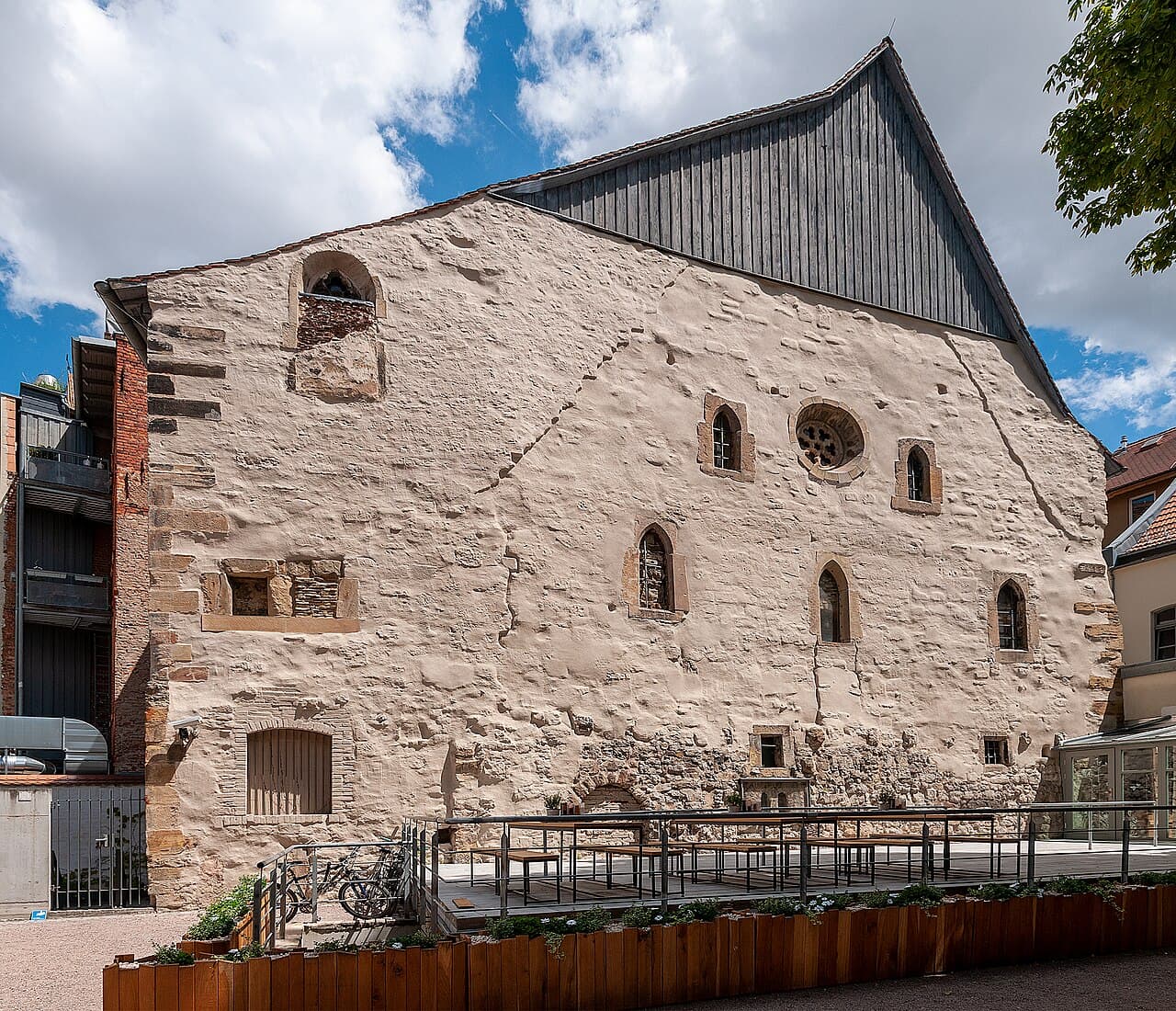
In a religious sense, an Ashkenazi Jew is any Jew whose family tradition and synagogue ritual follow Ashkenazi practice (German rite). Until the Ashkenazi community first began to develop in the Early Middle Ages, the centers of Jewish religious authority were in the Islamic world, at Baghdad and in Islamic Spain. Ashkenaz (Germany) was so distant geographically that it developed a minhag of its own. Ashkenazi Hebrew came to be pronounced in ways distinct from other forms of Hebrew.
In this respect, the counterpart of Ashkenazi is Sephardic, since most non-Ashkenazi Orthodox Jews follow Sephardic rabbinical authorities, whether or not they are ethnically Sephardic. By tradition, a Sephardic or Mizrahi woman who marries into an Orthodox or Haredi Ashkenazi Jewish family raises her children to be Ashkenazi Jews; conversely an Ashkenazi woman who marries a Sephardi or Mizrahi man is expected to take on Sephardic practice and the children inherit a Sephardic identity, though in practice many families compromise. A convert generally follows the practice of the beth din that converted him or her. With the integration of Jews from around the world in Israel, North America, and other places, the religious definition of an Ashkenazi Jew is blurring, especially outside Orthodox Judaism.
New developments in Judaism often transcend differences in religious practice between Ashkenazi and Sephardic Jews. In North American cities, social trends such as the chavurah movement, and the emergence of "post-denominational Judaism" often bring together younger Jews of diverse ethnic backgrounds. In recent years, there has been increased interest in Kabbalah, which many Ashkenazi Jews study outside of the Yeshiva framework. Another trend is the new popularity of ecstatic worship in the Jewish Renewal movement and the Carlebach style minyan, both of which are nominally of Ashkenazi origin. Outside of Haredi communities, the traditional Ashkenazi pronunciation of Hebrew has also drastically declined in favor of the Sephardi-based pronunciation of Modern Hebrew.
By culture
Culturally, an Ashkenazi Jew can be identified by the concept of Yiddishkeit, which means "Jewishness" in the Yiddish language. Before the Haskalah and the emancipation of Jews in Europe, this meant the study of Torah and Talmud for men, and a family and communal life governed by the observance of Jewish Law for men and women. From the Rhineland to Riga to Romania, most Jews prayed in liturgical Ashkenazi Hebrew, and spoke Yiddish in their secular lives. But with modernization, Yiddishkeit now encompasses not just Orthodoxy and Hasidism, but a broad range of movements, ideologies, practices, and traditions in which Ashkenazi Jews have participated and somehow retained a sense of Jewishness. Although a far smaller number of Jews still speak Yiddish, Yiddishkeit can be identified in manners of speech, in styles of humor, in patterns of association.
As Ashkenazi Jews moved away from Europe, mostly in the form of aliyah to Israel, or immigration to North America, South Africa, Europe (particularly France) and Latin America, the geographic isolation that gave rise to Ashkenazim have given way to mixing with other cultures, and with non-Ashkenazi Jews who, similarly, are no longer isolated in distinct geographic locales. Hebrew has replaced Yiddish as the primary Jewish language for many Ashkenazi Jews, although many Hasidic and Hareidi groups continue to use Yiddish in daily life.
France's blended Jewish community is typical of the cultural recombination that is going on among Jews throughout the world. Although France expelled its original Jewish population in the Middle Ages, by the time of the French Revolution, there were two distinct Jewish populations. One consisted of Sephardic Jews, originally refugees from the Inquisition and concentrated in the southwest, while the other community was Ashkenazi, concentrated in formerly German Alsace, and mainly speaking a German dialect similar to Yiddish. (The third community of Provençal Jews living in Comtat Venaissin were technically outside France, and were later absorbed into the Sephardim.) The two communities were so separate and different that the National Assembly emancipated them separately in 1790 and 1791.
But after emancipation, a sense of a unified French Jewry emerged, especially when France was wracked by the Dreyfus affair in the 1890s. In the 1920s and 1930s, Ashkenazi Jews from Europe arrived in large numbers as refugees from antisemitism, the Russian revolution, and the economic turmoil of the Great Depression. By the 1930s, Paris had a vibrant Yiddish culture, and many Jews were involved in diverse political movements. After the Vichy years and the Holocaust, the French Jewish population was augmented once again, first by Ashkenazi refugees from Central Europe, and later by Sephardi immigrants and refugees from North Africa, many of them francophone.
Ashkenazi Jews did not record their traditions or achievements by text; instead, these traditions were passed down orally from one generation to the next. The desire to maintain pre-Holocaust traditions relating to Ashkenazi culture has often been met with criticism by Jews in Eastern Europe. Reasoning for this could be related to the development of a new style of Jewish arts and culture developed by the Jews of Palestine during the 1930s and 1940s, which in conjunction with the decimation of European Ashkenazi Jews and their culture by the Nazi regime made it easier to assimilate to the new style of ritual rather than try to repair the older traditions. This new style of tradition was referred to as the Mediterranean Style, and was noted for its simplicity and metaphorical rejuvenation of Jews abroad. This was intended to replace the Galut (lit. 'exile') traditions, which were more sorrowful in practice.
Then, in the 1990s, yet another Ashkenazi Jewish wave began to arrive to France from countries of the former Soviet Union and Central Europe. The result is a pluralistic Jewish community that still has some distinct elements of both Ashkenazi and Sephardic culture. But in France, it is becoming much more difficult to sort out the two, and a distinctly French Jewishness has emerged.
By ethnicity
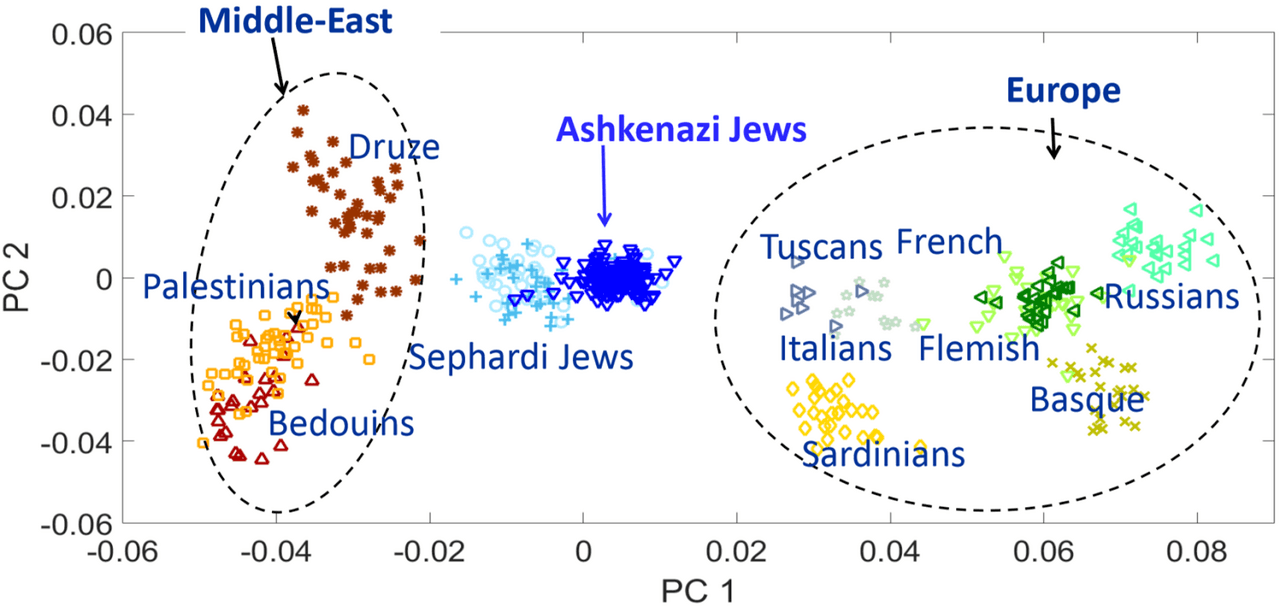
In an ethnic sense, an Ashkenazi Jew is a descendant of the Jews who settled in the Central European region of "Ashkenaz". For roughly a thousand years, the Ashkenazim were a reproductively isolated population in Europe, despite living in many countries, with little inflow or outflow from migration, conversion, or intermarriage with other groups, including other Jews. Geneticists have identified genetic variations found in high frequencies among Ashkenazi Jews, but not in the general European population, including patrilineal markers (Y-chromosome haplotypes) and matrilineal markers (mitotypes). Since the mid-20th century, many Ashkenazi Jews have intermarried, both with members of other Jewish communities and non-Jews.
For the important 16th century rabbinical scholar Moses Isserles, who lived and wrote in Krakow, Ashkenazi was a genealogical quality. Whether in Poland or in Moravia, these Jews descended from medieval German communities.
Eastern vs. Western/Central Askenazim
Religious persecution of the Jews in Western and Central Europe led to a considerable migration of the Ashkenazi Jews into Eastern Europe. This resulted in a major cultural divide between Western/Central and Eastern Ashkenazi communities. In particular, this was reflected in the division of Yiddish into Western and Eastern Yiddish dialects, as well as in other cultural distinctions: traditions, food, dress, etc. Initially the Jews of Eastern Europe enjoyed more relative freedom in terms of movement, being officially invited by the kings of the Polish–Lithuanian Commonwealth. Over time the situation reversed. By the 19th century the Jews in the West have gradually been integrating into the general society, while the Eastern Ashkenazi maintained their strict Jewish traditions and were mostly confined to ghettos, especially in the Pale of Settlement of the Russian Empire, which incorporated a considerable amount of lands where the Eastern Ashkenazi lived: Poland and Lithuania (of the Polish–Lithuanian Commonwealth).
History
Like other Jewish ethnic groups, the Ashkenazim originate from the Israelites and Hebrews of historical Israel and Judah. Ashkenazi Jews share a significant amount of ancestry with other Jewish populations and derive their ancestry mostly from populations in the Levant and Southern Europe. The question of how Ashkenazi Jews came to exist as a distinct community is unknown, and has given rise to several theories.
Early Jewish communities in Europe
Beginning in the fourth century BCE, Jewish colonies sprang up in Southern Europe, including the Aegean Islands, Greece, and Italy. Jews left ancient Israel for a number of causes, including a number of push and pull factors. More Jews moved into these communities as a result of wars, persecution, unrest, and for opportunities in trade and commerce.
Following Alexander the Great's conquests, Jews migrated to Greek settlements in the Eastern Mediterranean, spurred on by economic opportunities. Jewish economic migration to southern Europe is also believed to have occurred during the Roman period.
In 63 BCE, the Siege of Jerusalem saw the Roman Republic conquer Judea, and thousands of Jewish prisoners of war were brought to Rome as slaves. After gaining their freedom, they settled permanently in Rome as traders. It is likely that there was an additional influx of Jewish slaves taken to southern Europe by Roman forces after the capture of Jerusalem by the forces of Herod the Great with assistance from Roman forces in 37 BCE. It is known that Jewish war captives were sold into slavery after the suppression of a minor Jewish revolt in 53 BCE, and some were probably taken to southern Europe.
Regarding Jewish settlements founded in southern Europe during the Roman era, E. Mary Smallwood wrote that "no date or origin can be assigned to the numerous settlements eventually known in the west, and some may have been founded as a result of the dispersal of Palestinian Jews after the revolts of AD 66–70 and 132–135, but it is reasonable to conjecture that many, such as the settlement in Puteoli attested in 4 BC, went back to the late republic or early empire and originated in voluntary emigration and the lure of trade and commerce."
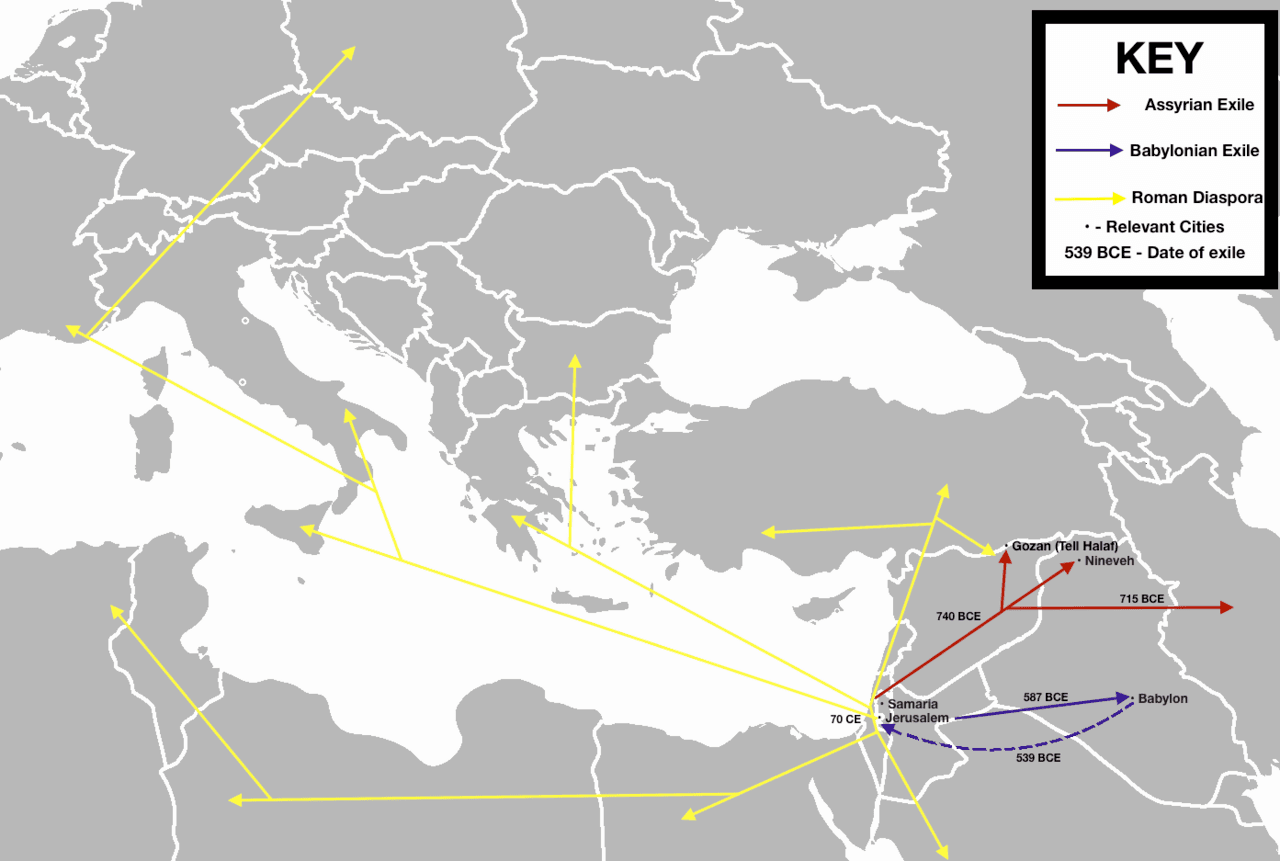
The Diaspora Jews maintained ties with the Land of Israel, embarking on pilgrimages and making voluntary donations to the Temple via the half-shekel tax. Following the destruction of the Temple in 70 CE, this internal contribution was replaced by the fiscus Judaicus, a coerced Roman tax redirected toward the construction and maintenance of the Temple of Jupiter Optimus Maximus in Rome.
Jewish–Roman Wars
The first and second centuries CE saw a series of unsuccessful large-scale Jewish revolts against Rome. The Roman suppression of these revolts led to wide-scale destruction, a very high toll of life and enslavement. The First Jewish–Roman War (66–73 CE) resulted in the destruction of Jerusalem and the Second Temple. Two generations later, the Bar Kokhba Revolt (132–136 CE) erupted. Judea's countryside was devastated, and many were killed, displaced or sold into slavery. Jerusalem was rebuilt as a Roman colony under the name of Aelia Capitolina, and the province of Judea was renamed Syria Palaestina. Jews were prohibited from entering the city on pain of death. Jewish presence in the region significantly dwindled after the failure of the Bar Kokhba revolt.
With their national aspirations crushed and widespread devastation in Judea, despondent Jews migrated out of Judea in the aftermath of both revolts, and many settled in southern Europe. In contrast to the earlier Assyrian and Babylonian captivities, the movement was by no means a singular, centralized event, and a Jewish diaspora had already been established before.
During both of these rebellions, many Jews were captured and sold into slavery by the Romans. According to the Jewish historian Josephus, 97,000 Jews were sold as slaves in the aftermath of the first revolt. In one occasion, Vespasian reportedly ordered 6,000 Jewish prisoners of war from Galilee to work on the Isthmus of Corinth in Greece. It is also possible that Jews contributed to the Colosseum's construction; an inscription from the site reads “The emperor Titus Caesar Vespasian Augustus had the new amphitheater built from the profits of the war.” Jewish slaves and their children eventually gained their freedom and joined local free Jewish communities.
Late antiquity
In the late Roman Empire, Jews were free to form networks of cultural and religious ties and enter into various local occupations. They also continued to send voluntary contributions to the Nesi'im in Israel, in accordance with Roman law. (This tax was distinct from the retributory fiscus Judaicus.)
After Christianity became the official religion of Rome and Constantinople in 380 CE, Jews were increasingly marginalized and the contributions were banned.
Archaeological evidence from this period illustrates the presence of the Jewish Diaspora across the Greco-Roman world. For instance, the Ostia Synagogue near Rome is one of the oldest synagogues yet found outside the Land of Israel, dating to the first century CE. The Synagogue in the Agora of Athens is dated to the period between 267 and 396 CE. The Stobi Synagogue in Macedonia was built on the ruins of a more ancient synagogue in the 4th century, while later in the 5th century, the synagogue was transformed into a Christian basilica. Hellenistic Judaism thrived in Antioch and Alexandria, and many of these Greek-speaking Jews would convert to Christianity.
Sporadic epigraphic evidence in gravesite excavations attest to the presence of Jews after the 2nd and 3rd centuries where Roman garrisons were established, particularly in Brigetio (Szőny), Aquincum (Óbuda), Intercisa (Dunaújváros), Triccinae (Sárvár), Savaria (Szombathely), Sopianae (Pécs) in Hungary, and Mursa (Osijek) in Croatia. There was a sufficient number of Jews in Pannonia to form communities and build a synagogue. Jewish troops were among the Syrian soldiers transferred there, and replenished from the Middle East. After 175 CE Jews came from Antioch, Tarsus, and Cappadocia. Others came from Italy and the Hellenized parts of the Roman Empire. The excavations suggest they first lived in isolated enclaves attached to Roman legion camps and intermarried with other similar oriental families within the military orders of the region. Raphael Patai states that later Roman writers remarked that they differed little in either customs, manner of writing, or names from the people among whom they dwelt; and it was especially difficult to differentiate Jews from the Syrians. After Pannonia was ceded to the Huns in 433, the garrison populations were withdrawn to Italy, and only a few, enigmatic traces remain of a possible Jewish presence in the area some centuries later.
No evidence has yet been found of a Jewish presence in antiquity in Germany beyond its Roman border, nor in Eastern Europe. In Gaul and Germany itself, with the possible exception of Trier and Cologne, the archeological evidence suggests at most a fleeting presence of very few Jews, primarily itinerant traders or artisans. A substantial Jewish population emerged in northern Gaul by the Middle Ages, but Jewish communities existed in 465 CE in Brittany, in 524 CE in Valence, and in 533 CE in Orléans. Throughout this period and into the early Middle Ages, some Jews assimilated into the dominant Greek and Latin cultures, mostly through conversion to Christianity. King Dagobert I of the Franks expelled the Jews from his Merovingian kingdom in 629. Jews in former Roman territories faced new challenges as harsher anti-Jewish Church rulings were enforced.
Population estimate
Estimating the number of Jews in the Roman Empire is difficult due to a lack of accurate documentation. The 13th-century author Bar Hebraeus gave a figure of 6,944,000 Jews in the first-century Roman world and one million beyond. Salo Wittmayer Baron considered the figure convincing. However, contemporary scholars now accept that Bar Hebraeus based his figure on a census of total Roman citizens and thus included non-Jews, the figure of 6,944,000 being recorded in Eusebius' Chronicon. Louis Feldman, previously an active supporter of the figure, now states that he and Baron were mistaken. Brian McGing rejects Baron's figures entirely, arguing that we have no idea as to the size of the Jewish demographic in the ancient world. Some scholars who accepted the high number of Jews in Rome had argued it was caused by proselytising. The idea of ancient Jews trying to convert Gentiles to Judaism is nowadays rejected by several scholars.
Early and High Middle Ages
Historical records show evidence of Jewish communities north of the Alps and Pyrenees as early as the 8th and 9th centuries. Charlemagne's expansion of the Frankish empire around 800, including northern Italy and Rome, brought on a brief period of stability and unity in Francia. This created opportunities for Jewish merchants to settle again north of the Alps. Charlemagne granted the Jews freedoms similar to those once enjoyed under the Roman Empire. In addition, Jews from southern Italy, fleeing religious persecution, began to move into Central Europe. Returning to Frankish lands, many Jewish merchants took up occupations in finance and commerce, including moneylending (then commonly referred to as usury, as medieval Church law prohibited Christians from charging interest on loans). Additional Jewish merchants arrived under Louis the Pious, with Jewish communities emerging in southern France, and from there north along the Rhone River.
Germany too saw new Jewish communities by the Rhine and Danube Rivers, including the SHuM cities of Speyer, Worms, and Mainz. This cluster of cities, along with Troyes and Sens in France, contains some of the earliest Jewish settlements north of the Alps, and played a major role in the formation of Ashkenazi Jewish religious tradition. Jews arrived from southern Europe, as well as from Middle Eastern centers (such as Babylonian Jews and Persian Jews) and Maghrebi Jewish traders from North Africa, who had contacts with their Ashkenazi brethren and had visited each other from time to time in each's domain. Jews migrated to these cities often in response to new economic opportunities and at the invitation of local Christian rulers. Thus Baldwin V, Count of Flanders, invited Jacob ben Yekutiel and his fellow Jews to settle in his lands; and soon after the Norman conquest of England, William the Conqueror likewise extended a welcome to continental Jews to take up residence there. Bishop Rüdiger Huzmann called on the Jews of Mainz to relocate to Speyer. In all of these decisions, the idea that Jews had the know-how and capacity to jump-start the economy, improve revenues, and enlarge trade seems to have played a prominent role. Typically, Jews relocated close to the markets and churches in town centres, where, though they came under the authority of both royal and ecclesiastical powers, they were accorded administrative autonomy.
In the 11th century, the "Rabbinic mode of thought and life" and the culture of the Babylonian Talmud that underlies it became established in southern Italy and then spread north in what came to be known as "Ashkenaz". Jews in Ashkenaz were known for their halakhic and Talmudic studies. However, many traditions and customs from the Jerusalem Talmud and other Land of Israel rabbinic sources were known and practiced in Ashkenaz long before the 11th century—so long before that the sources of these practices were forgotten by 11th-century Ashkenazi writers, and the practices regarded simply as "minhag".
By the 11th century, Yiddish emerged as a result of Judeo-Latin language contact with various High German vernaculars in the medieval period. It is a Germanic language written in Hebrew letters, and heavily influenced by Hebrew and Aramaic, with some elements of Romance and later Slavic languages.
In the 9th through 11th centuries, diaspora Jews from Europe embarked on pilgrimages to Jerusalem for the holiday of Sukkot and attended the annual Mount of Olives Hoshana Rabbah ceremony. Ashkenazi Jews also lived in Jerusalem during the 11th century, according to 16th-century mystic Rabbi Elijah of Chelm. The story is told that a German-speaking Jew saved the life of a young German man surnamed Dolberger. So when the knights of the First Crusade came to siege Jerusalem, one of Dolberger's family members who was among them rescued Jews in Palestine and carried them back to Worms to repay the favor. Further evidence of German communities in the holy city comes in the form of halakhic questions sent from Germany to Jerusalem during the second half of the 11th century.
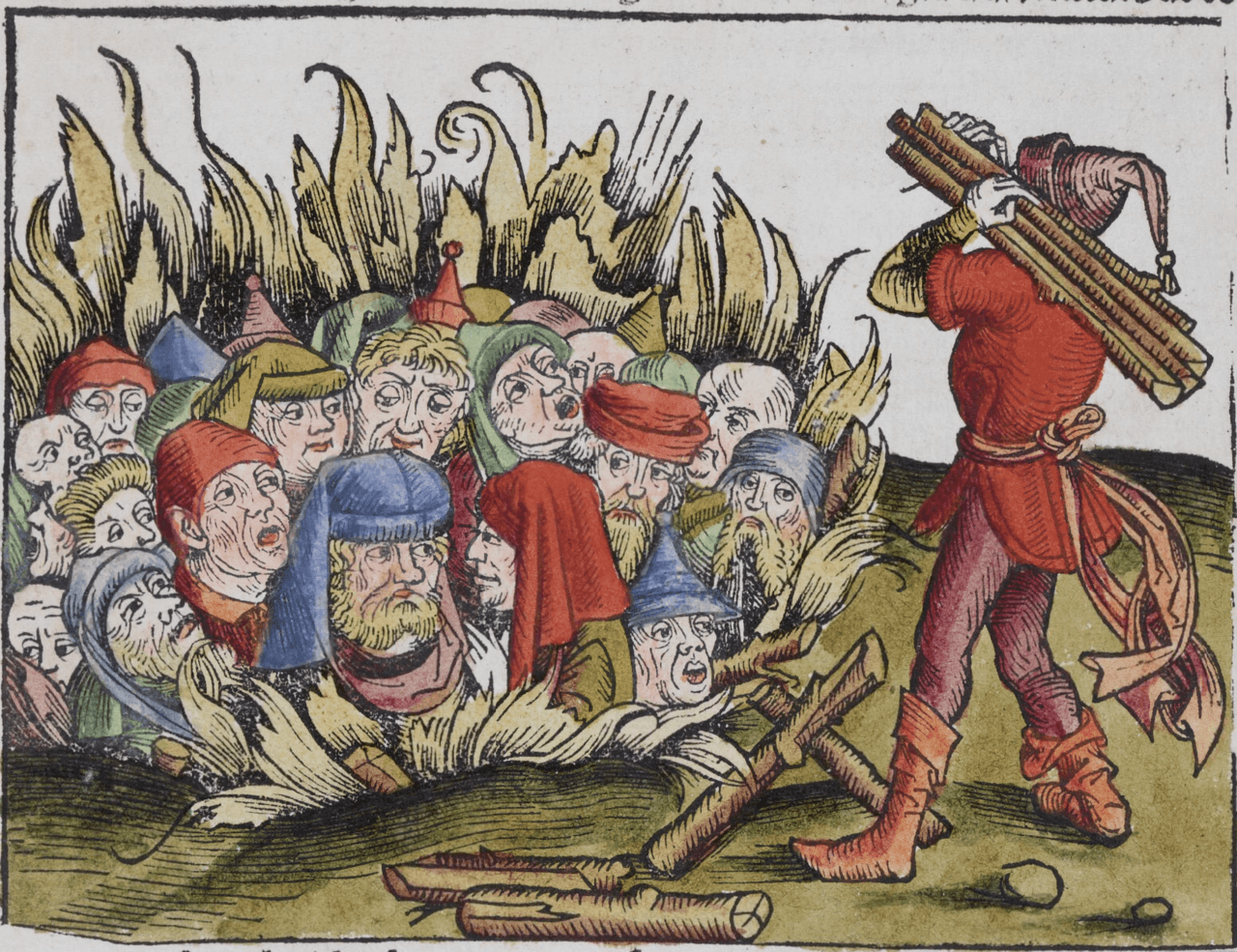
Numerous massacres of Jews occurred throughout Europe during the Christian Crusades. Inspired by the preaching of a First Crusade, crusader mobs in France and Germany perpetrated the Rhineland massacres of 1096, devastating Jewish communities along the Rhine River, including the SHuM cities of Speyer, Worms, and Mainz. Nonetheless, Jewish life in Germany persisted, while some Ashkenazi Jews joined Sephardic Jewry in Spain.
Late Middle Ages
Expulsions from England (1290), France (1394), and parts of Germany (15th century), gradually pushed Ashkenazi Jewry eastward, to Poland (10th century), Lithuania (10th century), and Russia (12th century). Over this period of several hundred years, some have suggested, Jewish economic activity was focused on trade, business management, and financial services, due to several presumed factors: Christian European prohibitions restricting certain activities by Jews, preventing certain financial activities (such as "usurious" loans) between Christians, high rates of literacy, near-universal male education, and ability of merchants to rely upon and trust family members living in different regions and countries.
In Poland, Jews were granted special protection by the Statute of Kalisz of 1264. By the 15th century, the Ashkenazi Jewish communities in Poland were the largest Jewish communities of the Diaspora. This area, which eventually fell under the domination of Russia, Austria, and Prussia (Germany) following the Partitions of Poland, and was later largely regained by reborn Poland in the interbellum, would remain the main center of Ashkenazi Jewry until the Holocaust.
The answer to why there was so little assimilation of Jews in central and eastern Europe for so long would seem to lie in part in the probability that the alien surroundings in central and eastern Europe were not conducive, though there was some assimilation. Furthermore, Jews lived almost exclusively in shtetls, maintained a strong system of education for males, heeded rabbinic leadership, and had a very different lifestyle to that of their neighbours; all of these tendencies increased with every outbreak of antisemitism.
