
The Battle of Stalingrad was a major battle on the Eastern Front of World War II in which Nazi Germany and its Axis allies fought the Soviet Union for control of the city of Stalingrad in southern Russia. Marked by intense close-quarters combat and heavy civilian losses during aerial bombardment, the battle is considered the largest and deadliest urban battle in military history and the largest battle in World War II. By the end of the fighting, the German 6th Army had been destroyed, the 4th Panzer Army had suffered severe losses, and Army Group B was routed. The defeat reversed the momentum of Hitler's invasion of the Soviet Union and shifted the balance on the Eastern Front in the Soviet Union's favour. The Soviet victory at Stalingrad is generally considered the pivotal turning point of the European theatre of the war.
Both sides placed great strategic importance on the city of Stalingrad, as it was one of the largest industrial centres of the Soviet Union and an important transport hub on the Volga River. After more than a year of intense fighting along a vast front, Germany's fuel supplies had dwindled, creating a strategic need to advance into the Caucasus to capture the Soviet oil fields. Controlling Stalingrad would provide a supply route for this campaign while preventing Soviet shipments along the Volga. The city also held significant symbolic importance because it bore the name of Joseph Stalin, the Soviet supreme leader.
The German military first clashed with the Red Army's Stalingrad Front on the distant approaches to the city on 17 July. On 23 August, the 6th Army and elements of the 4th Panzer Army launched their offensive with support from intensive bombing raids by the Luftwaffe, which reduced much of the city to rubble.
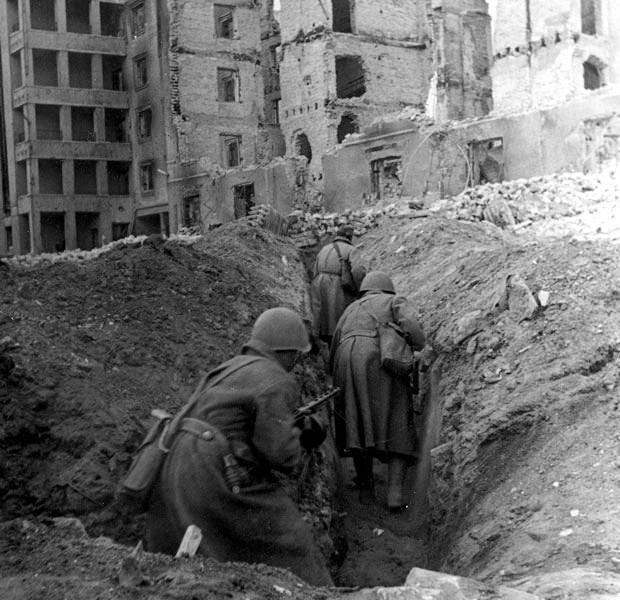
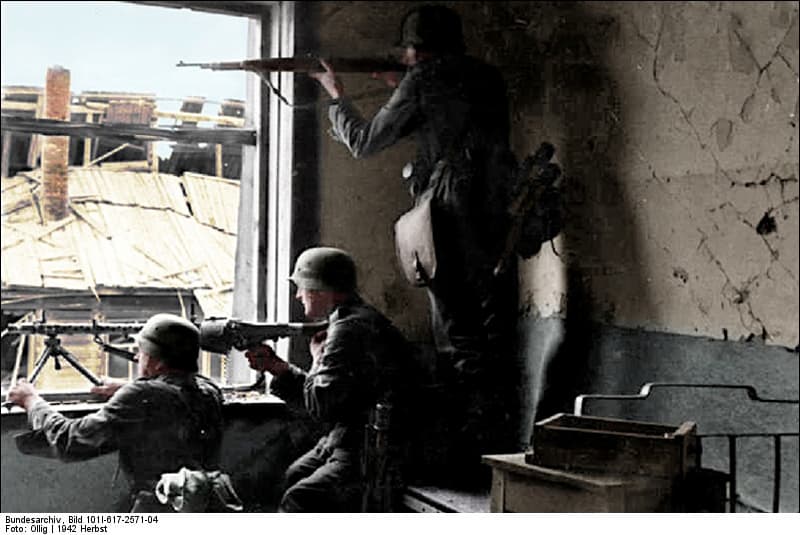
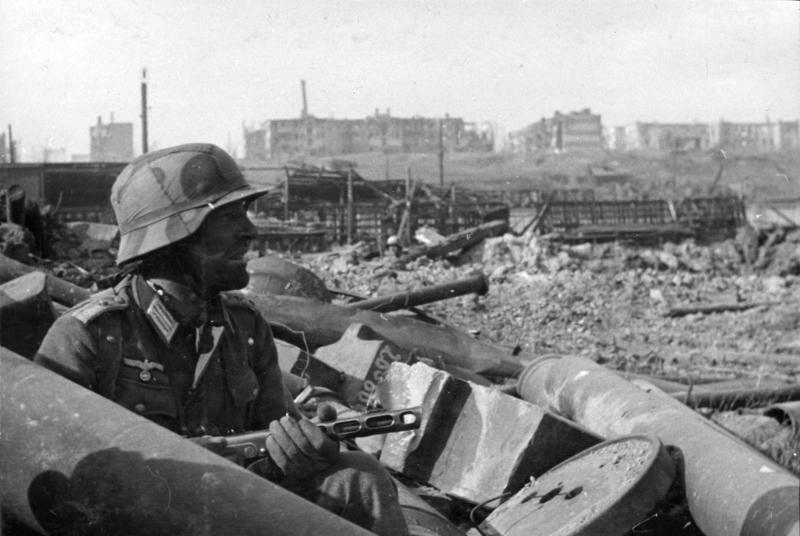
As German forces advanced into the city, the battle degenerated into house-to-house fighting, which escalated drastically as both sides continued pouring in reinforcements. By mid-November, the Germans, at great cost, had pushed the Soviet defenders back into narrow zones along the Volga's west bank. However, winter set in and conditions became particularly brutal, with temperatures often dropping tens of degrees below freezing, and the fighting bogged down into brutal trench warfare.
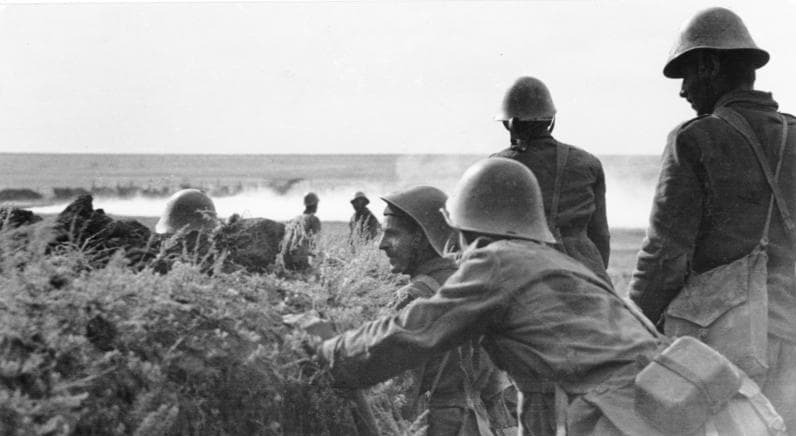
On 19 November, the Red Army launched Operation Uranus, a two-pronged counterattack targeting the Romanian armies protecting the 6th Army's flanks. The Axis flanks were overrun and the 6th Army was encircled. Hitler, who exercised daily operational command, was determined to hold the city for Germany at all costs and forbade the 6th Army to try a breakout; instead, attempts were made to supply it by air and to break the encirclement from outside. The Soviets managed to prevent the Germans from making enough airdrops to their trapped armies, but heavy fighting continued for another two months. On 2 February 1943, the 6th Army, having exhausted its ammunition and food, finally capitulated, making it the first of Hitler's field armies to surrender.
In modern Russia and a number of the post-Soviet states, the legacy of the Red Army's victory at Stalingrad is commemorated among the Days of Military Honour of the Great Patriotic War. It is also well known in many other countries that belonged to the Allied powers, and has thus become ingrained in popular culture.
Background
By the spring of 1942, despite the failure of Operation Barbarossa to defeat the Soviet Union in a single campaign, the Wehrmacht had captured vast territories, including Ukraine, Belarus, and the Baltic republics. On the Western Front, Germany held much of Europe, the U-boat offensive was curbing American support, and in North Africa, Erwin Rommel had just captured Tobruk. In the east, the Germans had stabilized a front running from Leningrad to Rostov, with several minor salients. Hitler remained confident of breaking the Red Army, despite heavy losses west of Moscow in the winter of 1941–42, because large parts of Army Group Centre had been rested and re-equipped. Hitler decided that the 1942 summer campaign would target the southern Soviet Union. The initial objectives around Stalingrad were to destroy the city's industrial capacity and block the Volga River traffic, crucial for connecting the Caucasus and Caspian Sea to central Russia. The capture of Stalingrad would also disrupt Lend-Lease supplies via the Persian Corridor.
Field Marshal Alanbrooke noted that "Hitler lost a golden opportunity by carrying on with the desperate attacks on Stalingrad instead of directing ... Paulus towards Persia and the Middle East. Instead of losing this army of 60,000 men captured by the Russians he would have found (according to his own assessments) the road leading to one of the greatest strategic prizes practically open and devoid of defences."
On 23 July 1942, Hitler expanded the campaign's objectives to include occupying Stalingrad, a city with immense propaganda value, as it bore the name of the Soviet leader. Hitler ordered the annihilation of Stalingrad's population, declaring that after its capture, all male citizens would be killed and women and children deported due to their "thoroughly communistic" nature. The city's fall was intended to secure the northern and western flanks of the German advance on Baku to capture its petroleum resources. This expansion of objectives stemmed from German overconfidence and an underestimation of Soviet reserves.
Meanwhile, Stalin, convinced that the main German attack would target Moscow, prioritized defending the Soviet capital. As the Soviet winter counteroffensive of 1941–1942 culminated in March, the Soviet high command began planning for the summer campaign. Although Stalin desired a general offensive, he was dissuaded by Chief of the General Staff Boris Shaposhnikov, Deputy Chief of the General Staff Aleksandr Vasilevsky, and Western Main Direction commander Georgy Zhukov. Ultimately, Stalin instructed that the summer campaign be based on "active strategic defence," while also ordering local offensives across the Eastern Front. Southwestern Main Direction commander Semyon Timoshenko proposed an attack from the Izyum salient south of Kharkov to encircle and destroy the German 6th Army. Despite opposition from Shaposhnikov and Vasilevsky, Stalin approved the plan.
After delays in troop movements and logistical challenges, the Kharkov operation began on 12 May. The Soviets achieved initial success, prompting 6th Army commander Friedrich Paulus to request reinforcements. However, a German counterattack on 13 May halted the Soviet advance. On 17 May, Ewald von Kleist's forces launched Operation Fridericus I, encircling and destroying much of the Soviet forces in the ensuing Second Battle of Kharkov. The defeat at Kharkov left the Soviets vulnerable to the German summer offensive. Despite the setback, Stalin continued to prioritize defending Moscow, allocating only limited reinforcements to the Southwestern Front.
The commitment of panzer divisions needed for Case Blue to the Second Battle of Kharkov further delayed the offensive's start. On 1 June, Hitler modified the summer plans, delaying Case Blue to 20 June after preliminary operations in Ukraine.
Prelude
If I do not get the oil of Maykop and Grozny then I must finish [liquidieren; "kill off", "liquidate"] this war.
Army Group South was selected for a sprint forward through the southern Russian steppes into the Caucasus to capture the vital Soviet oil fields there. The planned summer offensive, code-named Fall Blau (Case Blue), was to include the German 6th, 17th, 4th Panzer and 1st Panzer Armies.
Hitler intervened, however, ordering the Army Group to split in two. Army Group South (A), under the command of Wilhelm List, was to continue advancing south towards the Caucasus as planned with the 17th Army and First Panzer Army. Army Group South (B), including Paulus's 6th Army and Hermann Hoth's 4th Panzer Army, was to move east towards the Volga and Stalingrad. Army Group B was commanded by General Maximilian von Weichs.
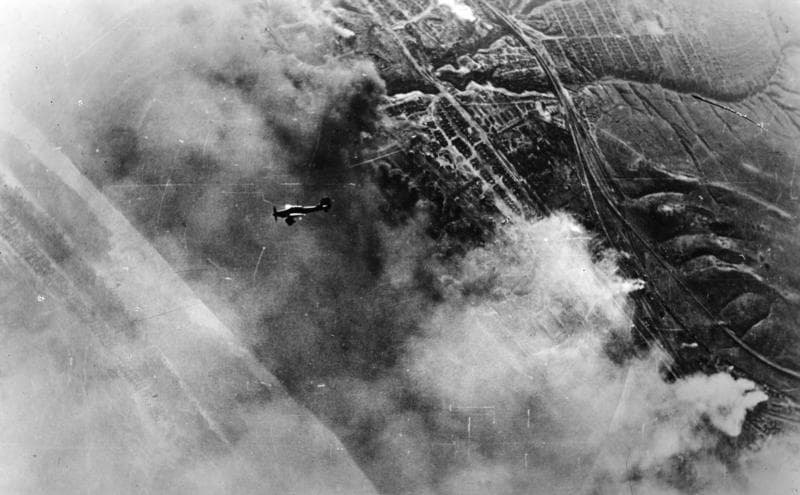
The start of Case Blue had been planned for late May 1942. However, a number of German and Romanian units that were to take part in Blau were besieging Sevastopol on the Crimean Peninsula. Delays in ending the siege pushed back the start date for Blau several times, and the city did not fall until early July.
Operation Fridericus I by the Germans against the "Izyum bulge", pinched off the Soviet salient in the Second Battle of Kharkov, and resulted in the envelopment of a large Soviet force between 17 May and 29 May. Similarly, Operation Wilhelm attacked Voltshansk on 13 June, and Operation Fridericus attacked Kupiansk on 22 June.
Blau finally opened as Army Group South began its attack into southern Russia on 28 June 1942. The German offensive achieved rapid success, as Soviet forces offered little resistance in the vast empty steppes and started streaming eastward. Several attempts to re-establish a defensive line failed when German units outflanked them. Two major pockets were formed and destroyed: the first, northeast of Kharkov, on 2 July, and a second, around Millerovo, Rostov Oblast, a week later. Meanwhile, the Hungarian 2nd Army and the German 4th Panzer Army had launched an assault on Voronezh, capturing the city on 5 July.
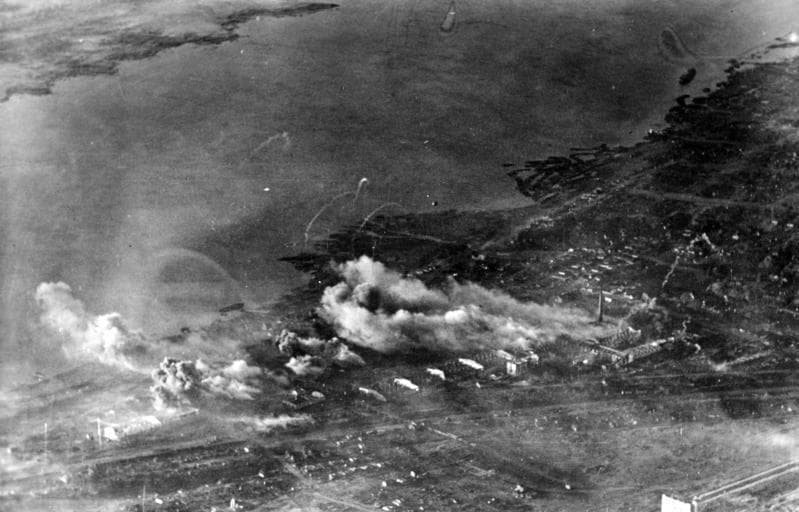
The initial advance of the 6th Army was so successful that Hitler intervened and ordered the 4th Panzer Army to join Army Group South (A) to the south. A massive roadblock resulted when the 4th Panzer and the 1st Panzer choked the roads, stopping both in their tracks while they cleared the mess of thousands of vehicles. The traffic jam is thought to have delayed the advance by at least one week. With the advance now slowed, Hitler changed his mind and reassigned the 4th Panzer Army back to the attack on Stalingrad.
By the end of July, Soviet forces were pushed back across the Don River. At this point, the Don and Volga Rivers are only 65 km (40 mi) apart, and the Germans left their main supply depots west of the Don. The Germans began using the armies of their Italian, Hungarian and Romanian allies to guard their left (northern) flank. Italian actions were also mentioned in official German communiques. Italian forces were generally held in little regard by the Germans, and were accused of low morale: in reality, the Italian divisions fought comparatively well, with the 3rd Infantry Division "Ravenna" and 5th Infantry Division "Cosseria" showing spirit, according to a German liaison officer. Italian forces were forced to retreat only after a massive armoured attack in which German reinforcements failed to arrive in time.
To the south, Army Group A was pushing far into the Caucasus, but the advance slowed as supply lines grew overextended. The two German army groups were too far apart to support one another.
After German intentions became clear in July, Stalin appointed General Andrey Yeryomenko commander of the Southeastern Front on 1 August 1942. Yeryomenko and Commissar Nikita Khrushchev were tasked with planning the defence of Stalingrad. Beyond the Volga River on the eastern boundary of Stalingrad, additional Soviet units were formed into the 62nd Army under Lieutenant General Vasiliy Chuikov on 11 September 1942. Tasked with holding the city at all costs, Chuikov proclaimed, "We will defend the city or die in the attempt." The battle earned him one of his two Hero of the Soviet Union awards.
Orders of battle
Red Army
During the defence of Stalingrad, the Red Army deployed 5 armies in and around the city (28th, 51st, 57th, 62nd and 64th Armies), and an additional nine armies in the encirclement counteroffensive (24th, 65th, 66th Armies and 16th Air Army from the north as part of the Don Front offensive, and 1st Guards Army, 5th Tank, 21st Army, 2nd Air Army and 17th Air Army from the south as part of the Southwestern Front).
Axis
Attack on Stalingrad
Initial attack
German forces first clashed with the Stalingrad Front on 17 July on the distant approaches to Stalingrad, in the bend of the Don. A significant clash in the early stages of the battle was fought at Kalach, in which the Germans "had had to pay a high cost in men and materiel ... left on the Kalatch [sic] battlefield were numerous burnt-out or shot-up German tanks". Military historian David Glantz indicated that four hard-fought battles – collectively known as the Kotluban Operations – north of Stalingrad, where the Soviets made their greatest stand, decided Germany's fate before the Nazis ever set foot in the city itself, and were a turning point in the war. Beginning in late August and lasting into October, the Soviets committed between two and four armies in hastily coordinated and poorly controlled attacks against the Germans' northern flank. The actions resulted in over 200,000 Soviet Army casualties but did slow the German assault.
The Germans formed bridgeheads across the Don on 20 August, with the 295th and 76th Infantry Divisions enabling the XIVth Panzer Corps "to thrust to the Volga north of Stalingrad." The German 6th Army was only a few dozen kilometres from Stalingrad. The 4th Panzer Army, ordered south on 13 July to block the Soviet retreat with the 17th Army and the 1st Panzer Army, had turned northwards alone to help take the city from the south. 17th Army and 1st Panzer Army were transferred to the new Army Group A and continued towards the Caucasus. On 19 August, German forces were in position to launch an attack on the city.
On 23 August, the 6th Army reached the outskirts of Stalingrad in pursuit of the 62nd and 64th Armies, which had fallen back into the city. Kleist said after the war:
The capture of Stalingrad was subsidiary to the main aim. It was only of importance as a convenient place, in the bottleneck between Don and the Volga, where we could block an attack on our flank by Russian forces coming from the east. At the start, Stalingrad was no more than a name on the map to us.
The Soviets had enough warning of the German advance to ship grain, cattle, and railway cars across the Volga out of harm's way. This "harvest victory" left the city short of food even before the German attack began. Before the Heer reached the city itself, the Luftwaffe had cut off shipping on the Volga. In the days between 25 and 31 July, 32 Soviet ships were sunk, with another nine crippled.
Generaloberst Wolfram von Richthofen's Luftflotte 4 dropped some 1,000 tons of bombs on 23 August, with the aerial attack on Stalingrad being the most single intense aerial bombardment at that point on the Eastern Front, and the heaviest bombing raid that had ever taken place on the Eastern Front. At least 90% of the city's housing stock was obliterated as a result. The Stalingrad Tractor Factory continued to turn out T-34 tanks up until German troops burst into the plant. The 369th (Croatian) Reinforced Infantry Regiment was the only non-German unit selected by the Wehrmacht to enter Stalingrad city during assault operations, with it fighting as part of the 100th Jäger Division.
Georgy Zhukov, who was deputy commander-in-chief and commander of Stalingrad's defence during the battle, noted the importance of the battle, stating that:It was clear to me that the battle for Stalingrad was of the greatest military and political significance. If Stalingrad fell, the enemy command would be able to cut off the south of the country from the centre. We could lose the Volga – the important water artery, along which a large amount of goods flowed from the Caucasus.Stalin rushed all available troops to the east bank of the Volga, some from as far away as Siberia. Regular river ferries were quickly destroyed by the Luftwaffe, which then targeted troop barges being towed slowly across by tugs. It has been said that Stalin prevented civilians from leaving the city in the belief that their presence would encourage greater resistance from the city's defenders. Civilians, including women and children, were put to work building trenchworks and protective fortifications. Casualties due to the air raid on 23 August and beyond are debated, as between 23 and 26 August, Soviet reports indicate 955 people were killed and another 1,181 wounded as a result of the bombing. However, the death toll of civilians due to the bombing has been estimated to have been 40,000, or as many as 70,000, though these estimates may be exaggerated. Also estimated are 150,000 wounded.
The Soviet Air Force, the Voyenno-Vozdushnye Sily (VVS), was swept aside by the Luftwaffe. The VVS bases in the immediate area lost 201 aircraft between 23 and 31 August, and despite meagre reinforcements of some 100 aircraft in August, it was left with just 192 serviceable aircraft, 57 of which were fighters.
Early on 23 August, the German 16th Panzer and 3rd Motorized Divisions attacked out of the Vertyachy bridgehead with a force of 120 tanks and over 200 armoured personnel carriers strong. The German attack broke through the 1382nd Rifle Regiment of the 87th Rifle Division and the 137th Tank Brigade, which were forced to retreat towards Dmitryevka. The 16th Panzer Division drove east towards the Volga, supported by the strikes of Henschel Hs 129 ground attack aircraft. Crossing the railway line to Stalingrad at 564 km Station around midday, both divisions continued their rush towards the river. Around 15:00, Hyacinth Graf Strachwitz's Panzer Detachment and the kampfgruppe of the 2nd Battalion, 64th Panzer Grenadier Regiment from the 16th Panzer reached the area of Latashanka, Rynok, and Spartanovka, northern suburbs of Stalingrad, and the Stalingrad Tractor Factory.
A Soviet female soldier stated about the battle that:I had been imagining what war was like – everything on fire, children crying, cats running about, and when we got to Stalingrad it turned out to be really like that, only more terrible.One of the first units to offer resistance in this area was the 1077th Anti-Aircraft Regiment, covering the Stalingrad Tractor Factory and the Volga ferry near Latashanka. The majority of the regiment was composed of men, but its directing and rangefinding crews and unit headquarters were made up of women. Several women also crewed anti-aircraft guns. The 1077th was notified of the German tanks' approach at 14:30 and its 6th Battery, dominating the Sukhaya Mechatka ravine, claimed the destruction of 28 German tanks. Later that day, its 3rd Battery on the road between Yerzovka and Stalingrad, saw particularly intense fighting against the 16th Panzer, reportedly fighting "shot for shot." Two women were decorated for their actions that day, and the regiment's report praised the "exceptional steadfastness and heroism" of the women soldiers. The regiment lost 35 guns, eighteen killed, 46 wounded, and 74 missing on 23 and 24 August. The 16th Panzer Division's history mentioned its encounter with the regiment, claiming the destruction of 37 guns, and the unit's surprise that its opponents had in part included women.
In the early stages of the battle, the NKVD organised poorly armed "Workers' militias" similar to those that had defended the city twenty-four years earlier, composed of civilians not directly involved in war production for immediate use in the battle. The civilians were often sent into battle without rifles. Staff and students from the local technical university formed a "tank destroyer" unit. They assembled tanks from leftover parts at the tractor factory. These tanks, unpainted and lacking gun-sights, were driven directly from the factory floor to the front line. They could only be aimed at point-blank range through the bore of their gun barrels. Chuikov later remarked that soldiers approaching the battle would say "We are entering hell", but after one or two days, they said "No, this isn't hell, this is ten times worse than hell".
By the end of August, Army Group South (B) had finally reached the Volga, north of Stalingrad. Another advance to the river south of the city followed, while the Soviets abandoned their Rossoshka position for the inner defensive ring west of Stalingrad. The wings of the 6th Army and the 4th Panzer Army met near Jablotchni along the Zaritza on 2 September.
September city battles
A letter found on the body of a German officer described the insanity of the battle and brutal nature of the urban combat:We must reach the Volga. We can see it – less than a kilometre away. We have the constant support of our aircraft and artillery. We are fighting like madmen but cannot reach the river. The whole war for France was shorter than the fight for one Volga factory. We must be up against suicide squads. They have simply decided to fight to the last soldier. And how many soldiers are left over there? When will this hell come to an end? Historian David Glantz stated that the grinding and brutal battle resembled "the fighting on the Somme and at Verdun in 1916 more than it did the familiar blitzkrieg war of the previous three summers".
On 5 September, the Soviet 24th and 66th Armies organized a massive attack against XIV Panzer Corps. The Luftwaffe helped repel the offensive by heavily attacking Soviet artillery positions and defensive lines. The Soviets were forced to withdraw at midday after only a few hours. Of the 120 tanks the Soviets had committed, 30 were lost to air attack.
On 13 September, the battle for the city itself began. With German forces launching an attack which overran the small hill where the 62nd Soviet Army headquarters was established, in addition, the railway station was captured, and German forces advanced far enough to threaten the Volga landing stage.
Soviet operations were constantly hampered by the Luftwaffe. On 18 September, the Soviet 1st Guards and 24th Army launched an offensive against VIII Army Corps at Kotluban. VIII Fliegerkorps dispatched multiple waves of Stuka dive-bombers to prevent a breakthrough. The offensive was repelled. The Stukas claimed 41 of the 106 Soviet tanks knocked out that morning, while escorting Bf 109s destroyed 77 Soviet aircraft.
Stalin's Order No. 227 of 27 July 1942 decreed that all commanders who ordered unauthorised retreats would be subject to a military tribunal. Blocking detachments composed of NKVD or regular troops were positioned behind Red Army units to prevent desertion and straggling, sometimes executing deserters and perceived malingerers. During the battle, the 62nd Army had the most arrests and executions: 203 in all, of which 49 were executed, while 139 were sent to penal companies and battalions. Blocking detachments of the Stalingrad and Don Fronts detained 51,758 men from the beginning of the battle to 15 October, with the majority returned to their units. Of those detained, the vast majority of which were from the Don Front, 980 were executed and 1,349 sent to penal companies. In the two-day period between 13 and 15 September, the 62nd Army blocking detachment detained 1,218 men, returning most to their units while shooting 21 men and arresting ten. Beevor claims that 13,500 Soviet soldiers were executed by Soviet authorities during the battle, however, this claim has been disputed.
By 12 September, at the time of their retreat into the city, the Soviet 62nd Army had been reduced to 90 tanks, 700 mortars and just 20,000 personnel. The remaining tanks were used as immobile strong-points within the city. The initial German attack on 14 September attempted to take the city in a rush. The 51st Army Corps' 295th Infantry Division went after the Mamayev Kurgan hill, the 71st attacked the central rail station and toward the central landing stage on the Volga, while 48th Panzer Corps attacked south of the Tsaritsa River. Though initially successful, the German attacks stalled in the face of Soviet reinforcements brought in from across the Volga. Lieutenant General Alexander Rodimtsev's 13th Guards Rifle Division had been hurried up to cross the river and join the defenders inside the city. Assigned to counterattack at the Mamayev Kurgan and at Railway Station No. 1, it suffered particularly heavy losses. Despite their losses, Rodimtsev's troops were able to inflict similar damage on their opponents. By 26 September, the opposing 71st Infantry Division had half of its battalions considered exhausted, reduced from all of them being considered average in combat capability when the attack began twelve days earlier. Rodimtsev received one of two Hero of the Soviet Union awards issued during the battle for his actions.
The brutality of the battle was noted in a journal found on German lieutenant Weiner of the 24th Panzer Division:
The street is no longer measured by meters but by corpses... Stalingrad is no longer a town. By day it is an enormous cloud of burning, blinding smoke; it is a vast furnace lit by the reflection of the flames. And when night arrives, one of those scorching howling bleeding nights, the dogs plunge into the Volga and swim desperately to gain the other bank. The nights of Stalingrad are a terror for them. Animals flee this hell; the hardest stones cannot bear it for long; only men endure.
A ferocious battle raged for several days at the giant grain elevator in the south of the city. About fifty Red Army defenders, cut off from resupply, held the position for five days and fought off ten different assaults before running out of ammunition and water. Only forty dead Soviet fighters were found, though the Germans had thought there were many more due to the intensity of resistance. The Soviets burned large amounts of grain during their retreat in order to deny the enemy food. The grain elevator and silos were decided upon by Paulus to be the symbol of Stalingrad for a patch he was having designed to commemorate the battle after victory.
Mamayev Kurgan changed hands multiple times over the course of days, with fighting over the hill, rail station and Red Square being so intense that it was difficult to determine who was attacking and who was defending.
In another part of the city, a Soviet platoon under the command of Sergeant Yakov Pavlov fortified a four-story building that oversaw a square 300 metres from the river bank, which was later called "Pavlov's House". The soldiers surrounded it with minefields, set up machine-gun positions at the windows and breached the walls in the basement for better communications. The soldiers found about ten Soviet civilians hiding in the basement. They were not relieved, nor significantly reinforced, for the length of the two month siege. The building was labelled Festung ("Fortress") on German maps. Pavlov was awarded the Hero of the Soviet Union title for his actions. General Chuikov took note of the brutal efficiency of the defence of "Pavlov's House", stating that "Pavlov's small group of men, defending one house, killed more enemy soldiers than the Germans lost in taking Paris".
Generalmajor Hans Doerr stated about the conditions of the battle that:
A bitter battle for every house, workshop, water tower, railway embankment, wall, cellar and every pile of rubble was waged, without equal even in the First World War... The distance between the enemy's arms and ours was as small as could possibly be. Despite the concentrated air and artillery power, it was impossible to break out of the area of close fighting. The Russians surpassed the Germans in their use of the terrain and in camouflage, and were more experienced in barricade warfare for individual buildings.Stubborn defences of semi-fortified buildings in the centre of the city cost the Germans countless soldiers. A violent battle occurred for the Univermag department store on Red Square, which served as the headquarters of the 1st Battalion of the 13th Guards Rifle Division's 42nd Guards Rifle Regiment. Another battle occurred for a nearby warehouse dubbed the "nail factory". In a three-story building close by, guardsmen fought on for five days, their noses and throats filled with brick dust from pulverized walls, with only six out of close to half a battalion escaping alive.
The Germans made slow but steady progress through the city. Positions were taken individually, but the Germans were never able to capture the key crossing points along the river bank. By 27 September, the Germans occupied the southern portion of the city, but the Soviets held the centre and northern part. Most importantly, the Soviets controlled the ferries to their supplies on the east bank of the Volga.
Fighting in the industrial district
After 27 September, much of the fighting in the city shifted north to the industrial district. Having slowly advanced over 10 days against strong Soviet resistance, the 51st Army Corps was finally in front of the three giant factories of Stalingrad: the Red October Steel Factory, the Barrikady Arms Factory and Stalingrad Tractor Factory. It took a few more days for them to prepare for the most savage offensive of all, which was unleashed on 14 October, which Chuikov considered to be the worst day of the battle. Exceptionally intense shelling and bombing paved the way for the first German assault groups. The main attack (led by the 14th Panzer and 305th Infantry Divisions) attacked towards the tractor factory, while another assault led by the 24th Panzer Division hit to the south of the giant plant.
Werth points out the difficulties the Siberian Division faced, as throughout the course of an entire month, German forces launched 117 assaults at the division's regiments, and on one day they launched 23 attacks. Every trench, pillbox, rifle-pit and ruin in the area was turned into a strongpoint with its own direction and system of communications.