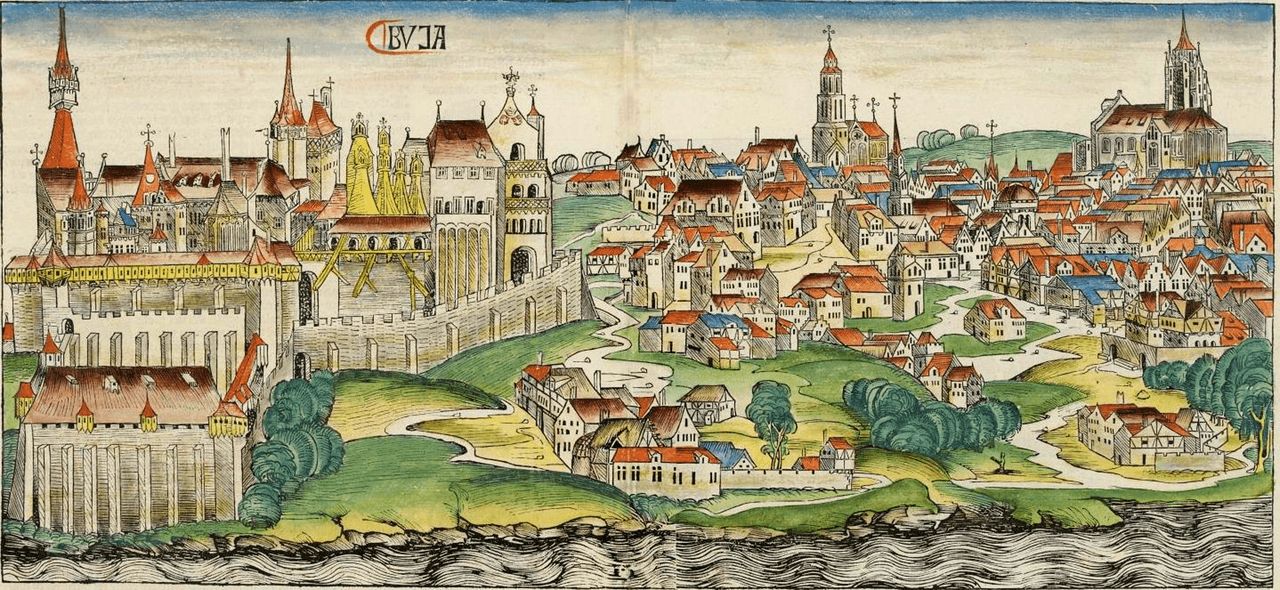
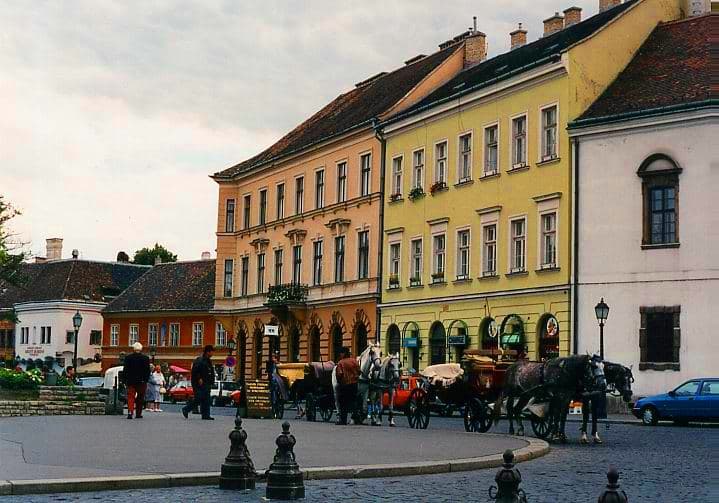
Buda (Hungarian pronunciation: [ˈbudɒ], German: Ofen) is the part of Budapest, the capital city of Hungary, that lies on the western bank of the Danube. Historically, "Buda" referred only to the royal walled city on Castle Hill (Hungarian: Várhegy), which was constructed by Béla IV between 1247 and 1249 and subsequently served as the capital of the Kingdom of Hungary from 1361 to 1873. In 1873, Buda was administratively unified with Pest and Óbuda to form modern Budapest.
Royal Buda is called the Várnegyed (lit. 'Castle Quarter') today, while "Buda" pars pro toto denotes Budapest's I., II., III., XI., XII. and XXII. districts. This colloquial definition thus includes medieval Óbuda and amounts to a third of the city's total area, much of it forested. Buda's landmarks include the Royal Palace, Matthias Church, the Citadella, Gellért Baths, the Buda Hills, the Carmelite Monastery of Buda, and the residence of the President of Hungary, Sándor Palace.
Etymology
According to a legend recorded in chronicles from the Middle Ages, the name "Buda" comes from the name of Bleda (Hungarian: Buda), brother of Hunnic ruler Attila.Attila went in the city of Sicambria in Pannonia, where he killed Buda, his brother, and he threw his corpse into the Danube. For while Attila was in the west, his brother crossed the boundaries in his reign, because he named Sicambria after his own name Buda's Castle. And though King Attila forbade the Huns and the other peoples to call that city Buda's Castle, but he called it Attila's Capital, the Germans who were terrified by the prohibition named the city as Eccylburg, which means Attila Castle, however, the Hungarians did not care about the ban and call it Óbuda [Old Buda] and call it to this day.The Scythians are certainly an ancient people and the strength of Scythia lies in the east, as we said above. And the first king of Scythia was Magog, son of Japhet, and his people were called Magyars [Hungarians] after their King Magog, from whose royal line the most renowned and mighty King Attila descended, who, in the 451st year of Our Lord’s birth, coming down from Scythia, entered Pannonia with a mighty force and, putting the Romans to flight, took the realm and made a royal residence for himself beside the Danube above the hot springs, and he ordered all the old buildings that he found there to be restored and he built them in a circular and very strong wall that in the Hungarian language is now called Budavár [Buda Castle] and by the Germans Etzelburg [Attila Castle]