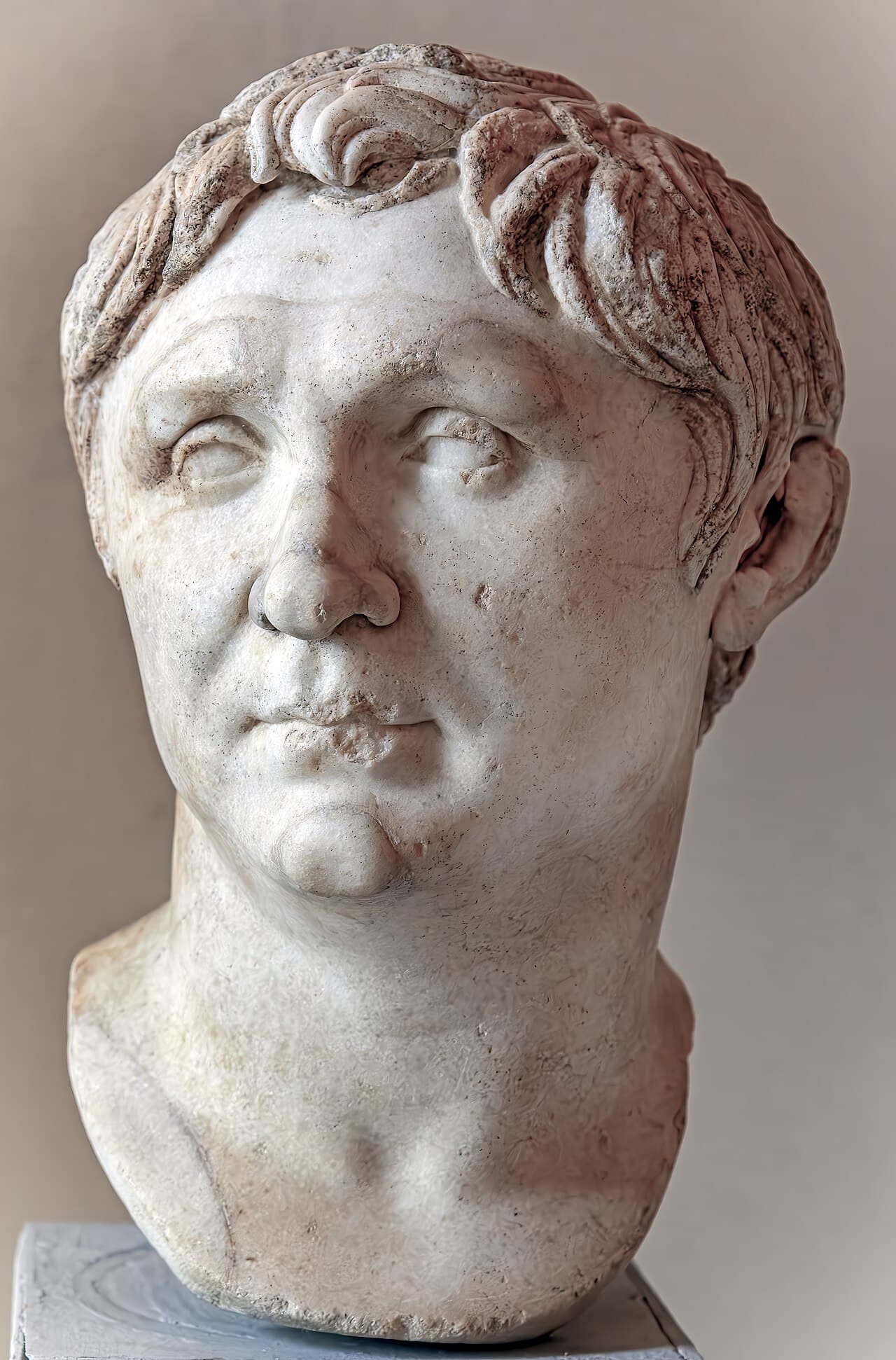
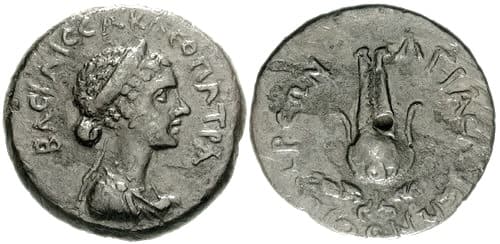
Cleopatra VII Thea Philopator (Koine Greek: Κλεοπάτρα Θεά Φιλοπάτωρ, lit. 'Cleopatra father-loving goddess'; 70/69 BC – 10 or 12 August 30 BC) was Queen of the Ptolemaic Kingdom of Egypt from 51 to 30 BC, and the last active Hellenistic pharaoh. A member of the Ptolemaic dynasty, she was a descendant of its founder Ptolemy I Soter, a Macedonian Greek general and companion of Alexander the Great. Her first language was Koine Greek, and she is the only Ptolemaic ruler known to have learned the Egyptian language, among several others. After her death, Egypt became a province of the Roman Empire, marking the end of the Hellenistic period in the Mediterranean, which had begun during the reign of Alexander (336–323 BC).
Born in Alexandria, Cleopatra was the daughter of Ptolemy XII Auletes, who named her his heir before his death in 51 BC. Cleopatra began her reign alongside her brother Ptolemy XIII, but a falling-out between them led to a civil war. Roman statesman Pompey fled to Egypt after losing the 48 BC Battle of Pharsalus against his rival Julius Caesar, the Roman dictator, in Caesar's civil war. Pompey had been a political ally of Ptolemy XII, but Ptolemy XIII had him ambushed and killed before Caesar arrived and occupied Alexandria. Caesar then attempted to reconcile the rival Ptolemaic siblings, but Ptolemy XIII's forces besieged Cleopatra and Caesar at the palace. Shortly after reinforcements lifted the siege, Ptolemy XIII died in the Battle of the Nile. Caesar declared Cleopatra and her brother Ptolemy XIV joint rulers, and maintained a private affair with Cleopatra which produced a son, Caesarion. Cleopatra traveled to Rome as a client queen in 46 and 44 BC, where she stayed at Caesar's villa. After Caesar's assassination, followed shortly afterwards by the sudden death of Ptolemy XIV (possibly murdered on Cleopatra's order), she named Caesarion co-ruler as Ptolemy XV.
In the Liberators' civil war of 43–42 BC, Cleopatra sided with the Roman Second Triumvirate formed by Caesar's heir Octavian, Mark Antony, and Marcus Aemilius Lepidus. After their meeting at Tarsos in 41 BC, the queen had an affair with Antony, which produced three children. Antony became increasingly reliant on Cleopatra for both funding and military aid during his invasions of the Parthian Empire and the Kingdom of Armenia. The Donations of Alexandria declared their children rulers over various territories under Antony's authority. Octavian portrayed this event as an act of treason, forced Antony's allies in the Roman Senate to flee Rome in 32 BC, and declared war on Cleopatra. After defeating Antony and Cleopatra's naval fleet at the 31 BC Battle of Actium, Octavian's forces invaded Egypt in 30 BC and defeated Antony, who committed suicide. After his death, Cleopatra reportedly killed herself, probably by poisoning, to avoid being publicly displayed by Octavian in a Roman triumphal procession.
Reading level
Audio Summary
Played with your browser's voice. Studio-quality audio can be added with a text-to-speech service.
Ask about this article
📝 Quick Quiz1 / 3
What is "Cleopatra" primarily known for?
Vocix Daily — In Your Inbox
Top stories, deep-dive articles, and "On This Day" history — one crisp digest delivered every morning.
Sources & references
Reference material for this entry is drawn from the open encyclopedic record, including Wikipedia , available under the CC BY-SA 4.0 license. Images are credited individually beside each photo.
Cleopatra's legacy survives in ancient and modern works of art. Roman historiography and Latin poetry produced a generally critical view of the queen that pervaded later Medieval and Renaissance literature. In the visual arts, her ancient depictions include Roman busts, paintings, sculptures, cameo carvings and glass, Ptolemaic and Roman coinage, and reliefs. In Renaissance and Baroque art, she was the subject of many works including operas, paintings, poetry, sculptures, and theatrical dramas. She has become a pop culture icon of Egyptomania since the Victorian era, and in modern times has appeared in the applied and fine arts, burlesque satire, Hollywood films, and brand images for commercial products.
Etymology
The Latinized form Cleopatra comes from the Ancient Greek Kleopátra (Κλεοπάτρα), meaning "glory of her father", from κλέος (kléos, "glory") and πατήρ (patḗr, "father"). The masculine form would have been written either as Kleópatros (Κλεόπατρος) or Pátroklos (Πάτροκλος). Cleopatra was the name of Alexander the Great's sister Cleopatra of Macedonia, as well as the wife of Meleager in Greek mythology, Cleopatra. Through the marriage of Ptolemy V Epiphanes and Cleopatra I Syra (a Seleucid princess), the name entered the Ptolemaic dynasty. Cleopatra's adopted title Theā́ Philopátōra (Θεᾱ́ Φιλοπάτωρα) means "goddess who loves her father".
Background
Ptolemaic pharaohs were crowned by the Egyptian high priest of Ptah at Memphis, but resided in the multicultural and largely Greek city of Alexandria, established by Alexander the Great. They spoke Greek and governed Egypt as Hellenistic Greek monarchs, refusing to learn the native Egyptian language. In contrast, Cleopatra could speak multiple languages by adulthood and was the first Ptolemaic ruler known to have learned the Egyptian language. Plutarch implies that she also spoke Ethiopian, the language of the "Troglodytes", Hebrew (or Aramaic), Arabic, the "Syrian language" (perhaps Syriac), Median, and Parthian, and she could apparently also speak Latin, although her Roman contemporaries would have preferred to speak with her in her native Koine Greek. Aside from Greek, Egyptian, and Latin, these languages reflected Cleopatra's desire to restore North African and West Asian territories that once belonged to the Ptolemaic Kingdom.
Roman interventionism in Egypt predated the reign of Cleopatra. When her grandfather Ptolemy IX Lathyros died in late 81 BC, he was succeeded by his daughter Berenice III. With opposition building at the royal court against the idea of a sole reigning female monarch, the Roman dictator Sulla arranged Berenice III's marriage to Ptolemy XI Alexander II, the son of her late husband Ptolemy X Alexander I from a previous marriage. Ptolemy XI had his wife killed shortly after their marriage in 80 BC, and was lynched soon after in the resulting riot over the assassination. Ptolemy XI, and perhaps Ptolemy IX or Ptolemy X, willed the Ptolemaic Kingdom to Rome as collateral for loans, giving the Romans legal grounds to take over Egypt, their client state, after the assassination of Ptolemy XI. The Romans chose instead to divide the Ptolemaic realm among the illegitimate sons of Ptolemy IX, bestowing Egypt on Ptolemy XII Auletes and Cyprus on Ptolemy of Cyprus.
Biography
Early childhood
Cleopatra VII was born in early 69 BC to the ruling Ptolemaic pharaoh Ptolemy XII and an uncertain mother, presumably Ptolemy XII's wife Cleopatra V Tryphaena (who may have been the same person as Cleopatra VI Tryphaena), the mother of Cleopatra's older sister, Berenice IV Epiphaneia. Cleopatra Tryphaena disappears from official records a few months after the birth of Cleopatra in 69 BC. The three younger children of Ptolemy XII, Cleopatra's sister Arsinoe IV and brothers Ptolemy XIII Theos Philopator and Ptolemy XIV Philopator, were born in the absence of his wife. Cleopatra's childhood tutor was Philostratos, from whom she learned the Greek arts of oration and philosophy. During her youth Cleopatra presumably studied at the Musaeum, including the Library of Alexandria.
Reign and exile of Ptolemy XII
In 65 BC the Roman censor Marcus Licinius Crassus argued before the Roman Senate that Rome should annex Ptolemaic Egypt, but his proposed bill and the similar bill of tribune Servilius Rullus in 63 BC were rejected. Ptolemy XII responded to the threat of possible annexation by offering remuneration and lavish gifts to powerful Roman statesmen, such as Pompey during his campaign against Mithridates VI of Pontus, and eventually Julius Caesar after he became Roman consul in 59 BC. However, Ptolemy XII's profligate behavior bankrupted him, and he was forced to acquire loans from the Roman banker Gaius Rabirius Postumus.
In 58 BC the Romans annexed Cyprus and on accusations of piracy drove Ptolemy of Cyprus, Ptolemy XII's brother, to commit suicide instead of enduring exile to Paphos. Ptolemy XII remained publicly silent on the death of his brother, a decision which, along with ceding traditional Ptolemaic territory to the Romans, damaged his credibility among subjects already enraged by his economic policies. Ptolemy XII was then exiled from Egypt by force, traveling first to Rhodes, then Athens, and finally the villa of triumvir Pompey in the Alban Hills, near Praeneste, Italy.
Ptolemy XII spent up to a year there on the outskirts of Rome, ostensibly accompanied by his daughter Cleopatra, then about 11. Berenice IV sent an embassy to Rome to advocate for her rule and oppose the reinstatement of her father. Ptolemy had assassins kill the leaders of the embassy, an incident that was covered up by his powerful Roman supporters. When the Roman Senate denied Ptolemy XII the offer of an armed escort and provisions for a return to Egypt, he decided to leave Rome in late 57 BC and reside at the Temple of Artemis in Ephesus.
The Roman financiers of Ptolemy XII remained determined to restore him to power. Pompey persuaded Aulus Gabinius, the Roman governor of Syria, to invade Egypt and restore Ptolemy XII, offering him 10,000 talents for the proposed mission. Although it put him at odds with Roman law, Gabinius invaded Egypt in the spring of 55 BC by way of Hasmonean Judea, where Hyrcanus II had Antipater the Idumaean, father of Herod the Great, furnish the Roman-led army with supplies. As a young cavalry officer, Mark Antony was under Gabinius's command. He distinguished himself by preventing Ptolemy XII from massacring the inhabitants of Pelousion and for rescuing the body of Berenice's husband, Archelaos, after he was killed in battle, ensuring him a proper royal burial. Cleopatra, then 14 years of age, would have traveled with the Roman expedition into Egypt; years later, Antony would profess that he had fallen in love with her at this time.
Gabinius was put on trial in Rome for abusing his authority, for which he was acquitted. However, his second trial, for accepting bribes, led to his exile. He was recalled from exile seven years later, in 48 BC, by Caesar. Crassus replaced him as governor of Syria and extended his provincial command to Egypt, but Crassus was killed by the Parthians at the Battle of Carrhae in 53 BC. Ptolemy XII had Berenice and her wealthy supporters executed, seizing their properties. He allowed Gabinius's largely Germanic and Gallic Roman garrison, the Gabiniani, to harass people in the streets of Alexandria and installed his longtime Roman financier Rabirius as his chief financial officer.
Within a year, Rabirius was placed under protective custody and sent back to Rome after his life was endangered for draining Egypt of its resources. Despite these problems, Ptolemy XII created a will designating Cleopatra and Ptolemy XIII as his joint heirs, oversaw major construction projects such as the Temple of Edfu and a temple at Dendera, and stabilized the economy. On 31 May 52 BC, Cleopatra was made a regent to Ptolemy XII, as indicated by an inscription in the Temple of Hathor at Dendera. Rabirius was unable to collect the entirety of Ptolemy XII's debt by the time of the latter's death, and so it was passed on to his successors Cleopatra and Ptolemy XIII.
Reign
Accession to the throne
Ptolemy XII died sometime before 22 March 51 BC, when Cleopatra, in her first act as queen, began her voyage to Hermonthis, near Thebes, to install a new sacred Buchis bull, worshiped as an intermediary for the god Montu in the Ancient Egyptian religion. Cleopatra faced several pressing issues and emergencies shortly after taking the throne. These included famine caused by drought and a low level of the annual flooding of the Nile, and lawless behavior instigated by the Gabiniani, the now unemployed and assimilated Roman soldiers left by Gabinius to garrison Egypt. Inheriting her father's debts, Cleopatra also owed the Roman Republic 17.5 million drachmas.
In 50 BC, Marcus Calpurnius Bibulus, proconsul of Syria, sent his two eldest sons to Egypt, most likely to negotiate with the Gabiniani and recruit them as soldiers in the desperate defense of Syria against the Parthians. The Gabiniani tortured and murdered these two, perhaps with secret encouragement by rogue senior administrators in Cleopatra's court. Cleopatra sent the Gabiniani culprits to Bibulus as prisoners awaiting his judgment, but he sent them back to Cleopatra and chastised her for interfering in their adjudication, which was the prerogative of the Roman Senate. Bibulus, siding with Pompey in Caesar's Civil War, failed to prevent Caesar from landing a naval fleet in Greece, which ultimately allowed Caesar to reach Egypt in pursuit of Pompey.
By 29 August 51 BC, official documents started listing Cleopatra as the sole ruler, evidence that she had rejected her brother Ptolemy XIII as a co-ruler. She had probably married him, but there is no record of this. The Ptolemaic practice of sibling marriage was introduced by Ptolemy II and his sister Arsinoe II. A long-held royal Egyptian practice, it was loathed by contemporary Greeks. By the reign of Cleopatra, however, it was considered a normal arrangement for Ptolemaic rulers.
Despite Cleopatra's rejection of him, Ptolemy XIII still retained powerful allies, notably the eunuch Potheinos, his childhood tutor, regent, and administrator of his properties. Others involved in the cabal against Cleopatra included Achillas, a prominent military commander, and Theodotus of Chios, another tutor of Ptolemy XIII. Cleopatra seems to have attempted a short-lived alliance with her brother Ptolemy XIV, but by the autumn of 50 BC Ptolemy XIII had the upper hand in their conflict and began signing documents with his name before that of his sister, followed by the establishment of his first regnal date in 49 BC.
In the summer of 49 BC, Cleopatra and her forces were still fighting against Ptolemy XIII within Alexandria when Pompey's son Gnaeus Pompeius arrived, seeking military aid on behalf of his father. After returning to Italy from the wars in Gaul and crossing the Rubicon in January of 49 BC, Caesar had forced Pompey and his supporters to flee to Greece. In perhaps their last joint decree, both Cleopatra and Ptolemy XIII agreed to Gnaeus Pompeius's request and sent his father 60 ships and 500 troops, including the Gabiniani, a move that helped erase some of the debt owed to Rome. Losing the fight against her brother, Cleopatra was then forced to flee Alexandria and withdraw to the region of Thebes. By the spring of 48 BC Cleopatra had traveled to Roman Syria with her younger sister, Arsinoe IV, to gather an invasion force that would head to Egypt. She returned with an army, but her advance to Alexandria was blocked by her brother's forces, including some Gabiniani mobilized to fight against her, so she camped outside Pelousion in the eastern Nile Delta.
In Greece, Caesar and Pompey's forces engaged each other at the decisive Battle of Pharsalus on 9 August 48 BC, leading to the destruction of most of Pompey's army and his forced flight to Tyre, Lebanon. Given his close relationship with the Ptolemies, Pompey ultimately decided that Egypt would be his place of refuge, where he could replenish his forces. Ptolemy XIII's advisers, however, feared the idea of Pompey using Egypt as his base in a protracted Roman civil war. In a scheme devised by Theodotus, Pompey arrived by ship near Pelousion after being invited by a written message, only to be ambushed and stabbed to death on 28 September 48 BC. Ptolemy XIII believed he had demonstrated his power and simultaneously defused the situation by having Pompey's head, severed and embalmed, sent to Caesar, who arrived in Alexandria by early October and took up residence at the royal palace. Caesar expressed grief and outrage over the killing of Pompey and called on both Ptolemy XIII and Cleopatra to disband their forces and reconcile with each other.
Relationship with Julius Caesar
Ptolemy XIII arrived at Alexandria at the head of his army, in clear defiance of Caesar's demand that he disband and leave his army before his arrival. Cleopatra initially sent emissaries to Caesar, but upon allegedly hearing that Caesar was inclined to having affairs with royal women, she came to Alexandria to see him personally. Historian Cassius Dio records that she did so without informing her brother, dressed in an attractive manner, and charmed Caesar with her wit. Plutarch provides an entirely different account that alleges she was bound inside a bed sack to be smuggled into the palace to meet Caesar.
When Ptolemy XIII realized that his sister was in the palace consorting directly with Caesar, he attempted to rouse the populace of Alexandria into a riot, but he was arrested by Caesar, who used his oratorical skills to calm the frenzied crowd. Caesar then brought Cleopatra and Ptolemy XIII before the assembly of Alexandria, where Caesar revealed the written will of Ptolemy XII—previously possessed by Pompey—naming Cleopatra and Ptolemy XIII as his joint heirs. Caesar then attempted to arrange for the other two siblings, Arsinoe IV and Ptolemy XIV, to rule together over Cyprus, thus removing potential rival claimants to the Egyptian throne while also appeasing the Ptolemaic subjects still bitter over the loss of Cyprus to the Romans in 58 BC.
Judging that this agreement favored Cleopatra over Ptolemy XIII and that the latter's army of 20,000, including the Gabiniani, could most likely defeat Caesar's army of 4,000 unsupported troops, Potheinos decided to have Achillas lead their forces to Alexandria to attack both Caesar and Cleopatra. After Caesar managed to execute Potheinos, Arsinoe joined forces with Achillas and was declared queen, but soon afterward had her tutor Ganymedes kill Achillas and take his position as commander of her army. Ganymedes then tricked Caesar into requesting the presence of the erstwhile captive Ptolemy XIII as a negotiator, only to have him join Arsinoe's army. The resulting siege of the palace, with Caesar and Cleopatra trapped together inside, lasted into the following year of 47 BC.
Sometime between January and March of 47 BC, Caesar's reinforcements arrived, including those led by Mithridates of Pergamon and Antipater the Idumaean. Ptolemy XIII and Arsinoe IV withdrew their forces to the Nile, where Caesar attacked them. Ptolemy XIII tried to flee by boat, but it capsized, and he drowned. Ganymedes may have been killed in the battle. Theodotus was found years later in Asia, by Marcus Junius Brutus, and executed. Caesar paraded Arsinoe in his triumph in Rome before exiling her to the Temple of Artemis at Ephesus. Cleopatra was conspicuously absent from these events and resided in the palace, most likely because she had been pregnant with Caesar's child since September 48 BC.
Caesar's term as consul had expired at the end of 48 BC. However, Antony, an officer of his, helped to secure Caesar's appointment as dictator lasting for a year, until October 47 BC, providing Caesar with the legal authority to settle the dynastic dispute in Egypt. Wary of repeating the mistake of Cleopatra's sister Berenice IV in having a female monarch as sole ruler, Caesar appointed the 12-year-old Ptolemy XIV as joint ruler with the 22-year-old Cleopatra in a nominal sibling marriage, but Cleopatra continued living privately with Caesar. The exact date at which Cyprus was returned to her control is not known, although she had a governor there by 42 BC.
Caesar is alleged to have joined Cleopatra for a cruise of the Nile and sightseeing of Egyptian monuments, although this may be a romantic tale reflecting later well-to-do Roman proclivities and not a real historical event. The historian Suetonius provided considerable details about the voyage, including use of Thalamegos, the pleasure barge constructed by Ptolemy IV, which during his reign measured 90 meters (300 ft) in length and 24 meters (80 ft) in height and was complete with dining rooms, state rooms, holy shrines, and promenades along its two decks, resembling a floating villa. Caesar could have had an interest in the Nile cruise owing to his fascination with geography; he was well-read in the works of Eratosthenes and Pytheas, and perhaps wanted to discover the source of the river, but turned back before reaching Ethiopia.
Caesar departed from Egypt around April 47 BC, allegedly to confront Pharnaces II of Pontus, the son of Mithridates VI of Pontus, who was stirring up trouble for Rome in Anatolia. It is possible that Caesar, married to the prominent Roman woman Calpurnia, also wanted to avoid being seen together with Cleopatra when she had their son. He left three legions in Egypt, later increased to four, under the command of the freedman Rufio, to secure Cleopatra's tenuous position, but also perhaps to keep her activities in check.
Caesarion, Cleopatra's alleged child with Caesar, was born sometime in 47, possibly on 23 June 47 BC if stele at the Serapeum of Saqqara that mentions "King Caesar" refers to him. Perhaps owing to his still childless marriage with Calpurnia, Caesar remained publicly silent about Caesarion (but perhaps accepted his parentage in private). Cleopatra, on the other hand, made repeated official declarations about Caesarion's parentage, naming Caesar as the father.
Cleopatra and Ptolemy XIV visited Rome sometime in late 46 BC, presumably without Caesarion, and were given lodging in Caesar's villa within the Horti Caesaris. As with their father Ptolemy XII, Caesar awarded both Cleopatra and Ptolemy XIV the legal status of "friend and ally of the Roman people" (Latin: socius et amicus populi Romani), in effect client rulers loyal to Rome. Cleopatra's visitors at Caesar's villa across the Tiber included the senator Cicero, who found her arrogant. Sosigenes of Alexandria, one of the members of Cleopatra's court, aided Caesar in the calculations for the new Julian calendar, put into effect 1 January 45 BC. The Temple of Venus Genetrix, established in the Forum of Caesar on 25 September 46 BC, contained a golden statue of Cleopatra (which stood there at least until the 3rd century AD), associating the mother of Caesar's child directly with the goddess Venus, mother of the Romans. The statue also subtly linked the Egyptian goddess Isis with the Roman religion.
Cleopatra's presence in Rome most likely had an effect on the events at the Lupercalia festival a month before Caesar's assassination. Antony attempted to place a royal diadem on Caesar's head, but Caesar refused in what was most likely a staged performance, perhaps to gauge the Roman public's mood about accepting Hellenistic-style kingship. Cicero, who was present at the festival, mockingly asked where the diadem came from, an obvious reference to the Ptolemaic queen whom he abhorred. Caesar was assassinated on the Ides of March (15 March 44 BC), but Cleopatra stayed in Rome until about mid-April, in the vain hope of having Caesarion recognized as Caesar's heir. However, Caesar's will named his grandnephew Octavian as the primary heir, and Octavian arrived in Italy around the same time Cleopatra decided to depart for Egypt.
It is suggested, based on Cicero's letter, that Cleopatra might have been pregnant at that time with her and Caesar's second child; if so, this pregnancy ended in the loss of the baby. A few months later, Ptolemy XIV died—allegedly poisoned by Cleopatra—and she elevated her son Caesarion as her co-ruler.
Liberators' civil war
Octavian, Antony, and Marcus Aemilius Lepidus formed the Second Triumvirate in 43 BC, in which they were each elected for five-year terms to restore order in the Republic and bring Caesar's assassins to justice. Cleopatra received messages from both Gaius Cassius Longinus, one of Caesar's assassins, and Publius Cornelius Dolabella, proconsul of Syria and Caesarian loyalist, requesting military aid. She decided to write Cassius an excuse that her kingdom faced too many internal problems, while sending the four legions left by Caesar in Egypt to Dolabella. These troops were captured by Cassius in Palestine.
While Serapion, Cleopatra's governor of Cyprus, defected to Cassius and provided him with ships, Cleopatra took her own fleet to Greece to personally assist Octavian and Antony. Her ships were heavily damaged in a Mediterranean storm, and she arrived too late to aid in the fighting. By the autumn of 42 BC, Antony had defeated the forces of Caesar's assassins at the Battle of Philippi in Greece, leading to the suicides of Cassius and Brutus.
By the end of 42 BC, Octavian had gained control over much of the western half of the Roman Republic and Antony the eastern half, with Lepidus largely marginalized. In the summer of 41 BC, Antony established his headquarters at Tarsos in Anatolia and summoned Cleopatra there in several letters, which she rebuffed until Antony's envoy Quintus Dellius convinced her to come. The meeting would allow Cleopatra to clear up the misconception that she had supported Cassius during the civil war and address territorial exchanges in the Levant, but Antony also undoubtedly desired to form a personal, romantic relationship with the queen. Cleopatra sailed up the Kydnos River to Tarsos in Thalamegos, hosting Antony and his officers for two nights of lavish banquets on board the ship. Cleopatra managed to clear her name as a supposed supporter of Cassius, arguing she had really attempted to help Dolabella in Syria, and convinced Antony to have her exiled sister, Arsinoe, executed at Ephesus. Cleopatra's former rebellious governor of Cyprus was also handed over to her for execution.
Relationship with Mark Antony
Cleopatra invited Antony to come to Egypt before departing from Tarsos, which led Antony to visit Alexandria by November 41 BC. Antony was well received by the populace of Alexandria, both for his heroic actions in restoring Ptolemy XII to power and coming to Egypt without an occupation force like Caesar had done. In Egypt, Antony continued to enjoy the lavish royal lifestyle he had witnessed aboard Cleopatra's ship docked at Tarsos. He also had his subordinates, such as Publius Ventidius Bassus, drive the Parthians out of Anatolia and Syria.
Cleopatra carefully chose Antony as her partner for producing further heirs, as he was deemed to be the most powerful Roman figure following Caesar's demise. With his powers as a triumvir, Antony also had the broad authority to restore former Ptolemaic lands, which were currently in Roman hands, to Cleopatra. While it is clear that both Cilicia and Cyprus were under Cleopatra's control by 19 November 38 BC, the transfer probably occurred earlier in the winter of 41–40 BC, during her time spent with Antony.
By the spring of 40 BC, Antony left Egypt due to troubles in Syria, where his governor Lucius Decidius Saxa was killed and his army taken by Quintus Labienus, a former officer under Cassius who now served the Parthian Empire. Cleopatra provided Antony with 200 ships for his campaign and as payment for her newly acquired territories. She would not see Antony again until 37 BC, but she maintained correspondence, and evidence suggests she kept a spy in his camp. By the end of 40 BC, Cleopatra had given birth to twins, a boy named Alexander Helios and a girl named Cleopatra Selene II, both of whom Antony acknowledged as his children. Helios (the Sun) and Selene (the Moon) were symbolic of a new era of societal rejuvenation, as well as an indication that Cleopatra hoped Antony would repeat the exploits of Alexander the Great by conquering the Parthians.
Mark Antony's Parthian campaign in the east was disrupted by the events of the Perusine War (41–40 BC), initiated by his ambitious wife Fulvia against Octavian in the hopes of making her husband the undisputed leader of Rome. It has been suggested that Fulvia wanted to cleave Antony away from Cleopatra, but the conflict emerged in Italy even before Cleopatra's meeting with Antony at Tarsos. Fulvia and Antony's brother Lucius Antonius were eventually besieged by Octavian at Perusia (modern Perugia, Italy) and then exiled from Italy, after which Fulvia died at Sicyon in Greece while attempting to reach Antony. Her sudden death led to a reconciliation of Octavian and Antony at Brundisium in Italy in September 40 BC. Although the agreement struck at Brundisium solidified Antony's control of the Roman Republic's territories east of the Ionian Sea, it also stipulated that he concede Italia, Hispania, and Gaul, and marry Octavian's sister Octavia the Younger, a potential rival for Cleopatra.
In December 40 BC, Cleopatra received Herod in Alexandria as an unexpected guest and refugee who fled a turbulent situation in Judea. Herod had been installed as a tetrarch there by Antony, but he was soon at odds with Antigonus II Mattathias of the long-established Hasmonean dynasty. Antigonus had imprisoned Herod's brother and fellow tetrarch Phasael, who was executed while Herod was fleeing toward Cleopatra's court. Cleopatra attempted to provide him with a military assignment, but Herod declined and traveled to Rome, where the triumvirs Octavian and Antony named him king of Judea. This act put Herod on a collision course with Cleopatra, who would desire to reclaim the former Ptolemaic territories that comprised his new Herodian kingdom.
Relations between Antony and Cleopatra perhaps soured when he not only married Octavia, but also sired her two children, Antonia the Elder in 39 BC and Antonia Minor in 36 BC, and moved his headquarters to Athens. However, Cleopatra's position in Egypt was secure. Her rival Herod was occupied with civil war in Judea that required heavy Roman military assistance, but received none from Cleopatra. Since the authority of Antony and Octavian as triumvirs had expired on 1 January 37 BC, Octavia arranged for a meeting at Tarentum, where the triumvirate was officially extended to the end of 33 BC. With two legions granted by Octavian and a thousand soldiers lent by Octavia, Antony traveled to Antioch, where he made preparations for war against the Parthians.
Antony summoned Cleopatra to Antioch to discuss pressing issues, such as Herod's kingdom and financial support for his Parthian campaign. Cleopatra brought her now three-year-old twins to Antioch, where Antony saw them for the first time and where they probably first received their surnames Helios and Selene as part of Antony and Cleopatra's ambitious plans for the future. In order to stabilize the east, Antony not only enlarged Cleopatra's domain, he also established new ruling dynasties and client rulers who would be loyal to him, yet would ultimately outlast him.
In this arrangement Cleopatra gained significant former Ptolemaic territories in the Levant, including nearly all of Phoenicia (Lebanon) minus Tyre and Sidon, which remained in Roman hands. She also received Ptolemais Akko (modern Acre, Israel), a city that was established by Ptolemy II. Given her ancestral relations with the Seleucids, she was granted the region of Coele-Syria along the upper Orontes River. She was even given the region surrounding Jericho in Palestine, but she leased this territory back to Herod. At the expense of the Nabataean king Malichus I (a cousin of Herod), Cleopatra was also given a portion of the Nabataean Kingdom around the Gulf of Aqaba on the Red Sea, including Ailana (modern Aqaba, Jordan). To the west Cleopatra was handed Cyrene along the Libyan coast, as well as Itanos and Olous in Roman Crete. Although still administered by Roman officials, these territories nevertheless enriched her kingdom and led her to declare the inauguration of a new era by double-dating her coinage in 36 BC.
Antony's enlargement of the Ptolemaic realm by relinquishing directly controlled Roman territory was exploited by his rival Octavian, who tapped into the public sentiment in Rome against the empowerment of a foreign queen at the expense of their Republic. Octavian, fostering the narrative that Antony was neglecting his virtuous Roman wife Octavia, granted both her and Livia, his own wife, extraordinary privileges of sacrosanctity. Some 50 years before, Cornelia Africana, daughter of Scipio Africanus, had been the first living Roman woman to have a statue dedicated to her. She was now followed by Octavia and Livia, whose statues were most likely erected in the Forum of Caesar to rival that of Cleopatra's, erected by Caesar.
In 36 BC, Cleopatra accompanied Antony to the Euphrates in his journey toward invading the Parthian Empire. She then returned to Egypt, perhaps due to her advanced state of pregnancy. By the summer of 36 BC, she had given birth to Ptolemy Philadelphus, her third child and second son with Antony.
Antony's Parthian campaign in 36 BC turned into a complete debacle for a number of reasons, in particular the betrayal of Artavasdes II of Armenia, who defected to the Parthian side. After losing some 30,000 men, more than Crassus at Carrhae (an indignity he had hoped to avenge), Antony finally arrived at Leukokome near Berytus (modern Beirut, Lebanon) in December, engaged in heavy drinking before Cleopatra arrived to provide funds and clothing for his battered troops. Antony desired to avoid the risks involved in returning to Rome, and so he traveled with Cleopatra back to Alexandria to see his newborn son.
Donations of Alexandria
As Antony prepared for another Parthian expedition in 35 BC, this time aimed at their ally Armenia, Octavia traveled to Athens with 2,000 troops in alleged support of Antony, but most likely in a scheme devised by Octavian to embarrass Antony for his military losses. Antony received these troops but told Octavia not to stray east of Athens as he and Cleopatra traveled together to Antioch, only to suddenly and inexplicably abandon the military campaign and head back to Alexandria. When Octavia returned to Rome, Octavian portrayed his sister as a victim wronged by Antony, although she refused to leave Antony's household. Octavian's confidence grew as he eliminated his rivals in the west, including Sextus Pompeius and even Lepidus, the third member of the triumvirate, who was placed under house arrest after revolting against Octavian in Sicily.
Dellius was sent as Antony's envoy to Artavasdes II in 34 BC to negotiate a potential marriage alliance that would wed the Armenian king's daughter to Alexander Helios, the son of Antony and Cleopatra. When this was declined, Antony marched his army into Armenia, defeated their forces and captured the king and the Armenian royal family. Antony then held a military parade in Alexandria as an imitation of a Roman triumph, dressed as Dionysus and riding into the city on a chariot to present the royal prisoners to Cleopatra, who was seated on a golden throne above a silver dais. News of this event was heavily criticized in Rome as a perversion of time-honored Roman rites and rituals to be enjoyed instead by an Egyptian queen.
In an event held at the gymnasium soon after the triumph, Cleopatra dressed as Isis and declared that she was the Queen of Kings with her son Caesarion, King of Kings, while Alexander Helios was declared king of Armenia, Media, and Parthia, and two-year-old Ptolemy Philadelphus was declared king of Syria and Cilicia. Cleopatra Selene II was bestowed with Crete and Cyrene. Antony and Cleopatra may have been wed during this ceremony. Antony sent a report to Rome requesting ratification of these territorial claims, now known as the Donations of Alexandria. Octavian wanted to publicize it for propaganda purposes, but the two consuls, both supporters of Antony, had it censored from public view.