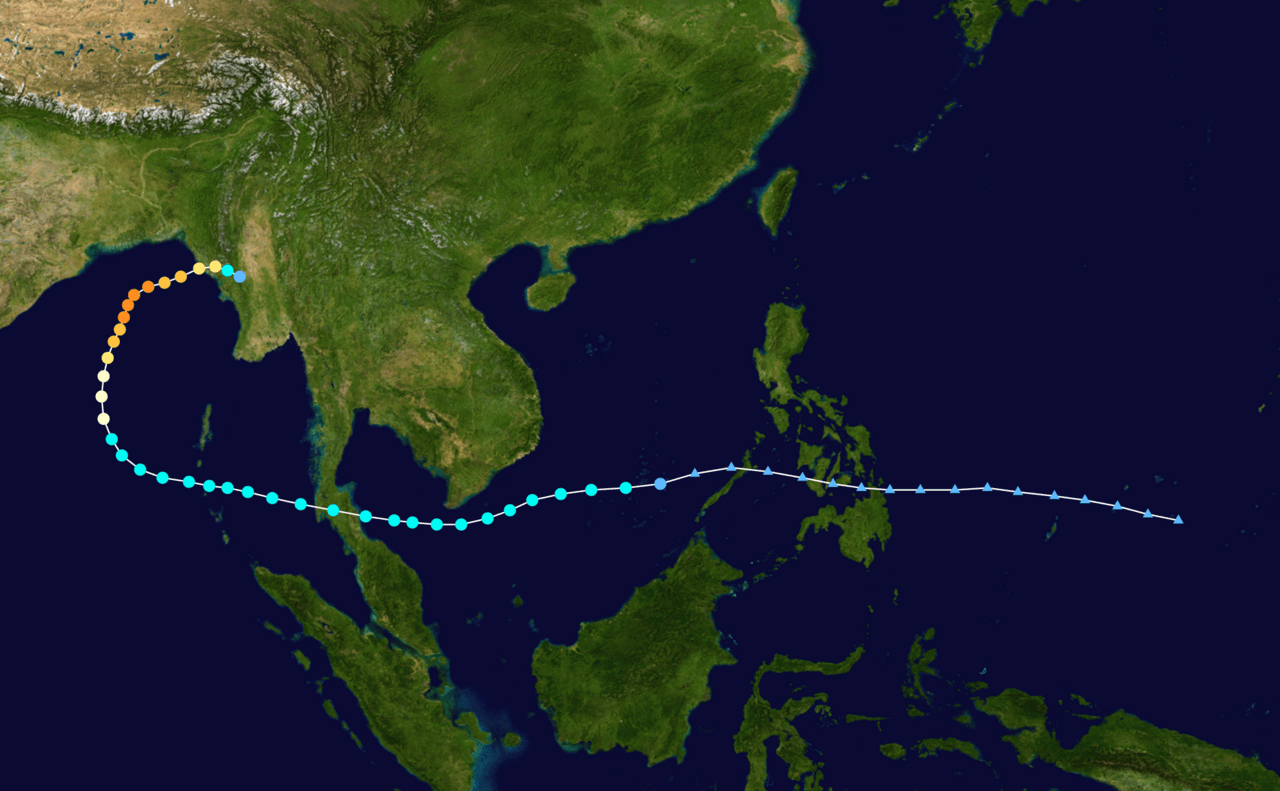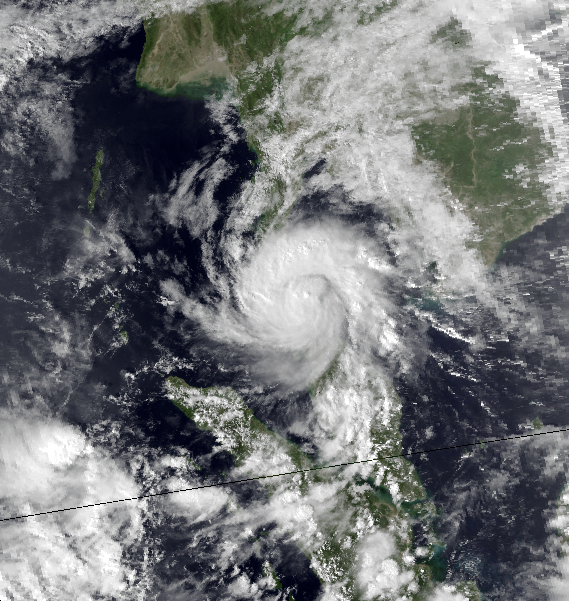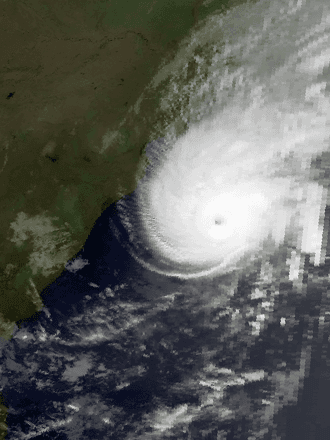
Extremely Severe Cyclonic Storm Forrest, also referred to as Tropical Storm Forrest while in the western Pacific basin before its Thai crossover, was a powerful tropical cyclone that prompted the evacuation of 600,000 people in Bangladesh in late November 1992. Originating from an area of disturbed weather near the Caroline Islands on November 9, Forrest was classified as a tropical depression three days later over the South China Sea. Tracking generally west, the system steadily organized into a tropical storm, passing Vietnam to the south, before striking Thailand along the Malay Peninsula on November 15. Once over the Bay of Bengal, Forrest turned northward on November 17 and significantly intensified. It reached its peak intensity on November 20 as a Category 4-equivalent cyclone on the Saffir–Simpson hurricane scale with winds of 230 km/h (140 mph). Hostile environmental conditions soon affected the cyclone as it turned abruptly east-northeastward. Forrest made landfall in northwestern Myanmar as a weakening system on November 21 before dissipating early the next day.
The majority of deaths associated with Forrest resulted from a plane crash on November 14 in Vietnam which killed 30 of the 31 occupants. In Thailand, the system produced significant storm surge, damaged or destroyed 1,700 homes, and killed two people. Agricultural losses in the hardest hit areas were estimated at ฿800 million (US$32 million). On November 20, as Forrest reached its peak intensity, fears arose across Bangladesh that a repeat of the catastrophic April 1991 cyclone would take place. As a result, mass evacuation plans were enacted across coastal areas of the country, with plans to relocate up to 2 million people. But the storm abruptly turned eastward, and the successful evacuation of 600,000 residents spared countless lives. Only two deaths were recorded, and overall damage was light, though half of all homes on St. Martin's Island were damaged.
Meteorological history
The second of four notable tropical cyclones in the Western Pacific in early November 1992, Forrest was first identified as an area of disturbed weather over the western Caroline Islands on November 9. Moving generally west-northwest, convection associated with the system steadily organized and the Joint Typhoon Warning Center (JTWC) subsequently issued a Tropical Cyclone Formation Alert (TCFA) on November 10. Development into a tropical depression was not anticipated until the system cleared the Philippines; however, organization was slower than forecast and a second TCFA was issued late on November 11. Once west of Palawan Island and over the South China Sea on November 12, the convective structure rapidly consolidated. The disturbance was designated Tropical Depression 30W at 12:00 UTC, when it was 940 km (580 mi) east-southeast of Ho Chi Minh City, Vietnam. The Japan Meteorological Agency (JMA) followed suit six hours later. Moving toward the west-southwest, the system steadily organized; later that day, it attained gale-force winds and was assigned the name Forrest by the JTWC. As the storm approached Vietnam, it turned southwest and moved parallel to the coast before resuming its westerly track. Forrest made its closest approach to the nation on November 14, passing 110 km (68 mi) south of Cà Mau province.