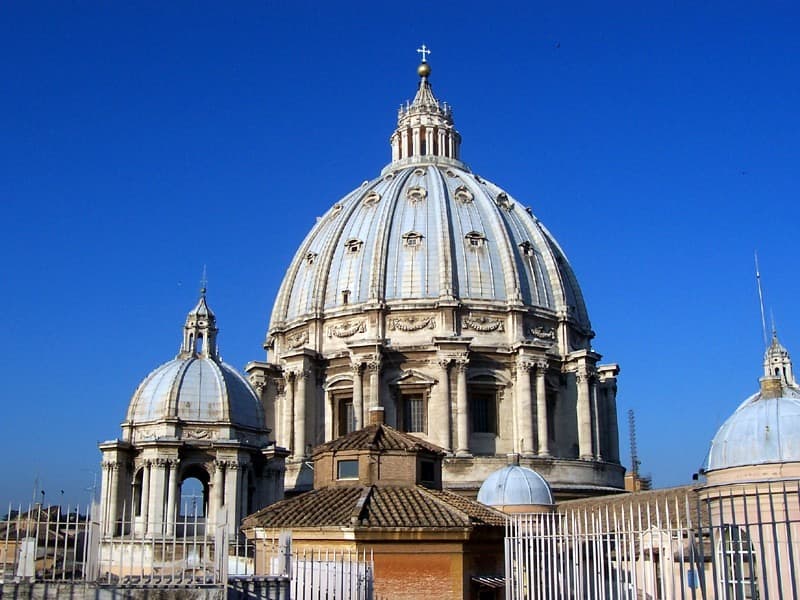
The Latin Church (Latin: Ecclesia Latina) is the largest autonomous (sui iuris) particular church within the Catholic Church, whose members constitute the vast majority of the 1.3 billion Catholics. The Latin Church is one of 24 sui iuris churches in full communion with the pope; the other 23 are collectively referred to as the Eastern Catholic Churches, and they have approximately 18 million members combined.
The Latin Church is directly headed by the pope in his role as the bishop of Rome, whose cathedra as a bishop is located in the Archbasilica of Saint John Lateran in Rome, Italy. The Latin Church both developed within and strongly influenced Western culture; as such, it is sometimes called the Western Church (Latin: Ecclesia Occidentalis), which is reflected in one of the pope's traditional titles in some eras and contexts, the Patriarch of the West. It is also known as the Roman Church (Latin: Ecclesia Romana), the Latin Catholic Church, and in some contexts as the Roman Catholic Church (though this name can also refer to the Catholic Church as a whole).
The Latin Church was in full communion with what is referred to as the Eastern Orthodox Church until the East–West Schism of Rome and Constantinople in 1054. From that time, but also before it, it became common to refer to Western Christians as Latins in contrast to Byzantines or Greeks.
The Latin Church employs the Latin liturgical rites, which since the mid-20th century are very often translated into the vernacular. The predominant liturgical rite is the Roman Rite, elements of which have been practiced since the fourth century. There exist and have existed since ancient times additional Latin liturgical rites and uses, including the currently used Mozarabic Rite in restricted use in Spain, the Ambrosian Rite in parts of Italy, and the Anglican Use in the personal ordinariates.
In the early modern period and subsequently, the Latin Church carried out evangelizing missions to the Americas, and from the late modern period to Sub-Saharan Africa and East Asia. The Protestant Reformation in the 16th century resulted in Protestantism breaking away, resulting in the fragmentation of Western Christianity, including not only Protestant offshoots of the Latin Church, but also smaller groups of 19th-century break-away Independent Catholic denominations.
Reading level
Audio Summary
Played with your browser's voice. Studio-quality audio can be added with a text-to-speech service.
Ask about this article
📝 Quick Quiz1 / 4
What is "Latin Church" primarily known for?
Vocix Daily — In Your Inbox
Top stories, deep-dive articles, and "On This Day" history — one crisp digest delivered every morning.
Sources & references
Reference material for this entry is drawn from the open encyclopedic record, including Wikipedia , available under the CC BY-SA 4.0 license. Images are credited individually beside each photo.
Terminology
Name
The historical part of the Catholic Church in the West is called the Latin Church to distinguish itself from the Eastern Catholic Churches which are also under the pope's primacy. In historical context, before the East–West Schism in 1054 the Latin Church is sometimes referred to as the Western Church. Writers belonging to various Protestant denominations sometime use the term Western Church as an implicit claim to legitimacy.
The term Latin Catholic refers to followers of the Latin liturgical rites, of which the Roman Rite is predominant. The Latin liturgical rites are contrasted with the liturgical rites of the Eastern Catholic Churches.
"Church" and "rite"
The 1990 Code of Canons of the Eastern Churches defines the use within that code of the words "church" and "rite". In accordance with these definitions of usage within the code that governs the Eastern Catholic Churches, the Latin Church is one such group of Christian faithful united by a hierarchy and recognized by the supreme authority of the Catholic Church as a sui iuris particular Church. The "Latin Rite" is the whole of the patrimony of that distinct particular church, by which it manifests its own manner of living the faith, including its own liturgy, its theology, its spiritual practices and traditions and its canon law. A Catholic, as an individual person, is necessarily a member of a particular church. A person also inherits, or "is of", a particular patrimony or rite. Since the rite has liturgical, theological, spiritual and disciplinary elements, a person is also to worship, to be catechized, to pray and to be governed according to a particular rite.
Particular churches that inherit and perpetuate a particular patrimony are identified by the metonymy "church" or "rite". Accordingly, "Rite" has been defined as "a division of the Christian Church using a distinctive liturgy", or simply as "a Christian Church". In this sense, "Rite" and "Church" are treated as synonymous, as in the glossary prepared by the United States Conference of Catholic Bishops and revised in 1999, which states that each "Eastern-rite (Oriental) Church ... is considered equal to the Latin rite within the Church". The Second Vatican Council likewise stated that "it is the mind of the Catholic Church that each individual Church or Rite should retain its traditions whole and entire and likewise that it should adapt its way of life to the different needs of time and place" and spoke of patriarchs and of "major archbishops, who rule the whole of some individual Church or Rite". It thus used the word "Rite" as "a technical designation of what may now be called a particular Church". "Church or rite" is also used as a single heading in the United States Library of Congress classification of works.
Historically, the governing entity of the Latin Church (i.e. the Holy See) has been viewed as one of the five patriarchates of the Pentarchy of early Christianity, along with the patriarchates of Constantinople, Alexandria, Antioch, and Jerusalem. Due to geographic and cultural considerations, the latter patriarchates developed into churches with distinct Eastern Christian traditions. This scheme, tacitly at least accepted by Rome, is constructed from the viewpoint of Greek Christianity and does not take into consideration other churches of great antiquity which developed in the East outside the frontiers of the Roman Empire. The majority of Eastern Christian Churches broke full communion with the Bishop of Rome and the Latin Church, following various theological and jurisdictional disputes in the centuries following the Council of Chalcedon in AD 451. These included notably the Nestorian Schism (431–544) (Church of the East), Chalcedonian Schism (451) (Oriental Orthodoxy), and the East-West Schism (1054) (Eastern Orthodoxy). The Protestant Reformation of the 16th century saw a schism which was not analogous since it was not based upon the same historical factors and involved far more profound theological dissent from the teaching of the totality of previously existing historical Christian churches. Until 2006, the pope claimed the title "patriarch of the West"; Benedict XVI set aside this title. In 2024, Pope Francis reinstated patriarch of the West as one of the official papal titles.
Following the Islamic conquests, the Crusades were launched by the West from 1095 to 1291 in order to defend Christians and their properties in the Holy Land against persecution. In the long term the Crusaders did not succeed in re-establishing political and military control of Palestine, which like former Christian North Africa and the rest of the Middle East remained under Islamic control. The names of many former Christian dioceses of this vast area are still used by the Catholic Church as the names of Catholic titular sees, irrespective of the question of liturgical families.
In the High Middle Ages began the development of Scholasticism in the Latin Church, which saw to reconcile the rediscovery of Classical Greek works such as those of Aristotle with Christianity. Under that came new theologians such as Thomas Aquinas and Anselm of Canterbury who believed that faith and reason could exist without any contradiction.
During the Age of Discovery, the Latin Church spread to the Americas and the Philippines under the colonial powers of Spain and Portugal, which Pope Alexander VI in the papal bull Inter caetera awarded colonial rights to. The French colonization of the Americas beginning in the 16th century established the French Latin Church in Quebec.
Membership
In the Catholic Church, in addition to the Latin Church—directly headed by the pope as Latin patriarch and notable within Western Christianity for its sacred tradition and seven sacraments— there are 23 Eastern Catholic Churches, self-governing particular churches sui iuris with their own hierarchies. Most of these churches trace their origins to the other four patriarchates of the ancient pentarchy, but either never historically broke full communion or returned to it with the Papacy at some time. These differ from each other in liturgical rite (ceremonies, vestments, chants, language), devotional traditions, theology, canon law, and clergy, but all maintain the same faith, and all see full communion with the pope as bishop of Rome as essential to being Catholic as well as part of the one true church as defined by the Four Marks of the Church in Catholic ecclesiology.
The approximately 18 million Eastern Catholics represent a minority of Christians in communion with the pope, compared to well over 1 billion Latin Catholics. Additionally, there are roughly 250 million Eastern Orthodox and 86 million Oriental Orthodox around the world that are not in union with Rome. Unlike the Latin Church, the pope does not exercise a direct patriarchal role over the Eastern Catholic churches and their faithful, instead encouraging their internal hierarchies, which while separate from that of the Latin Church and function analogously to it, and follow the traditions shared with the corresponding Eastern Christian churches in Eastern and Oriental Orthodoxy.
Cardinal Joseph Ratzinger (later Pope Benedict XVI) described the Latin liturgical rites on 24 October 1998:
Several forms of the Latin rite have always existed, and were only slowly withdrawn, as a result of the coming together of the different parts of Europe. Before the Council there existed, side by side with the Roman rite, the Ambrosian rite, the Mozarabic rite of Toledo, the rite of Braga, the Carthusian rite, the Carmelite rite, and best known of all, the Dominican rite, and perhaps still other rites of which I am not aware.
Today, the most common Latin liturgical rites are the Roman Rite—either the post-Vatican II Mass promulgated by Pope Paul VI in 1969 and revised by Pope John Paul II in 2002 (the "Ordinary Form"), or the 1962 form of the Tridentine Mass (the "Extraordinary Form"); the Ambrosian Rite; the Mozarabic Rite; and variations of the Roman Rite (such as the Anglican Use). The 23 Eastern Catholic Churches employ five different families of liturgical rites. The Latin liturgical rites are used only in a single sui iuris particular church.
Of other liturgical families, the main survivors are what is now referred to officially as the Hispano-Mozarabic Rite, still in restricted use in Spain; the Ambrosian Rite, centred geographically on the Archdiocese of Milan, in Italy, and much closer in form, though not specific content, to the Roman Rite; and the Carthusian Rite, practised within the strict Carthusian monastic Order, which also employs in general terms forms similar to the Roman Rite, but with a number of significant divergences which have adapted it to the distinctive way of life of the Carthusians.
There once existed what is referred to as the Gallican Rite, used in Gaulish or Frankish territories. This was a conglomeration of varying forms, not unlike the present Hispano-Mozarabic Rite in its general structures, but never strictly codified and which from at least the seventh century was gradually infiltrated, and then eventually for the most part replaced, by liturgical texts and forms which had their origin in the diocese of Rome. Other former "Rites" in past times practised in certain religious orders and important cities were in truth usually partial variants upon the Roman Rite and have almost entirely disappeared from current use, despite limited nostalgic efforts at revival of some of them and a certain indulgence by the Roman authorities.
Disciplinary patrimony
Canon law for the Latin Church is codified in the Code of Canon Law, of which there have been two codifications, the first promulgated by Pope Benedict XV in 1917 and the second by Pope John Paul II in 1983.
In the Latin Church, the norm for administration of confirmation is that, except when in danger of death, the person to be confirmed should "have the use of reason, be suitably instructed, properly disposed, and able to renew the baptismal promises", and "the administration of the Most Holy Eucharist to children requires that they have sufficient knowledge and careful preparation so that they understand the mystery of Christ according to their capacity and are able to receive the body of Christ with faith and devotion." In the Eastern Churches these sacraments are usually administered immediately after baptism, even for an infant.
Celibacy, as a consequence of the duty to observe perfect continence, is obligatory for priests in the Latin Church. An exception is made for married clergy from other churches, who join the Catholic Church; they may continue as married priests. In the Latin Church, a married man may not be admitted even to the diaconate unless he is legitimately destined to remain a deacon and not become a priest. Marriage after ordination is not possible, and attempting it can result in canonical penalties. The Eastern Catholic Churches, unlike the Latin Church, have a married clergy.
At the present time, Bishops in the Latin Church are generally appointed by the pope after hearing the advice of the various dicasteries of the Roman Curia, specifically the Congregation for Bishops, the Congregation for the Evangelization of Peoples (for countries in its care), the Section for Relations with States of the Secretariat of State (for appointments that require the consent or prior notification of civil governments), and the Congregation for the Oriental Churches (in the areas in its charge, even for the appointment of Latin bishops). The Congregations generally work from a "terna" or list of three names advanced to them by the local church, most often through the Apostolic Nuncio or the Cathedral Chapter in those places where the Chapter retains the right to nominate bishops.
Theology and philosophy
Augustinianism
Augustine of Hippo was a Roman African, philosopher and bishop in the Catholic Church. He helped shape Latin Christianity, and is viewed as one of the most important Church Fathers in the Latin Church for his writings in the Patristic Period. Among his works are The City of God, De doctrina Christiana, and Confessions.
In his youth he was drawn to Manichaeism and later to neoplatonism. After his baptism and conversion in 386, Augustine developed his own approach to philosophy and theology, accommodating a variety of methods and perspectives. Believing that the grace of Christ was indispensable to human freedom, he helped formulate the doctrine of original sin and made seminal contributions to the development of just war theory. His thoughts profoundly influenced the medieval worldview. The segment of the church that adhered to the concept of the Trinity as defined by the Council of Nicaea and the Council of Constantinople closely identified with Augustine's On the Trinity
When the Western Roman Empire began to disintegrate, Augustine imagined the church as a spiritual City of God, distinct from the material Earthly City. in his book On the city of God against the pagans, often called The City of God, Augustine declared its message to be spiritual rather than political. Christianity, he argued, should be concerned with the mystical, heavenly city, the New Jerusalem, rather than with earthly politics.
The City of God presents human history as a conflict between what Augustine calls the Earthly City (often colloquially referred to as the City of Man, but never by Augustine) and the City of God, a conflict that is destined to end in victory for the latter. The City of God is marked by people who forego earthly pleasure to dedicate themselves to the eternal truths of God, now revealed fully in the Christian faith. The Earthly City, on the other hand, consists of people who have immersed themselves in the cares and pleasures of the present, passing world.
For Augustine, the Logos "took on flesh" in Christ, in whom the logos was present as in no other man. He strongly influenced Early Medieval Christian Philosophy.
Like other Church Fathers such as Athenagoras, Tertullian, Clement of Alexandria and Basil of Caesarea, Augustine "vigorously condemned the practice of induced abortion", and although he disapproved of an abortion during any stage of pregnancy, he made a distinction between early abortions and later ones. He acknowledged the distinction between "formed" and "unformed" fetuses mentioned in the Septuagint translation of Exodus 21:22–23, which is considered as wrong translation of the word "harm" from the original Hebrew text as "form" in the Greek Septuagint and based in Aristotelian distinction "between the fetus before and after its supposed 'vivification'", and did not classify as murder the abortion of an "unformed" fetus since he thought that it could not be said with certainty that the fetus had already received a soul.
Augustine also used the term "Catholic" to distinguish the "true" church from heretical groups:
In the Catholic Church, there are many other things which most justly keep me in her bosom. The consent of peoples and nations keeps me in the Church; so does her authority, inaugurated by miracles, nourished by hope, enlarged by love, established by age. The succession of priests keeps me, beginning from the very seat of the Apostle Peter, to whom the Lord, after His resurrection, gave it in charge to feed His sheep (Jn 21:15–19), down to the present episcopate.
And so, lastly, does the very name of Catholic, which, not without reason, amid so many heresies, the Church has thus retained; so that, though all heretics wish to be called Catholics, yet when a stranger asks where the Catholic Church meets, no heretic will venture to point to his own chapel or house.
Such then in number and importance are the precious ties belonging to the Christian name which keep a believer in the Catholic Church, as it is right they should. ...With you, there is none of these things to attract or keep me. ...No one shall move me from the faith which binds my mind with ties so many and so strong to the Christian religion. ...For my part, I should not believe the gospel except as moved by the authority of the Catholic Church.
— St. Augustine (354–430): Against the Epistle of Manichaeus called Fundamental, chapter 4: Proofs of the Catholic Faith.
In both his philosophical and theological reasoning, Augustine was greatly influenced by Stoicism, Platonism and Neoplatonism, particularly by the work of Plotinus, author of the Enneads, probably through the mediation of Porphyry and Victorinus (as Pierre Hadot has argued). Although he later abandoned Neoplatonism, some ideas are still visible in his early writings. His early and influential writing on the human will, a central topic in ethics, would become a focus for later philosophers such as Schopenhauer, Kierkegaard, and Nietzsche. He was also influenced by the works of Virgil (known for his teaching on language), and Cicero (known for his teaching on argument).
In the East, his teachings are more disputed, and were notably attacked by John Romanides. But other theologians and figures of the Eastern Orthodox Church have shown significant approbation of his writings, chiefly Georges Florovsky. The most controversial doctrine associated with him, the filioque, was rejected by the Orthodox Church as heretical. Other disputed teachings include his views on original sin, the doctrine of grace, and predestination. Nevertheless, though considered to be mistaken on some points, he is still considered a saint, and has even had influence on some Eastern Church Fathers, most notably the Greek theologian Gregory Palamas. In the Orthodox Church his feast day is celebrated on 15 June. Historian Diarmaid MacCulloch has written: "[Augustine's] impact on Western Christian thought can hardly be overstated; only his beloved example Paul of Tarsus has been more influential, and Westerners have generally seen Paul through Augustine's eyes."
In his autobiographical book Milestones, Pope Benedict XVI claims Augustine as one of the deepest influences in his thought.
Scholasticism
Scholasticism is a method of critical thought which dominated teaching by the academics ("scholastics", or "schoolmen") of medieval universities in Europe from about 1100 to 1700, The 13th and early 14th centuries are generally seen as the high period of scholasticism. The early 13th century witnessed the culmination of the recovery of Greek philosophy. Schools of translation grew up in Italy and Sicily, and eventually in the rest of Europe. Powerful Norman kings gathered men of knowledge from Italy and other areas into their courts as a sign of their prestige. William of Moerbeke's translations and editions of Greek philosophical texts in the middle half of the thirteenth century helped form a clearer picture of Greek philosophy, particularly of Aristotle, than was given by the Arabic versions on which they had previously relied. Edward Grant writes: "Not only was the structure of the Arabic language radically different from that of Latin, but some Arabic versions had been derived from earlier Syriac translations and were thus twice removed from the original Greek text. Word-for-word translations of such Arabic texts could produce tortured readings. By contrast, the structural closeness of Latin to Greek permitted literal, but intelligible, word-for-word translations."
Universities developed in the large cities of Europe during this period, and rival clerical orders within the church began to battle for political and intellectual control over these centers of educational life. The two main orders founded in this period were the Franciscans and the Dominicans. The Franciscans were founded by Francis of Assisi in 1209. Their leader in the middle of the century was Bonaventure, a traditionalist who defended the theology of Augustine and the philosophy of Plato, incorporating only a little of Aristotle in with the more neoplatonist elements. Following Anselm, Bonaventure supposed that reason can only discover truth when philosophy is illuminated by religious faith. Other important Franciscan scholastics were Duns Scotus, Peter Auriol and William of Ockham.
Thomism
Saint Thomas Aquinas, an Italian Dominican friar, philosopher and priest, was immensely influential in the tradition of scholasticism, within which he is also known as the Doctor Angelicus and the Doctor Communis.
Aquinas emphasized that "Synderesis is said to be the law of our mind, because it is a habit containing the precepts of the natural law, which are the first principles of human actions."
According to Aquinas "…all acts of virtue are prescribed by the natural law, since each one's reason naturally dictates to him to act virtuously. But if we speak of virtuous acts, considered in themselves, i.e., in their proper species, not all virtuous acts are prescribed by the natural law for many things are done virtuously to which nature does not incline at first; but that, through the inquiry of reason, have been found by men to be conducive to well living." Therefore, we must determine if we are speaking of virtuous acts as under the aspect of virtuous or as an act in its species.
Thomas defined the four cardinal virtues as prudence, temperance, justice, and fortitude. The cardinal virtues are natural and revealed in nature, and they are binding on everyone. There are, however, three theological virtues: faith, hope, and charity. Thomas also describes the virtues as imperfect (incomplete) and perfect (complete) virtues. A perfect virtue is any virtue with charity, which completes a cardinal virtue. A non-Christian can display courage, but it would be courage with temperance. A Christian would display courage with charity. These are somewhat supernatural and are distinct from other virtues in their object, namely, God:
Now the object of the theological virtues is God Himself, Who is the last end of all, as surpassing the knowledge of our reason. On the other hand, the object of the intellectual and moral virtues is something comprehensible to human reason. Wherefore the theological virtues are specifically distinct from the moral and intellectual virtues.
Thomas Aquinas wrote: "[Greed] is a sin against God, just as all mortal sins, in as much as man condemns things eternal for the sake of temporal things."
Aquinas also contributed to economic thought as an aspect of ethics and justice. He dealt with the concept of a just price, normally its market price or a regulated price sufficient to cover seller costs of production. He argued it was immoral for sellers to raise their prices simply because buyers were in pressing need for a product.
Aquinas later expanded his argument to oppose any unfair earnings made in trade, basing the argument on the Golden Rule. The Christian should "do unto others as you would have them do unto you", meaning he should trade value for value. Aquinas believed that it was specifically immoral to raise prices because a particular buyer had an urgent need for what was being sold and could be persuaded to pay a higher price because of local conditions: