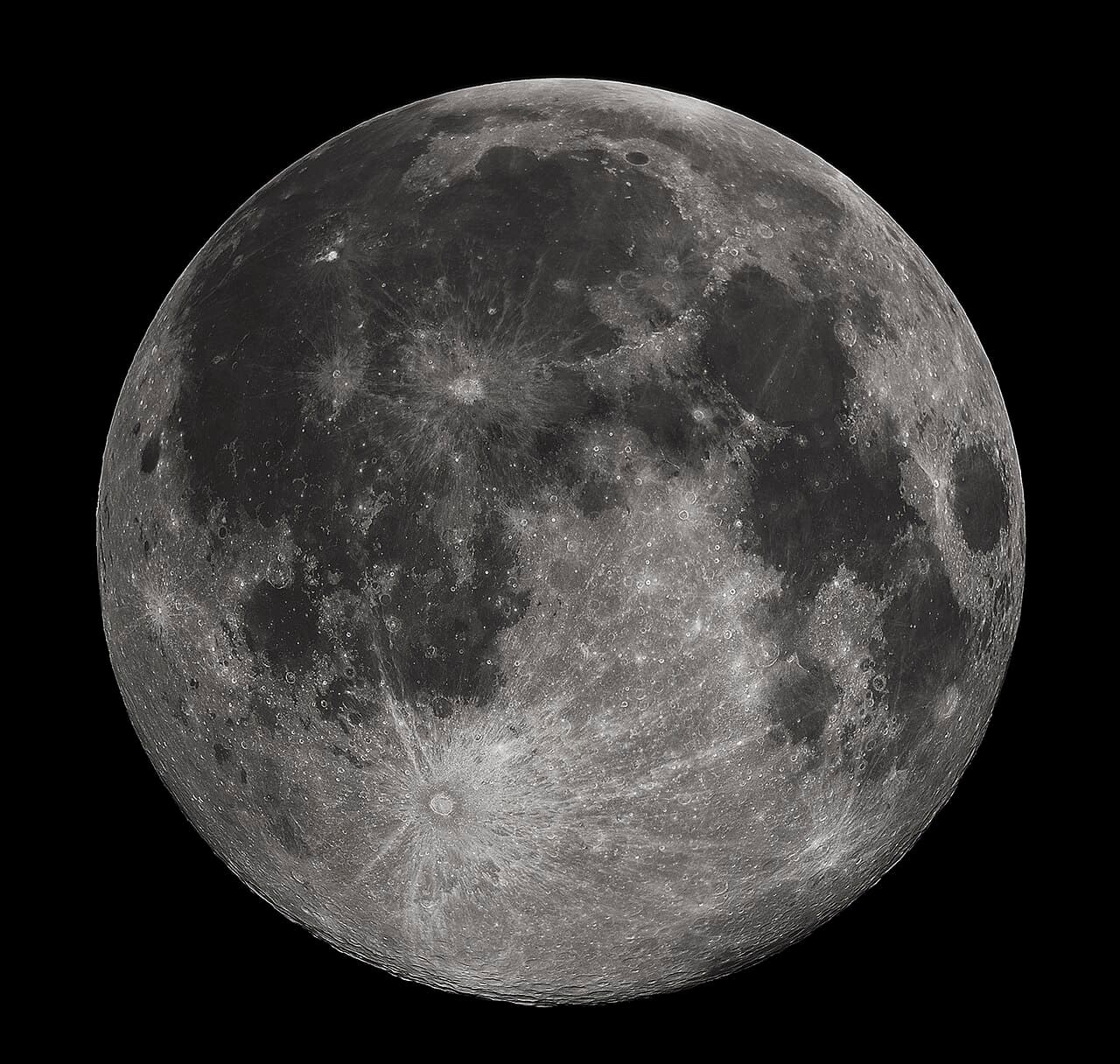
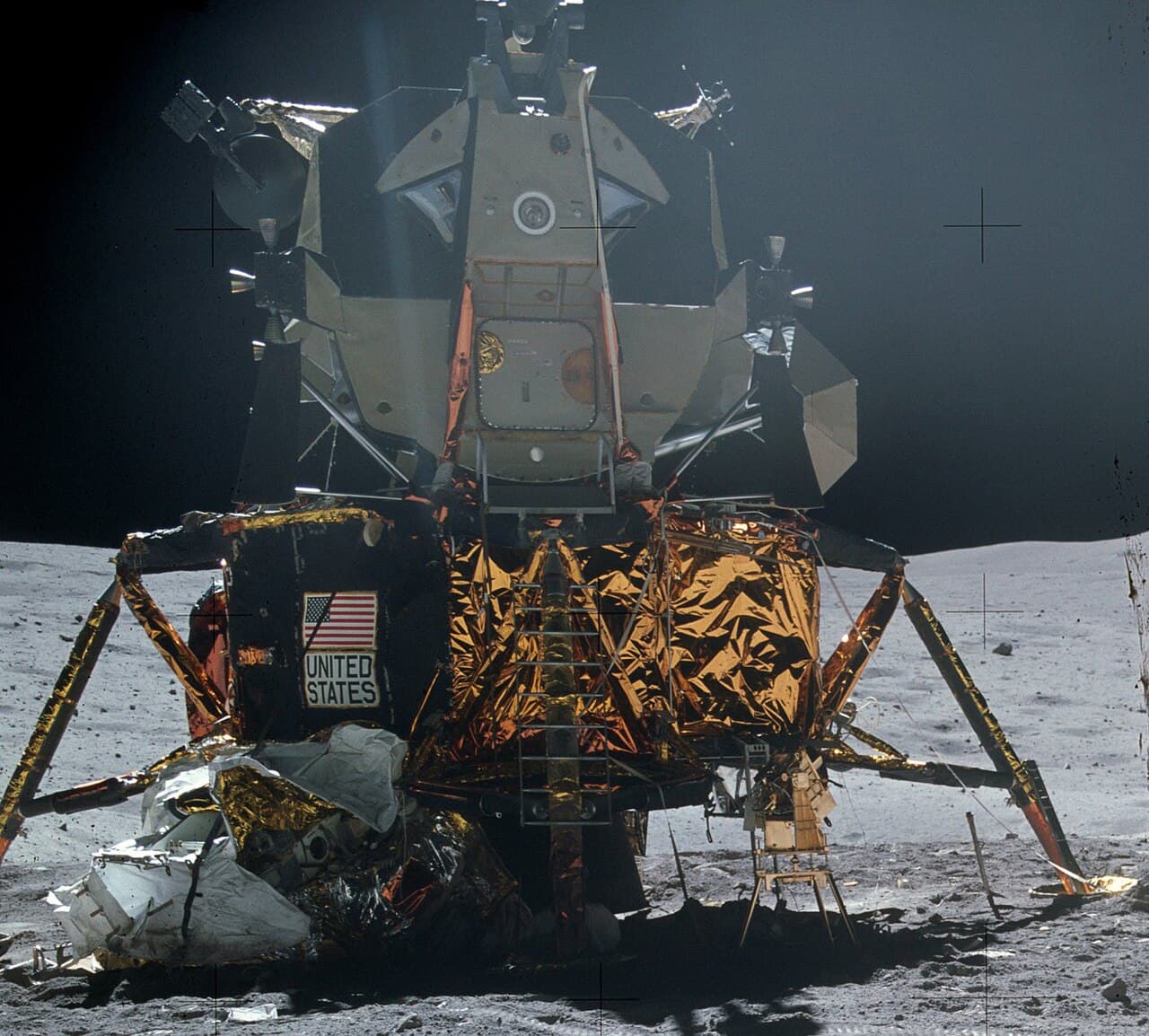
A Moon landing or lunar landing is the arrival of a crewed or robotic spacecraft on the Moon. The first human-made object to touch the Moon was Luna 2 in 1959, and the first crewed mission to land on the Moon was Apollo 11 in 1969.
There were six crewed landings between 1969 and 1972 and numerous uncrewed landings. All crewed missions to the Moon were conducted by the Apollo program, with the last departing in December 1972. After Luna 24 in 1976, there were no soft landings—landings without significant damage—on the Moon until Chang'e 3 in 2013. All soft landings took place on the near side of the Moon until Chang'e 4 landed on the far side of the Moon in 2019.
Uncrewed landings
Government landings
Six government space agencies, Interkosmos, NASA, CNSA, ISRO, JAXA and ESA, have reached the Moon with uncrewed missions. The Soviet Union (Interkosmos), the United States (NASA), China (CNSA), India (ISRO), and Japan (JAXA) are the only five nations to have successfully achieved soft landings.
The Soviet Union performed the first hard Moon landing, in which the spacecraft intentionally crashed into the Moon at high speed, with the Luna 2 spacecraft in 1959, a feat the U.S. duplicated in 1962 with Ranger 4.
Following their initial hard landings on the Moon, sixteen Soviet, U.S., Chinese and Indian spacecraft have used braking rockets (retrorockets) to make soft landings and perform scientific operations on the lunar surface. In 1966 the Soviet Union accomplished the first soft landings and took the first pictures from the lunar surface during the Luna 9 and Luna 13 missions. The U.S. followed with five Surveyor soft landings. China's ongoing Chang'e program has landed 4 times since 2013, achieving robotic soil sample return and the first landing on the far side of the Moon.
On 23 August 2023, ISRO successfully landed its Chandrayaan-3 module in the lunar south pole region, making India the fourth nation to successfully complete a soft landing on the Moon. Chandrayaan-3 saw a successful soft landing of its Vikram lander and Pragyan rover at 6.04 pm IST (1234 GMT), marking the first uncrewed soft landing in the little-explored region.
Reading level
Audio Summary
Played with your browser's voice. Studio-quality audio can be added with a text-to-speech service.
Ask about this article
📝 Quick Quiz1 / 3
What is "Moon landing" primarily known for?
Vocix Daily — In Your Inbox
Top stories, deep-dive articles, and "On This Day" history — one crisp digest delivered every morning.
Sources & references
Reference material for this entry is drawn from the open encyclopedic record, including Wikipedia , available under the CC BY-SA 4.0 license. Images are credited individually beside each photo.
On 19 January 2024, JAXA successfully landed its SLIM lander, making Japan the fifth nation to successfully complete a soft landing.
Commercial landings
Two organizations have attempted but failed to achieve soft landings: Israeli private space agency SpaceIL with their Beresheet spacecraft (2019), and Japanese company ispace's Hakuto-R Mission 1 (2023).
On 22 February 2024, Intuitive Machine's Odysseus successfully landed on the Moon after taking off on a SpaceX Falcon 9 liftoff on 15 February 2024 in a mission by NASA, SpaceX, and Intuitive Machines, marking the United States' first soft unmanned Moon landing in over 50 years and as the first successful landing of a privately owned spacecraft on the Moon. The lander broke a strut during landing and rested at an angle of 30° to the lunar surface and 18° to horizontal, with communications impaired. It operated until February 29, 2024.
On 2 March 2025, Firefly Aerospace's Blue Ghost lunar lander made the first fully successful commercial Moon landing after softly landing upright near Mons Latreille in Mare Crisium. Blue Ghost operated for 14 days, including 5 hours into the lunar night, marking it the longest commercial operations on the Moon until now. Part of NASA's Commercial Lunar Payload Services initiative, Firefly operated 10 NASA instruments aboard Blue Ghost. The mission concluded on 16 March 2025.
Crewed landings
A total of twelve astronauts have landed on the Moon. This was accomplished with two pilot-astronauts flying a Lunar Module on each of six NASA missions. The missions spanned a 41-month period starting 20 July 1969, beginning with Neil Armstrong and Buzz Aldrin on Apollo 11, and ending on 14 December 1972 with Gene Cernan and Harrison Schmitt on Apollo 17. Cernan was the last man to step off the lunar surface.
All Apollo lunar missions had a third crew member who remained on board the command module.
To get to the Moon, a spacecraft must first leave Earth's gravity well; currently, the only practical means is a rocket. Unlike airborne vehicles such as balloons and jet aircraft, a rocket can continue accelerating in the vacuum outside the atmosphere.
Upon approach of the target moon, a spacecraft will be drawn ever closer to its surface at increasing speeds due to gravity. In order to land intact it must decelerate to less than about 160 kilometres per hour (100 mph) and be ruggedized to withstand a "hard landing" impact, or it must decelerate to negligible speed at contact for a "soft landing" (the only option for humans). The first three attempts by the U.S. to perform a successful hard Moon landing with a ruggedized seismometer package in 1962 all failed. The Soviets first achieved the milestone of a hard lunar landing with a ruggedized camera in 1966, followed only months later by the first uncrewed soft lunar landing by the U.S.
The speed of a crash landing on its surface is typically between 70 and 100% of the escape velocity of the target moon, and thus this is the total velocity which must be shed from the target moon's gravitational attraction for a soft landing to occur. For Earth's Moon, the escape velocity is 2.38 kilometres per second (1.48 mi/s). The change in velocity (referred to as a delta-v) is usually provided by a landing rocket, which must be carried into space by the original launch vehicle as part of the overall spacecraft. An exception is the soft moon landing on Saturn's moon Titan carried out by the Huygens probe in 2005. As the moon with the thickest atmosphere, landings on Titan may be accomplished by using atmospheric entry techniques that are generally lighter in weight than a rocket with equivalent capability.
The Soviets succeeded in making the first crash landing on the Moon in 1959. Crash landings may occur because of malfunctions in a spacecraft, or they can be deliberately arranged for vehicles which do not have an onboard landing rocket. There have been many such Moon crashes, often with their flight path controlled to impact at precise locations on the lunar surface. For example, during the Apollo program the S-IVB third stage of the Saturn V rocket as well as the spent ascent stage of the Lunar Module were deliberately crashed on the Moon several times to provide impacts registering as a moonquake on seismometers that had been left on the lunar surface. Such crashes were instrumental in mapping the internal structure of the Moon.
To return to Earth, the escape velocity of the Moon must be overcome for the spacecraft to escape the gravity well of the Moon. Rockets must be used to leave the Moon and return to space. Upon reaching Earth, atmospheric entry techniques are used to absorb the kinetic energy of a returning spacecraft and reduce its speed for safe landing. These functions greatly complicate a moon landing mission and lead to many additional operational considerations. Any moon departure rocket must first be carried to the Moon's surface by a moon landing rocket, increasing the latter's required size. The Moon departure rocket, larger moon landing rocket and any Earth atmosphere entry equipment such as heat shields and parachutes must in turn be lifted by the original launch vehicle, greatly increasing its size by a significant and almost prohibitive degree.
Political background
The political context of the 1960s helps to parse both the United States and Soviet Union's efforts to land spacecraft, and eventually humans, on the Moon. World War II had introduced many new and deadly innovations including blitzkrieg-style surprise attacks used in the invasion of Poland and Finland, as well as in the attack on Pearl Harbor; the V-2 rocket, a ballistic missile which killed thousands in attacks on London and Antwerp; and the atom bomb, which killed hundreds of thousands in the atomic bombings of Hiroshima and Nagasaki. In the 1950s, tensions mounted between the two ideologically opposed superpowers of the United States and the Soviet Union that had emerged as victors in the conflict, particularly after the development by both countries of the hydrogen bomb.
On 4 October 1957, the Soviet Union launched Sputnik 1 as the first artificial satellite to orbit the Earth and so initiated the Space Race. This unexpected event was a source of pride to the Soviets and shock to the U.S., who could now potentially be surprise attacked by nuclear-tipped Soviet rockets in under 30 minutes. The steady beeping of the radio beacon aboard Sputnik 1 as it passed overhead every 96 minutes, and the sight of the much larger and visible co-orbiting R-7 booster that had placed it into orbit, was widely viewed on both sides as effective propaganda to Third World countries demonstrating the technological superiority of the Soviet political system compared to that of the U.S.
This perception was reinforced by a string of subsequent rapid-fire Soviet space achievements. In 1959, the R-7 rocket was used to launch the first escape from Earth's gravity into a solar orbit, the first crash impact onto the surface of the Moon, and the first photography of the never-before-seen far side of the Moon. These were the Luna 1, Luna 2, and Luna 3 spacecraft.
The U.S. response to these Soviet achievements was to greatly accelerate previously existing military space and missile projects and to create a civilian space agency, NASA. Military efforts were initiated to develop and produce mass quantities of intercontinental ballistic missiles (ICBMs) that would bridge the so-called missile gap and enable a policy of deterrence to nuclear war with the Soviets known as mutual assured destruction or MAD. These newly developed missiles were made available to civilians of NASA for various projects (which would have the added benefit of demonstrating the payload, guidance accuracy and reliabilities of U.S. ICBMs to the Soviets).
To out-perform the Soviet Union the United States Air Force proposed the Project A119, detonating a nuclear explosive on the Moon. With research done by Carl Sagan on its effects, a human landing was ultimately favoured, since the negative outcomes were too great.
Early Soviet uncrewed lunar missions (1958–1965)
After the fall of the Soviet Union in 1991, historical records were released to allow the true accounting of Soviet lunar efforts. Unlike the U.S. tradition of assigning a particular mission name in advance of a launch, the Soviets assigned a public "Luna" mission number only if a launch resulted in a spacecraft going beyond Earth orbit. The policy had the effect of hiding Soviet Moon mission failures from public view.
If the attempt failed in Earth orbit before departing for the Moon, it was frequently, but not always, given a "Sputnik" or "Cosmos" Earth-orbit mission number to hide its purpose. Launch explosions were not acknowledged at all.
Early U.S. uncrewed lunar missions (1958–1965)
The U.S. was not able to reach the Moon with the Pioneer and Ranger programs, with fifteen consecutive U.S. uncrewed lunar missions from 1958 to 1964 failing their primary photographic missions. However, Rangers 4 and 6 successfully repeated the Soviet lunar impacts as part of their secondary missions.
Three U.S. missions in 1962 attempted to hard land small seismometer packages released by the main Ranger spacecraft. These surface packages were to use retrorockets to survive landing, unlike the parent vehicle, which was designed to deliberately crash onto the surface. The final three Ranger probes performed successful high altitude lunar reconnaissance photography missions during intentional crash impacts between 2.62 and 2.68 kilometres per second (9,400 and 9,600 km/h).
Pioneer missions
Three different designs of Pioneer lunar probes were flown on three different modified ICBMs. Those flown on the Thor booster modified with an Able upper stage carried an infrared image scanning television system with a resolution of 1 milliradian to study the Moon's surface, an ionization chamber to measure radiation in space, a diaphragm/microphone assembly to detect micrometeorites, a magnetometer, and temperature-variable resistors to monitor spacecraft internal thermal conditions. The first, a mission managed by the United States Air Force, exploded during launch; all subsequent Pioneer lunar flights had NASA as the lead management organization. The next two returned to Earth and burned up upon reentry into the atmosphere after achieved maximum altitudes of around 114,000 kilometres (71,000 mi) and 1,530 kilometres (950 mi) respectively, far short of the roughly 400,000 kilometres (250,000 mi) required to reach the vicinity of the Moon.
NASA then collaborated with the United States Army's Ballistic Missile Agency to fly two extremely small cone-shaped probes on the Juno ICBM, carrying only photocells which would be triggered by the light of the Moon and a lunar radiation environment experiment using a Geiger-Müller tube detector. The first of these reached an altitude of only around 100,000 kilometres (62,000 mi), gathering data that established the presence of the Van Allen radiation belts before reentering Earth's atmosphere. The second passed by the Moon at a distance of more than 60,000 kilometres (37,000 mi), twice as far as planned and too far away to trigger either of the on-board scientific instruments, yet still becoming the first U.S. spacecraft to reach a solar orbit.
The final Pioneer lunar probe design consisted of four "paddlewheel" solar panels extending from a one-meter diameter spherical spin-stabilized spacecraft body equipped to take images of the lunar surface with a television-like system, estimate the Moon's mass and topography of the poles, record the distribution and velocity of micrometeorites, study radiation, measure magnetic fields, detect low frequency electromagnetic waves in space and use a sophisticated integrated propulsion system for maneuvering and orbit insertion as well. None of the four spacecraft built in this series of probes survived launch on its Atlas ICBM outfitted with an Able upper stage.
Following the unsuccessful Atlas-Able Pioneer probes, NASA's Jet Propulsion Laboratory embarked upon an uncrewed spacecraft development program whose modular design could be used to support both lunar and interplanetary exploration missions. The interplanetary versions were known as Mariners; lunar versions were Rangers. JPL envisioned three versions of the Ranger lunar probes: Block I prototypes, which would carry various radiation detectors in test flights to a very high Earth orbit that came nowhere near the Moon; Block II, which would try to accomplish the first Moon landing by hard landing a seismometer package; and Block III, which would crash onto the lunar surface without any braking rockets while taking very high resolution wide-area photographs of the Moon during their descent.
Ranger missions
The Ranger 1 and 2 Block I missions were virtually identical. Spacecraft experiments included a Lyman-alpha telescope, a rubidium-vapor magnetometer, electrostatic analyzers, medium-energy-range particle detectors, two triple coincidence telescopes, a cosmic-ray integrating ionization chamber, cosmic dust detectors, and scintillation counters. The goal was to place these Block I spacecraft in a very high Earth orbit with an apogee of 110,000 kilometres (68,000 mi) and a perigee of 60,000 kilometres (37,000 mi).
From that vantage point, scientists could make direct measurements of the magnetosphere over a period of many months while engineers perfected new methods to routinely track and communicate with spacecraft over such large distances. Such practice was deemed vital to be assured of capturing high-bandwidth television transmissions from the Moon during a one-shot fifteen-minute time window in subsequent Block II and Block III lunar descents. Both Block I missions suffered failures of the new Agena upper stage and never left low Earth parking orbit after launch; both burned up upon reentry after only a few days.
The first attempts to perform a Moon landing took place in 1962 during the Rangers 3, 4 and 5 missions flown by the United States. All three Block II missions basic vehicles were 3.1 m high and consisted of a lunar capsule covered with a balsa wood impact-limiter, 650 mm in diameter, a mono-propellant mid-course motor, a retrorocket with a thrust of 5,050 pounds-force (22.5 kN), and a gold- and chrome-plated hexagonal base 1.5 m in diameter. This lander (code-named Tonto) was designed to provide impact cushioning using an exterior blanket of crushable balsa wood and an interior filled with incompressible liquid freon. A 42-kilogram (93 lb) 30-centimetre-diameter (0.98 ft) metal payload sphere floated and was free to rotate in a liquid freon reservoir contained in the landing sphere.
This payload sphere contained six silver-cadmium batteries to power a fifty-milliwatt radio transmitter, a temperature sensitive voltage controlled oscillator to measure lunar surface temperatures, and a seismometer designed with sensitivity high enough to detect the impact of a 2.3 kg (5 lb) meteorite on the opposite side of the Moon. Weight was distributed in the payload sphere so it would rotate in its liquid blanket to place the seismometer into an upright and operational position no matter what the final resting orientation of the external landing sphere.
After landing, plugs were to be opened allowing the freon to evaporate and the payload sphere to settle into upright contact with the landing sphere. The batteries were sized to allow up to three months of operation for the payload sphere. Various mission constraints limited the landing site to Oceanus Procellarum on the lunar equator, which the lander ideally would reach 66 hours after launch.
No cameras were carried by the Ranger landers, and no pictures were to be captured from the lunar surface during the mission. Instead, the 3.1 metres (10 ft) Ranger Block II mother ship carried a 200-scan-line television camera to capture images during the free-fall descent to the lunar surface. The camera was designed to transmit a picture every 10 seconds. Seconds before impact, at 5 and 0.6 kilometres (3.11 and 0.37 mi) above the lunar surface, the Ranger mother ships took pictures (which may be viewed here).
Other instruments gathering data before the mother ship crashed onto the Moon were a gamma ray spectrometer to measure overall lunar chemical composition and a radar altimeter. The radar altimeter was to give a signal ejecting the landing capsule and its solid-fueled braking rocket overboard from the Block II mother ship. The braking rocket was to slow and the landing sphere to a dead stop at 330 metres (1,080 ft) above the surface and separate, allowing the landing sphere to free fall once more and hit the surface.
On Ranger 3, failure of the Atlas guidance system and a software error aboard the Agena upper stage combined to put the spacecraft on a course that would miss the Moon. Attempts to salvage lunar photography during a flyby of the Moon were thwarted by in-flight failure of the onboard flight computer. This was probably because of prior heat sterilization of the spacecraft by keeping it above the boiling point of water for 24 hours on the ground, to protect the Moon from being contaminated by Earth organisms. Ranger 3 later began orbiting the Sun, called heliocentric orbit. Heat sterilization was also blamed for subsequent in-flight failures of the spacecraft computer on Ranger 4 and the power subsystem on Ranger 5. Only Ranger 4 reached the Moon in an uncontrolled crash impact on the far side of the Moon.
Block III probes replaced the Block II landing capsule and its retrorocket with a heavier, more capable television system to support landing site selection for upcoming Apollo crewed Moon landing missions. Six cameras were designed to take thousands of high-altitude photographs in the final twenty-minute period before crashing on the lunar surface. Camera resolution was 1,132 scan lines, far higher than the 525 lines found in a typical U.S. 1964 home television. While Ranger 6 suffered a failure of this camera system and returned no photographs despite an otherwise successful flight, the subsequent Ranger 7 mission to Mare Cognitum was a complete success.
Breaking the six-year string of failures in U.S. attempts to photograph the Moon at close range, the Ranger 7 mission was viewed as a national turning point and instrumental in allowing the key 1965 NASA budget appropriation to pass through the United States Congress intact without a reduction in funds for the Apollo crewed Moon landing program. Subsequent successes with Ranger 8 and Ranger 9 further buoyed U.S. hopes.
Soviet uncrewed soft landings (1966–1976)
The Luna 9 spacecraft, launched by the Soviet Union, performed the first successful soft Moon landing on 3 February 1966. Airbags protected its 99-kilogram (218 lb) ejectable capsule which survived an impact speed of over 15 metres per second (54 km/h; 34 mph). Luna 13 duplicated this feat with a similar Moon landing on 24 December 1966. Both returned panoramic photographs that were the first views from the lunar surface.
Luna 16 was the first robotic probe to land on the Moon and safely return a sample of lunar soil back to Earth. It represented the first lunar sample return mission by the Soviet Union, and was the third lunar sample return mission overall, following the Apollo 11 and Apollo 12 missions. This mission was later successfully repeated by Luna 20 (1972) and Luna 24 (1976).
In 1970 and 1973, two Lunokhod ("Moonwalker") robotic lunar rovers were delivered to the Moon, where they successfully operated for 10 and 4 months respectively, covering 10.5 km (6.5 mi) (Lunokhod 1) and 37 km (23 mi) (Lunokhod 2). These rover missions were in operation concurrently with the Zond and Luna series of Moon flyby, orbiter and landing missions.
U.S. uncrewed soft landings (1966–1968)
The U.S. robotic Surveyor program was part of an effort to locate a safe site on the Moon for a human landing and test under lunar conditions the radar and landing systems required to make a true controlled touchdown. Five of Surveyor's seven missions made successful uncrewed Moon landings. Surveyor 3 was visited two years after its Moon landing by the crew of Apollo 12. They removed parts of it for examination back on Earth to determine the effects of long-term exposure to the lunar environment.
Transition from direct ascent landings to lunar orbit operations
Within four months of each other in early 1966 the Soviet Union and the United States had accomplished successful Moon landings with uncrewed spacecraft. To the general public both countries had demonstrated roughly equal technical capabilities by returning photographic images from the surface of the Moon. These pictures provided a key affirmative answer to the crucial question of whether or not lunar soil would support upcoming crewed landers with their much greater weight.
However, the Luna 9 hard landing of a ruggedized sphere using airbags at a 50-kilometre-per-hour (31 mph) ballistic impact speed had much more in common with the failed 1962 Ranger landing attempts and their planned 160-kilometre-per-hour (99 mph) impacts than with the Surveyor 1 soft landing on three footpads using its radar-controlled, adjustable-thrust retrorocket. While Luna 9 and Surveyor 1 were both major national accomplishments, only Surveyor 1 had reached its landing site employing key technologies that would be needed for a crewed flight. Thus as of mid-1966, the United States had begun to pull ahead of the Soviet Union in the so-called Space Race to land a man on the Moon.
Advances in other areas were necessary before crewed spacecraft could follow uncrewed ones to the surface of the Moon. Of particular importance was developing the expertise to perform flight operations in lunar orbit. Ranger, Surveyor and initial Luna Moon landing attempts all flew directly to the surface without a lunar orbit. Such direct ascents use a minimum amount of fuel for uncrewed spacecraft on a one-way trip.