
Nottingham ( NOT-ing-əm) is a city and unitary authority area in Nottinghamshire, East Midlands, England. It is located 42 miles (68 km) south-east of Sheffield and 54 miles (87 km) north-east of Birmingham. Nottingham is the legendary home of Robin Hood's belligerent Sheriff of Nottingham, and is historically associated with the lace-making, bicycle and tobacco industries. The city is also the county town of Nottinghamshire and the settlement was granted its city charter in 1897, as part of Queen Victoria's Diamond Jubilee celebrations. Nottingham is a UNESCO "City of Literature".
In the 2021 census, Nottingham had a reported population of 323,632. The wider conurbation, which includes many of the city's suburbs (including Arnold and Carlton), has a population of 768,638. It is the largest urban area in the East Midlands and the second-largest in the Midlands. Its Functional Urban Area, the largest in the East Midlands, has a population of 919,484. The population of the Nottingham/Derby metropolitan area is estimated to be 1,610,000. The metropolitan economy of Nottingham is the seventh-largest in the United Kingdom with a GDP of $50.9 billion (2014). Aside from Birmingham, it is the only city in the Midlands to be ranked as a sufficiency-level world city by the Globalization and World Cities Research Network.
Nottingham is a major sporting centre and, in October 2015, was named "Home of English Sport". The National Ice Centre, Holme Pierrepont National Water Sports Centre and Trent Bridge international cricket ground are all based in or around the city, which is also the home of two professional football teams: Notts County, recognised as the world's oldest professional league club, and Nottingham Forest, two-time winners of the UEFA European Cup under Brian Clough in 1979 and 1980. The city has professional rugby, ice hockey and cricket teams; it also hosts the Aegon Nottingham Open, an international tennis tournament on the ATP and WTA tours. This accolade came just over a year after Nottingham was named as the UK's first City of Football.
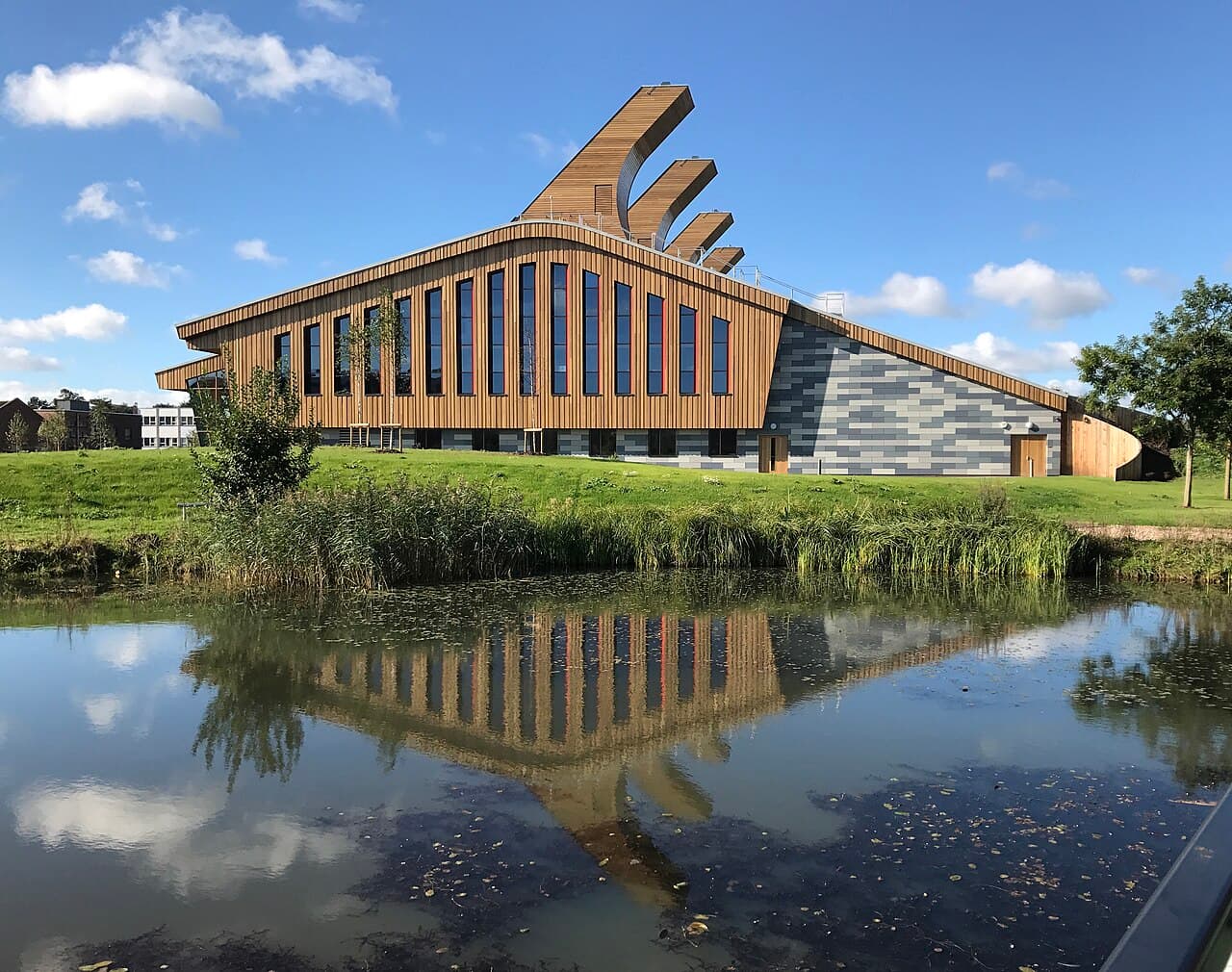
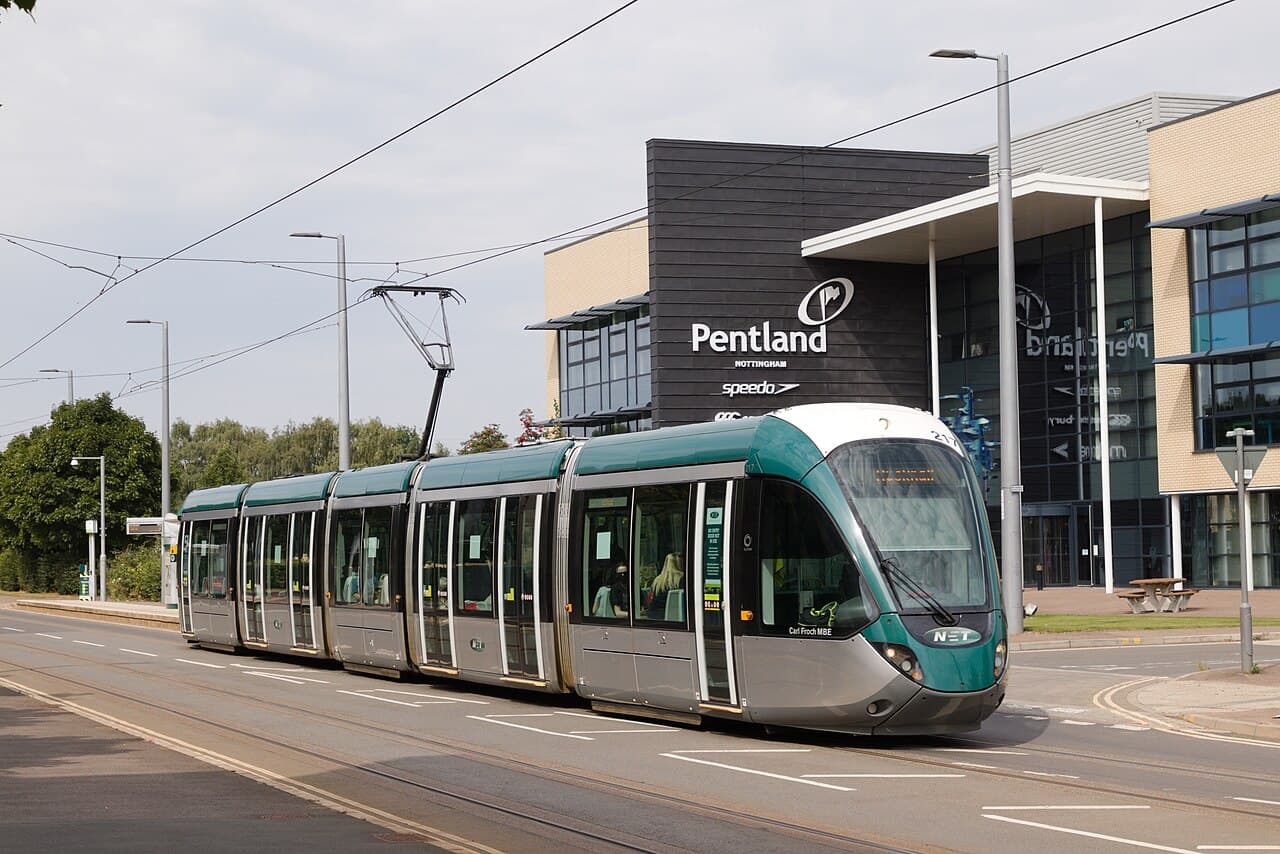
The city is served by Nottingham railway station and the Nottingham Express Transit tram system; its bus company, Nottingham City Transport, is the largest publicly owned bus network in England. In December 2015, Nottingham was named a 'City of Literature' by UNESCO, joining a list of 20 Cities of Literature. The title reflects Nottingham's literary heritage, with Lord Byron, D. H. Lawrence and Alan Sillitoe having links to the city, as well as a contemporary literary community, a publishing industry and a poetry scene. The city is served by three universities: the University of Nottingham, Nottingham Trent University and the Nottingham campus of the University of Law; it hosts the highest concentration of higher education providers in the East Midlands.
Toponymy
The name Nottingham comes from the Old English Snotingaham, meaning "homestead of the Snotingas" (that is, "the family or followers of a man called Snot"). The loss of the initial S is due to Norman influence. In his Life of King Alfred, the Welsh cleric Asser refers to Nottingham as Tigguocobauc (modern Welsh Tŷ Gogofawg), meaning "cave house". It is unclear, however, whether this is a genuine Welsh name for Nottingham or an invention of Asser's.
History
The written history of Nottingham dates back to 919 AD, when Edward the Elder captured the settlement, subsequently building a fortress on the south bank of the Trent. Following the Norman Conquest William the Conqueror built a castle in Nottingham, which he entrusted to William Peverel.
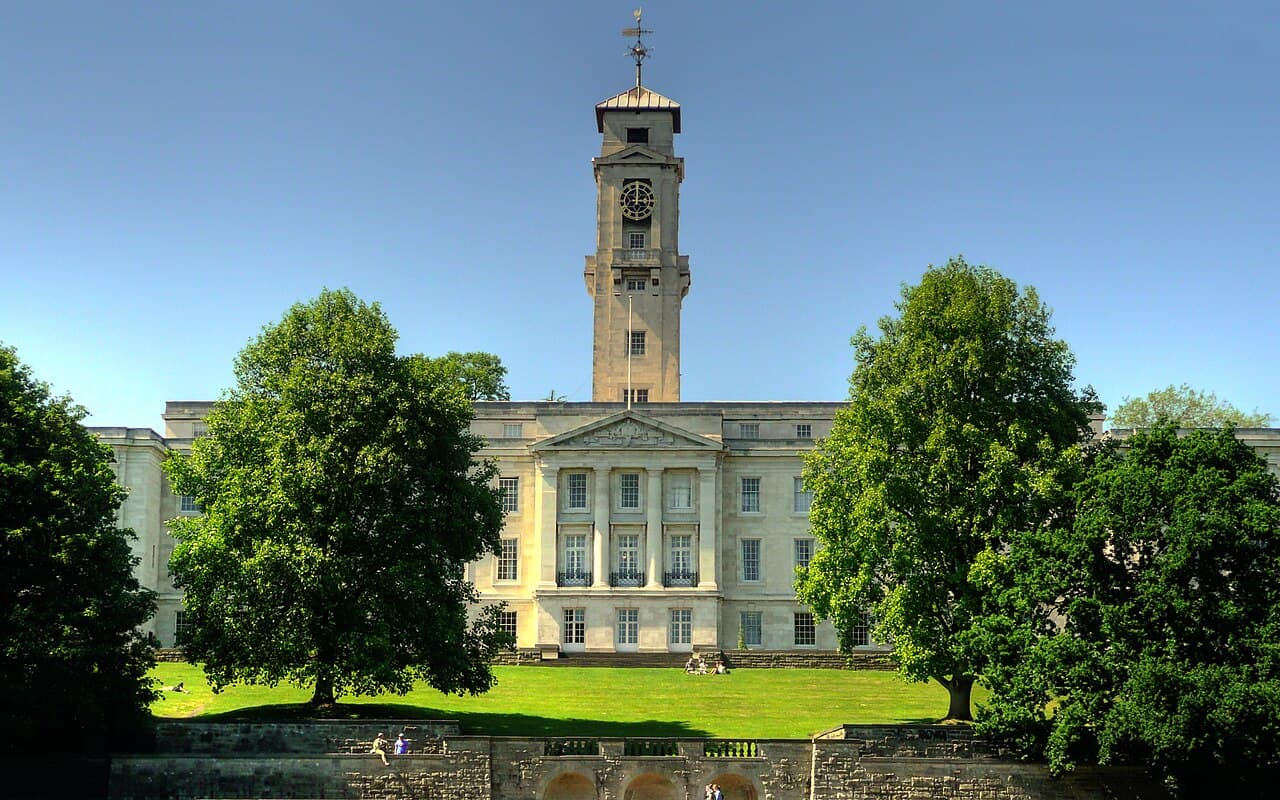
The Anglo-Saxon settlement was originally confined to the area today known as the Lace Market and was surrounded by a substantial defensive ditch and rampart. The ditch had fallen out of use and been filled in by the time of Domesday Book (1086). Following the Norman Conquest,the Saxon settlement developed into the "English Borough" of Nottingham. A "French Borough" also developed around the castle on the hill opposite. Eventually the space between was built on as the town grew and the Old Market Square became the focus of Nottingham. Defences consisted initially of a ditch and bank in the early 12th century. The ditch was widened in the mid-13th century and a stone wall built around much of the perimeter of the town. A short length of the wall survives and is visible at the northern end of Maid Marian Way. It is protected as a Scheduled Monument.
On the return of Richard the Lionheart from the Crusades in 1194, the castle was occupied by supporters of Prince John, including the Sheriff of Nottingham. It was besieged by Richard and after a sharp conflict was captured.
In the legends of Robin Hood, Nottingham Castle is the scene of the final showdown between the sheriff and the hero outlaw.
It is believed that during the Black Death of 1349 approximately 60% of Nottingham's population died but that migration from other parts of England helped begin the process of population recovery.
By the 15th century Nottingham had established itself as the centre of a thriving export trade in religious sculpture made from Nottingham alabaster. During the late medieval period Nottingham alabasters were exported as far afield as Iceland and may be one reason why a small number of Icelandic immigrants lived in Nottingham during the 15th century. The town became a county corporate in 1449, giving it effective self-government, in the words of the charter, "for eternity". The Castle and Shire Hall were expressly excluded and remained as detached parishes of Nottinghamshire.
One of those highly impressed by Nottingham in the late 18th century was the German traveller C. P. Moritz, who wrote in 1782, "Of all the towns I have seen outside London, Nottingham is the loveliest and neatest. Everything had a modern look, and a large space in the centre was hardly less handsome than a London square. A charming footpath leads over the fields to the highway, where a bridge spans the Trent. … Nottingham … with its high houses, red roofs and church steeples, looks excellent from a distance."
During the Industrial Revolution much of Nottingham's prosperity was founded on the textile industry; in particular the city became an internationally important centre of lace manufacture. In 1831 citizens rioted in protest against the Duke of Newcastle's opposition to the Reform Act 1832, setting fire to his residence on the site of Nottingham Castle.
In common with the rest of the British textile industry Nottingham's textile sector fell into decline in the decades following the Second World War. Little textile manufacture now takes place in Nottingham; however many of the former industrial buildings in the Lace Market district have been restored and put to new uses.
Nottingham was one of the boroughs reformed by the Municipal Corporations Act 1835 and at that time consisted of the parishes of St Mary, St Nicholas and St Peter. It was expanded in 1877 by the addition of the parishes of Basford, Brewhouse Yard, Bulwell, Radford, Sneinton, Standard Hill and parts of the parishes of West Bridgford, Carlton and Wilford (North Wilford). In 1889 Nottingham became a county borough under the Local Government Act 1888. City status was awarded as part of Queen Victoria's Diamond Jubilee celebrations and conveyed in a letter dated 18 June 1897 from the prime minister, the Marquess of Salisbury, to the mayor.
The city was enlarged in 1933 by the addition of Bilborough and Wollaton, parts of the parishes of Bestwood Park and Colwick and a recently developed part of the Beeston Urban District. A further boundary extension occurred in 1951 when Clifton and Wilford (south of the River Trent) were incorporated into the city.
Electric trams were introduced to the city in 1901; they served the city for 35 years until 1936. Trams were reintroduced after 68 years when a new network opened in 2004.
In the sporting world, Nottingham is home to the world's oldest professional football club, Notts County, which was formed in 1862. The town's other football club, Nottingham Forest, had a period of success between 1977 and 1993 under manager Brian Clough, winning the First Division, four League Cups, a UEFA Super Cup and two European Cups. During this time Forest signed Trevor Francis, Britain's first £1 million footballer, who joined the club in February 1979 from Birmingham City.
The city was the site of race riots in 1958, centred on the St Ann's neighbourhood.
During the second half of the 20th century Nottingham saw urban growth with the development of new public and private housing estates and new urban centres, which have engulfed former rural villages such as Bilborough, Wollaton, Gedling and Bramcote. South of the river there has also been expansion with new areas such as Edwalton and West Bridgford, adding to Nottingham's urban sprawl. Although this growth slowed towards the end of the century the modern pressures for more affordable and council housing are back on the political agenda and there is now pressure on the green belt that surrounds the city.
Governance
Local government
Nottingham City Council is a unitary authority and is based at Loxley House on Station Street. It consists of 55 councillors, representing 20 wards, who are elected every four years; the last elections were held on 4 May 2023. The council is independent of Nottinghamshire County Council but works with them for local developments and other matters. Nottingham remains the county town of Nottinghamshire, even though the county hall is in the neighbouring town of West Bridgford, where the county council is based. Since May 2024, the city has been a constituent member of the East Midlands Combined County Authority with a regional mayor.
The city also has a Lord Mayor who is selected by city councillors from among themselves. The position is largely ceremonial but the Lord Mayor also acts as Chair of Full Council meetings.
The City of Nottingham's boundaries are tightly drawn and exclude several suburbs and towns that are usually considered part of Greater Nottingham. Unlike the city, these areas are governed by a two tier system of local government. Nottinghamshire County Council is based at the county hall. It provides the upper tier of local government whilst the lower tier is split into several district or borough councils. The County Council are responsible for Health, Social Care, Education, Highways, Transport, Libraries and Trading Standards, whilst the lower tier councils are responsible for local planning, neighbourhood services, housing, licensing, environmental health and leisure facilities. The towns of Beeston, Stapleford and Eastwood are administered by Broxtowe Borough Council. Further west still, the Nottingham urban district extends into Derbyshire where Ilkeston and Long Eaton are administered by Erewash Borough Council, and Ripley by Amber Valley. To the north, Hucknall is governed by Ashfield District Council, while in the east Arnold and Carlton form part of the Borough of Gedling. South of the river, the town of West Bridgford lies in Rushcliffe, as do the outlying villages of Ruddington and Tollerton and the town of Bingham.
UK Parliament
Nottingham has three UK parliamentary constituency seats within its boundaries. Nottingham North has been represented since 2017 by Labour Member of Parliament (MP) Alex Norris, Nottingham East since 2019 by Labour MP Nadia Whittome and Nottingham South since 2010 by Labour MP Lilian Greenwood. Each of the outer districts (Broxtowe, Ashfield, Gedling and Rushcliffe) are also parliamentary constituencies in their own right although the parliamentary constituency boundaries do not align with the boundaries of the council districts of which they share their name.
Geography
Nottingham is situated on an area of low hills along the lower valley of the River Trent, and is surrounded by the Sherwood Forest in the north, the Nottinghamshire, Derbyshire and Yorkshire Coalfield in the west, and the Trent and Belvoir Vales in the east and south. The city is around 10–11 miles (16–18 km) north to south.
Within the city native wildlife includes red fox, peregrine falcon and common kingfisher. Notable nature reserves around the city include Attenborough Nature Reserve SSSI, Sherwood Forest National Nature Reserve, Holme Pit SSSI, Fairham Brook Local Wildlife Site and Wollaton Park. Owing to its position as a central city with strong transport links, Nottingham has become home to invasive animal and plant species including rose-ringed parakeet, Japanese knotweed and Himalayan balsam.
In 2017, it was reported that Nottingham was one of a number of UK cities that broke WHO air pollution guidelines for the maximum concentration of small particulate matter, the pollution in part being caused by wood-burning stoves.
Nottingham is bounded by a green belt, provisionally drawn up from the 1950s. Completely encircling the city, it extends for several miles into the surrounding districts as well as towards Derby.
Within the city
Around the city
Climate
Like most of the United Kingdom, Nottingham has a temperate oceanic climate (Köppen: Cfb) and experiences warm mild summers and mild to cool winters with abundant precipitation throughout the year. There are two weather-reporting stations close to Nottingham: the former "Nottingham Weather Centre", at Watnall, about 6 miles (10 km) northwest of the city centre; and the University of Nottingham's agricultural campus at Sutton Bonington, about 10 miles (16 km) southwest of the city centre. The highest temperature recorded in Nottingham (Watnall) stands at 39.8 °C (103.6 °F), whilst Sutton Bonington recorded a temperature of 39.4 °C (102.9 °F), both recorded on 19 July 2022, and the record-high minimum temperature is 20.3 °C (68.5 °F) recorded on 20 July 2022. On average, a temperature of 25 °C (77 °F) or above is recorded on 11 days per year, whilst a temperature of 30 °C (86 °F) is recorded at least 1 day per year at Watnall for the period of 1991–2020, and the warmest day of the year reaches an average of 30.0 °C (86.0 °F).
For the period 1991–2020 Nottingham (Watnall) recorded on average 36.9 days of air frost per year, and Sutton Bonington 42.2. The lowest recorded temperature in Nottingham (Watnall) is −13.3 °C (8.1 °F) recorded on 23 January 1963 and 13 January 1987, whilst a temperature of −17.8 °C (0.0 °F) was recorded in Sutton Bonington on 24 February 1947. The record-low maximum temperature is −6.3 °C (20.7 °F) recorded in January 1963. For the period of 1991–2020, the coldest temperature of the year reaches an average of −5.5 °C (22.1 °F) in Nottingham (Watnall).
City centre
The city centre of Nottingham is usually defined as the Old Market Square. The square is dominated by the Council House, which was built in the 1920s to replace the Nottingham Exchange. The Council House has baroque columns and two stone lion statues in the front to stand watch over the square. The Exchange Arcade, on the ground floor, is a shopping centre.
Tall office buildings line Maid Marian Way. The Georgian area around Oxford and Regent Streets is dominated by small professional firms. The Albert Hall faces the Gothic revival St Barnabas' Roman Catholic Cathedral by Pugin. Nottingham Castle and its grounds are located further south in the western third of the city. The central third descends from the university district in the north, past Nottingham Trent University's Gothic revival Arkwright Building. The university also owns many other buildings in this area.
The Theatre Royal on Theatre Square, with its pillared façade, was built in 1865. King and Queen Streets are home to striking Victorian buildings designed by such architects as Alfred Waterhouse and Watson Fothergill.
The eastern third of the city contains Hockley Village, with specialist and independent shops. The Victoria Centre is also in the area; it was built in the 1970s on the demolished Victoria railway station site. All that remains of the old station is the station hotel and clock tower. The 250-foot-high Victoria Centre flats stand above the shopping centre and are the tallest buildings in the city.
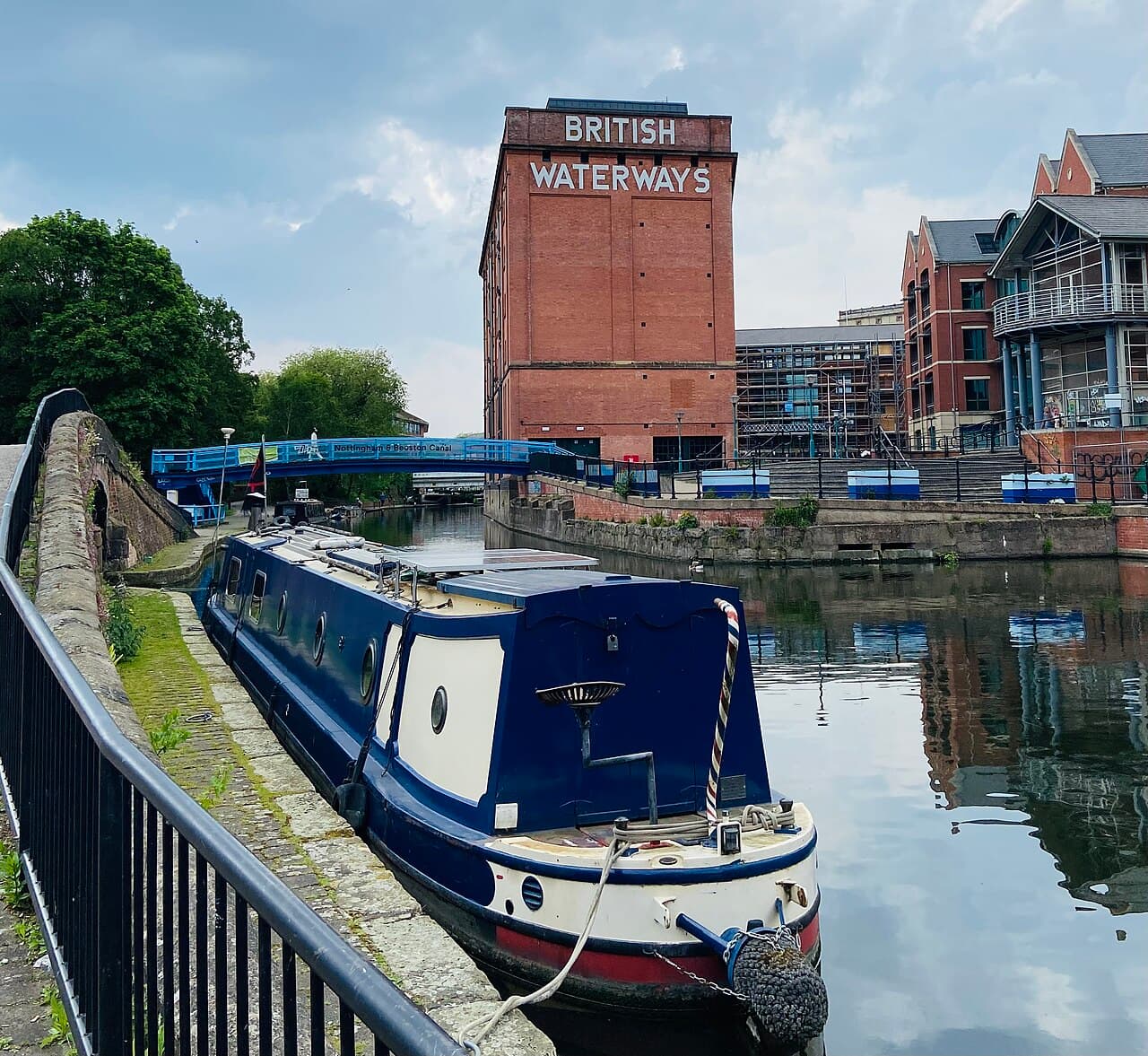
The canal-side to the south of the city is adjacent to Nottingham railway station and home to multiple repurposed (as bars and restaurants) 19th-century industrial buildings.
Lace Market
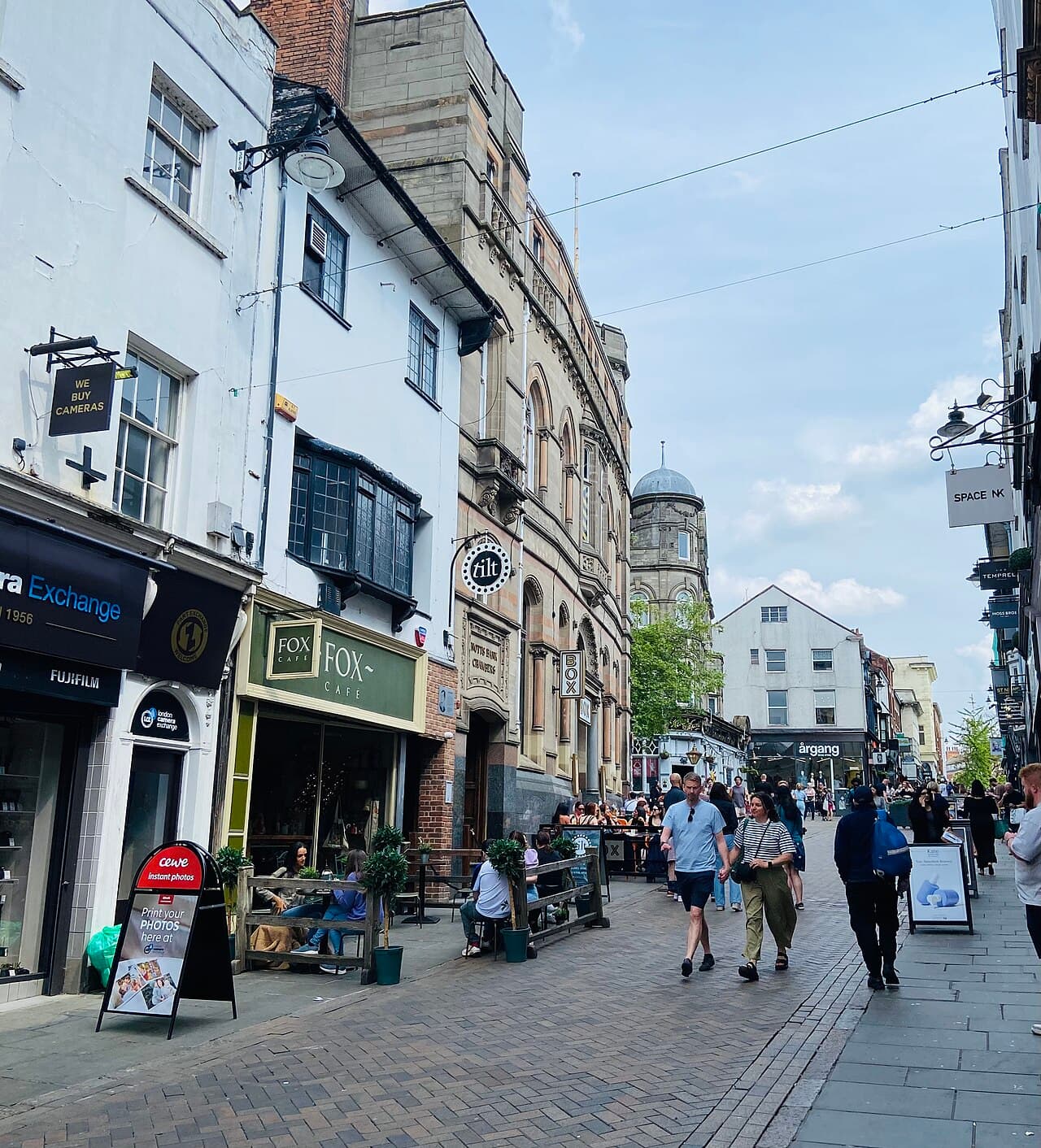
The Lace Market area just south of Hockley has streets with four- to seven-storey red brick warehouses, iron railings and red phone boxes.
Many of the buildings have been converted into apartments, bars and restaurants. The largest building in the Lace Market is the Adams Building, built by Thomas Chambers Hine for Thomas Adams (1807–1873), and currently used by Nottingham College. The Georgian-built Shire Hall, which was once Nottingham's main court and prison building, is now home to the National Justice Museum (formerly the "Galleries of Justice").
Public houses
Ye Olde Trip To Jerusalem (the Trip), partially built into the cave system beneath Nottingham Castle, is a contender for the title of England's Oldest Pub, as it is supposed to have been established in 1189.
The Bell Inn in the Old Market Square and Ye Olde Salutation Inn (the Salutation) in Maid Marian Way have both disputed this claim. The Trip's current timber building probably dates back to the 17th or 18th century but the caves are certainly older and may have been used to store beer and water for the castle during medieval times. There are also caves beneath the Salutation that date back to the medieval period, although they are no longer used as beer cellars. The Bell Inn is probably the oldest of the three pub buildings still standing, according to dendrochronology, and has medieval cellars that are still used to store beer.
Education
Almost 62,000 students attend the city's three universities, Nottingham Trent University, the University of Law and the University of Nottingham; in the 2016/17 academic year, Trent University was attended by 29,370 students and Nottingham University by 32,515. The University of Nottingham Medical School is part of the Queen's Medical Centre.
There are three colleges of further education in Nottingham: Bilborough College is solely a sixth form college; Nottingham College was formed in 2017 by the amalgamation of Central College Nottingham and New College Nottingham (which had both previously formed from the merger of smaller FE colleges); and the Confetti Institute of Creative Technologies, owned by Nottingham Trent University, is a further-education college that specialises in media. The city has dozens of sixth-form colleges and academies, providing education and training for adults aged over sixteen.
Nottingham also has a number of independent schools. The city's oldest educational establishment is Nottingham High School, a day school founded in 1513. The school used to be for boys only but became coeducational in 2015. Nottingham Girls' High School is another independent school but for girls only. Founded in 1875, it is now part of the Girls' Day School Trust (GDST).
Museums
The city contains several notable museums including:
National Justice Museum – Museum of Law, Crime and Punishment through the ages, based at the Shire Hall in the Lace Market.
City of Caves – A visitor attraction consisting of a network of man-made caves, carved out of sandstone, beneath the Broadmarsh.
Green's Mill, Sneinton and Science Centre – A unique working windmill in the heart of the city, which was home to the 19th-century mathematical physicist and miller George Green.