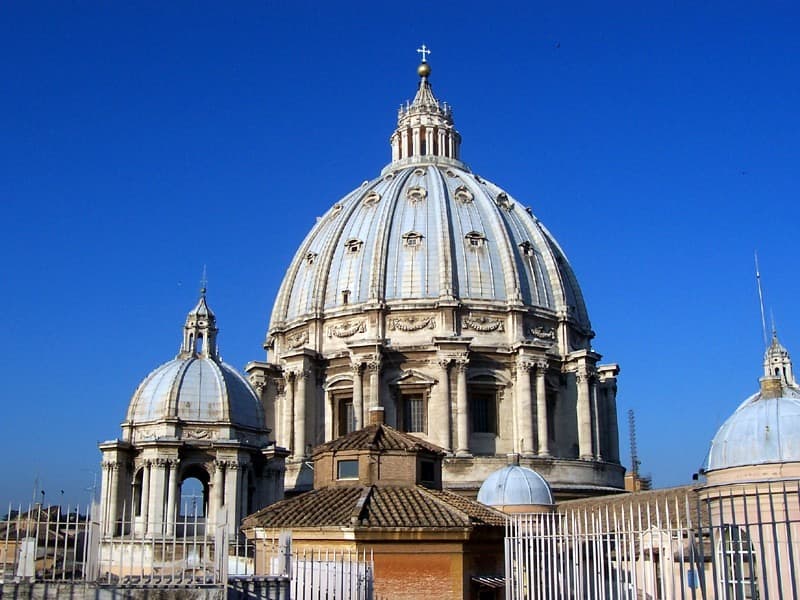
Saint Peter (born Shimon bar Yonah; c. 1 BC – AD 64/68), also known as Peter the Apostle and Simon Peter, was one of the Twelve Apostles of Jesus and one of the first leaders of the early Christian Church. He appears repeatedly and prominently in all four New Testament gospels, as well as the Acts of the Apostles. Catholic and Orthodox tradition treats Peter as the first bishop of Rome – or pope – and also as the first bishop of Antioch. According to Christian tradition, Peter was crucified in Rome under Emperor Nero.
The ancient Christian churches venerate Peter as a major saint and the founder of the Church of Antioch and the Church of Rome, but they differ in their attitudes regarding the authority of his successors. According to Catholic teaching, Jesus promised Peter a special position in the Church. In the New Testament, the name "Simon Peter" is found 19 times. He is the brother of Andrew, and they both were fishermen. The Gospel of Mark, in particular, is traditionally thought to show the influence of Peter's preaching and eyewitness accounts. He is also mentioned as Peter or Cephas in Paul's First Letter to the Corinthians and the Epistle to the Galatians. The New Testament also includes two general epistles, First Peter and Second Peter, which are traditionally attributed to him, but modern scholarship generally rejects the Petrine authorship of both.
Outside of the New Testament, several apocryphal books were later attributed to him, in particular the Acts of Peter, Gospel of Peter, the Preaching of Peter, Apocalypse of Peter, and Judgment of Peter, although scholars believe these works to be pseudepigrapha.
Although the New Testament does not explicitly identify Peter as the first bishop of Rome or detail his journey there, early Church Fathers and historians, including Irenaeus, Tertullian, Hegesippus, Clement of Alexandria, Lactantius, and Eusebius attest that Peter spent his closing years in Rome, and along with Paul founded the Church in Rome and conferred the episcopal office upon Linus. These accounts also maintain that Peter was martyred in Rome, traditionally on Vatican Hill during Nero's reign. The late second-century writer Caius further testified that the monuments of Peter were located at the Vatican.
Reading level
Audio Summary
Played with your browser's voice. Studio-quality audio can be added with a text-to-speech service.
Ask about this article
📝 Quick Quiz1 / 2
What is "Saint Peter" primarily known for?
Vocix Daily — In Your Inbox
Top stories, deep-dive articles, and "On This Day" history — one crisp digest delivered every morning.
Sources & references
Reference material for this entry is drawn from the open encyclopedic record, including Wikipedia , available under the CC BY-SA 4.0 license. Images are credited individually beside each photo.
Names and etymologies
The New Testament presents Peter's original name as Simon ( ; Σίμων, Simōn in Greek). In only two passages, his name is instead spelled "Simeon" (Συμεών in Greek). The variation possibly reflects "the well-known custom among Jews at the time of giving the name of a famous patriarch or personage of the Old Testament to a male child [i.e., Simeon], along with a similar-sounding Greek/Roman name [in this case, Simon]".
He was later given by Jesus the name Cephas (), from the Aramaic כֵּיפָא, Kepha, 'rock/stone'. In translations of the Bible from the original Greek, his name is maintained as Cephas in nine occurrences in the New Testament, whereas in the vast majority of mentions (156 occurrences in the New Testament), he is called Πέτρος, Petros, a masculinized form derived from the root of πέτρα (petra), adapted to serve as a masculine proper name.
The precise meaning of the Aramaic word is disputed, some saying that the
usual meaning is "rock" or "crag", others saying that it means rather "stone" and, particularly in its application by Jesus to Simon, like a "jewel", but most scholars agree that as a proper name, it denotes a rough or tough character. Both meanings, "stone" (jewel or hewn stone) and "rock", are indicated in dictionaries of Aramaic and Syriac.
Catholic theologian Rudolf Pesch argues that the Aramaic word would mean "precious stone" to designate a distinguished person. This cannot be sufficiently proven from Aramaic, however, since the use of the Aramaic root kp as a personal name has not been proven, and there are hardly any known examples of the word being used to mean "precious stone".
The combined name Σίμων Πέτρος (Símon Pétros, Simon Peter) appears 19 times in the New Testament. In some Syriac documents, he is called, in English translation, Simon Cephas.
Biographical information
Accounts
Peter was a Jewish fisherman born in Bethsaida. He was named Simon, the son of a man named Jonah or John. The three Synoptic Gospels recount how Peter's mother-in-law was healed by Jesus at their home in Capernaum; these passages depict Peter as being married or widowed. First Corinthians 9:5 has also been taken to imply that he was married.
In the synoptic gospels, Peter (then Simon) was a fisherman along with his brother Andrew and the sons of Zebedee, James and John. The Gospel of John also depicts Peter fishing, even after the resurrection of Jesus, in the story of the catch of 153 fish. In Matthew and Mark, Jesus called Simon and his brother Andrew to be "fishers of men".
In the Confession of Peter, he proclaims Jesus to be the Christ (Jewish Messiah), as described in the three synoptic gospels. It is there, in the area of Caesarea Philippi, that he receives from Jesus the name Cephas (Aramaic Kepha), or Peter (Greek Petros).
In Luke, Simon Peter owns the boat that Jesus uses to preach to the multitudes who are pressing on him at the shore of Lake Gennesaret. Jesus then amazes Simon and his companions, James and John (Andrew is not mentioned) by telling them to lower their nets, whereupon they catch a huge number of fish. Immediately after this, they follow him.
The Gospel of John gives a comparable account of "The First Disciples". In John, the readers are told that it was two disciples of John the Baptist (Andrew and an unnamed disciple) who heard John the Baptist announce Jesus as the "Lamb of God" and then followed Jesus. Andrew then goes to his brother Simon, saying, "We have found the Messiah", and then brings Simon to Jesus, who immediately names him as "Cephas".
Three of the four Gospels—Matthew, Mark, and John – recount the story of Jesus walking on water. Matthew additionally describes Peter walking on water for a moment but beginning to sink when his faith wavers.
At the beginning of the Last Supper, Jesus washed his disciples' feet. Peter initially refused to let Jesus wash his feet, but when Jesus told him: "If I wash thee not, thou hast no part with me", Peter replied: "Lord, not my feet only, but also my hands and my head". The washing of feet is often repeated in the service of worship on Maundy Thursday by some Christian denominations.
The three synoptic gospels all mention that, when Jesus was arrested, one of his companions cut off the ear of a servant of the High Priest of Israel. The Gospel of John also includes this event and names Peter as the swordsman and Malchus as the victim. Luke adds that Jesus touched the ear and miraculously healed it. This healing of the servant's ear is the last of the 37 miracles attributed to Jesus in the Bible.
Simon Peter was twice arraigned, along with John, before the Sanhedrin and directly defied them. Peter took a missionary journey to Lydda, Joppa, and Caesarea. At Joppa, Peter had a vision given to him from God which allowed the eating of previously unclean animals, leading the early believers to the decision to evangelise the Gentiles. Simon Peter applied the message of the vision on clean animals to the gentiles and follows his meeting with Cornelius the Centurion by claiming that "God shows no partiality".
According to the Acts of the Apostles, Peter and John were sent from Jerusalem to Samaria. Peter/Cephas is mentioned briefly in the opening chapter of one of the Pauline epistles, Epistle to the Galatians, which mentions a trip by Paul the Apostle to Jerusalem where he meets Peter. Peter features again in Galatians, fourteen years later, when Paul (now with Barnabas and Titus) returned to Jerusalem. When Peter came to Antioch, Paul opposed Peter to his face "because he [Peter] was in the wrong".
Acts 12 narrates how Peter, who was in Jerusalem, was imprisoned by Herod Agrippa (reigned AD 42–44) but was rescued by an angel. After his liberation Peter left Jerusalem to go to "another place". Concerning Peter's subsequent activity there is no further connected information from the extant sources, although there are short notices of certain individual episodes of his later life.
Peter's wife
The synoptic gospels mention that Peter had a mother-in-law at the time he joined Jesus and that Jesus healed Peter's mother-in-law. However, the gospels give no information about his wife. Clement of Alexandria claimed that Peter's wife was executed for her faith by the Roman authorities but he did not specify any date or location. Another opinion states that Peter's wife was no longer alive at the time he met Jesus, so he was a widower.
First leader of the early Church
The Gospels and Acts portray Peter as the most prominent apostle, though he denied Jesus three times during the events of the crucifixion. According to the Christian tradition, Peter was the first disciple to whom Jesus appeared, balancing Peter's denial and restoring his position. Peter is regarded as the first leader of the early Church, though he was soon eclipsed in this leadership by James the Just, "the brother of the Lord". Because Peter was the first to whom Jesus appeared, the leadership of Peter forms the basis of the Apostolic succession and the institutional power of orthodoxy, as the heirs of Peter, and he is described as "the rock" on which the church will be built.
Position among the apostles
Peter is always listed first among the Twelve Apostles in the Gospels and in the Book of Acts. Along with James the Elder and John he formed an informal triumvirate within the Twelve Apostles. Jesus allowed them to be the only apostles present at three particular occasions during his public ministry, the Raising of Jairus' daughter, Transfiguration of Jesus and Agony in the Garden of Gethsemane. Peter often confesses his faith in Jesus as the Messiah.
Peter is often depicted in the gospels as spokesman of all the Apostles. John Vidmar, a Catholic scholar, writes: "Catholic scholars agree that Peter had an authority that superseded that of the other apostles. Peter is their spokesman at several events, he conducts the election of Matthias, his opinion in the debate over converting Gentiles was crucial, etc".
The author of the Acts of the Apostles portrays Peter as the central figure within the early Christian community.
Denial of Jesus by Peter
All four canonical gospels recount that, during the Last Supper, Jesus foretold that Peter would deny him three times before the following cockcrow ("before the cock crows twice" in Mark's account). The three Synoptics and John describe the three denials as follows:
A denial when a female servant of the high priest spots Simon Peter, saying that he had been with Jesus. According to Mark (but not in all manuscripts), "the rooster crowed". Only Luke and John mention a fire by which Peter was warming himself among other people: according to Luke, Peter was "sitting"; according to John, he was "standing";
A denial when Simon Peter had gone out to the gateway, away from the firelight, but the same servant girl (per Mark) or another servant girl (per Matthew) or a man (per Luke and also John, for whom, though, this is the third denial) told the bystanders he was a follower of Jesus. According to John, "the rooster crowed". The Gospel of John places the second denial while Peter was still warming himself at the fire and gives as the occasion of the third denial a claim by someone to have seen him in the garden of Gethsemane when Jesus was arrested;
A denial came when Peter's Galilean accent was taken as proof that he was indeed a disciple of Jesus. According to Matthew, Mark and Luke, "the rooster crowed". Matthew adds that it was his accent that gave him away as coming from Galilee. Luke deviates slightly from this by stating that, rather than a crowd accusing Simon Peter, it was a third individual. John does not mention the Galilean accent.
In the Gospel of Luke is a record of Christ telling Peter: "Simon, Simon, behold, Satan hath desired to have you, that he may sift you as wheat: but I have prayed for thee, that thy faith fail not: and when thou art converted, strengthen thy brethren". In a reminiscent scene in John's epilogue, Peter affirms three times that he loves Jesus.
Resurrection appearances
Paul's First Epistle to the Corinthians contains a list of resurrection appearances of Jesus, the first of which is an appearance to Peter. Here, Paul apparently follows an early tradition that Peter was the first to see the risen Christ, which, however, did not seem to have survived to the time when the gospels were written.
In John's gospel, Peter is the first person to enter the empty tomb, although the women and the beloved disciple see it before him. In Luke's account, the women's report of the empty tomb is dismissed by the apostles, and Peter is the only one who goes to check for himself, running to the tomb. After seeing the graveclothes, he goes home, apparently without informing the other disciples.
In the final chapter of the Gospel of John, Peter, in one of the resurrection appearances of Jesus, three times affirmed his love for Jesus, balancing his threefold denial, and Jesus reconfirmed Peter's position. The Church of the Primacy of St. Peter on the Sea of Galilee is seen as the traditional site where Jesus Christ appeared to his disciples after his resurrection and, according to Catholic tradition, established Peter's supreme jurisdiction over the Christian church.
Leader of the early Church
Peter was considered along with James the Just and John the Apostle as the three Pillars of the Church. Legitimised by Jesus' appearance, Peter assumed leadership of the group of early followers, forming the Jerusalem ekklēsia mentioned by Paul. He was soon eclipsed in this leadership by James the Just, "the Brother of the Lord". According to Lüdemann, this was due to the discussions about the strictness of adherence to the Jewish Law, when the more conservative faction of James the Just took the overhand over the more liberal position of Peter, who soon lost influence. According to Methodist historian James D. G. Dunn, this was not "usurpation of power", but a consequence of Peter's involvement in missionary activities. The early Church historian Eusebius (c. 325) records Clement of Alexandria (c. 190) as saying:
For they say that Peter and James (the Greater) and John after the ascension of our Saviour, as if also preferred by our Lord, strove not after honor, but chose James the Just bishop of Jerusalem.
Dunn proposes that Peter was a "bridge-man" between the opposing views of Paul and James the Just [italics original]:
For Peter was probably in fact and effect the bridge-man (pontifex maximus!) who did more than any other to hold together the diversity of first-century Christianity. James the brother of Jesus and Paul, the two other most prominent leading figures in first-century Christianity, were too much identified with their respective "brands" of Christianity, at least in the eyes of Christians at the opposite ends of this particular spectrum.
Paul affirms that Peter had the special charge of being apostle to the Jews, just as he, Paul, was apostle to the Gentiles. Some argue James the Just was bishop of Jerusalem whilst Peter was bishop of Rome and that this position at times gave James privilege in some (but not all) situations.
"Rock" dialogue
In a dialogue between Jesus and his disciples (Matthew 16:13–19), Jesus asks, "Who do people say that the Son of Man is?" The disciples give various answers. When he asks, "Who do you say that I am?", Simon Peter answers, "You are the Messiah, the Son of the living God". Jesus then declares:
Blessed are you, Simon son of Jonah, for this was not revealed to you by flesh and blood, but by my Father in heaven. And I tell you that you are Cephas (Peter) (Petros), and on this rock (petra) I will build my church, and the gates of Hades will not overcome it. I will give you the keys of the kingdom of heaven; whatever you bind on earth will be bound in heaven, and whatever you loose on earth will be loosed in heaven.
A common view of Peter is provided by Jesuit Father Daniel J. Harrington, who suggests that Peter was an unlikely symbol of stability. While he was one of the first disciples called and was the spokesman for the group, Peter is also the exemplar of "little faith". In Matthew 14, Peter will soon have Jesus say to him, "O you of little faith, why did you doubt?", and he will eventually deny Jesus three times. Thus, in light of the Easter event, Peter became an exemplar of the forgiven sinner. Outside the Catholic Church, opinions vary as to the interpretation of this passage with respect to what authority and responsibility, if any, Jesus was giving to Peter.
In the Eastern Orthodox Church this passage is interpreted as not implying a special prominence to the person of Peter, but to Peter's position as representative of the Apostles. The word used for "rock" (petra) grammatically refers to "a small detachment of the massive ledge", not to a massive boulder. Thus, Orthodox Sacred Tradition understands Jesus' words as referring to the apostolic faith.
Petros had not previously been used as a name, but in the Greek-speaking world it became a popular Christian name after the tradition of Peter's prominence in the early Christian church had been established.
In 1 Corinthians 10:4 Apostle Paul says the spiritual rock (petra) was Christ:
They all ate the same spiritual food and drank the same spiritual drink; for they drank from the spiritual rock that accompanied them, and that rock was Christ (hē petra de ēn ho Christos).
The Matthew-Corinthians connection here is confessed by Jerome's Commentary on Matthew and by Augustine, the "greatest of the Latin fathers":
Let us call to mind the Gospel: "Upon this Rock I will build My Church" (Matthew 16:18). Therefore She cries from the ends of the earth, whom He has willed to be built upon a Rock. But in order that the Church might be built upon the Rock, who was made the Rock? Hear Paul saying: "But the Rock was Christ". On Him therefore built we have been.
Apostolic succession
Catholic and Orthodox sources argue that the leadership of Peter forms the basis of the Apostolic succession and the institutional power of orthodoxy, as the heirs of Peter. Catholics refer to him as chief of the Apostles, as do the Eastern Orthodox and the Oriental Orthodox. In Coptic Orthodox Church liturgy, he is once referred to as "prominent" or "head" among the Apostles, a title shared with Paul in the text (The Fraction of Fast and Feast of the Apostles Peter and Paul in the Coptic Orthodox Church of Alexandria). Some, including the Orthodox Churches, believe this is not the same as saying that the other Apostles were under Peter's orders.