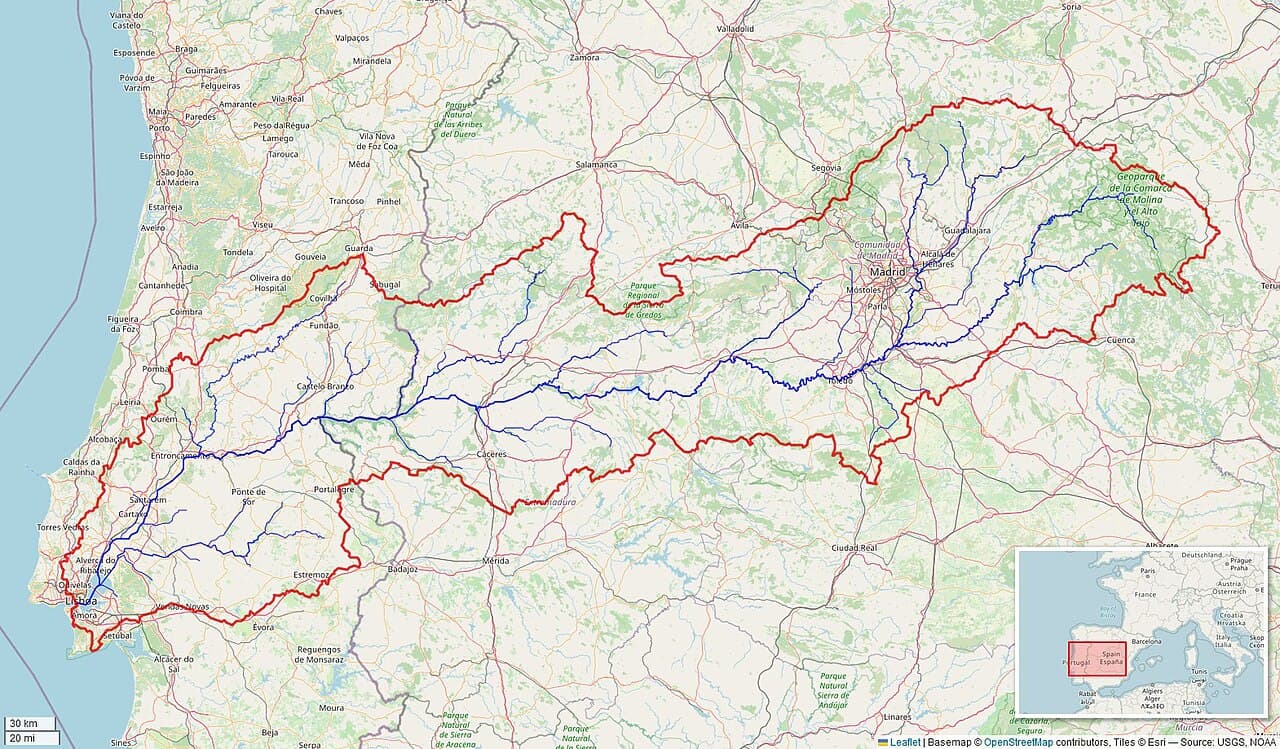
The Tagus ( TAY-gəs; Spanish: Tajo [ˈtaxo] ; Portuguese: Tejo [ˈtɛʒu]) is the longest river in the Iberian Peninsula. The river rises in the Montes Universales between Cuenca and Teruel, in mid-eastern Spain, flows 1,007 km (626 mi), generally westward, and empties into the Atlantic Ocean at Lisbon.
Name
The river's Latin name is Tagus. While the etymology is unclear, the most probable etymological origin for the hydronym Tagus is Indo-European *(s)tag- ('to drip').
Geography
Source
The Tagus River originates at an elevation of 1,593 meters above sea level in a place known as Fuente García, within the municipality of Frías de Albarracín in Teruel, Spain. Its source is located between the Muela de San Juan (1,830 m) and Cerro de San Felipe (1,839 m), in the Sierra de Albarracín, which belongs to the Montes Universales in the western branch of the Iberian System.
Course
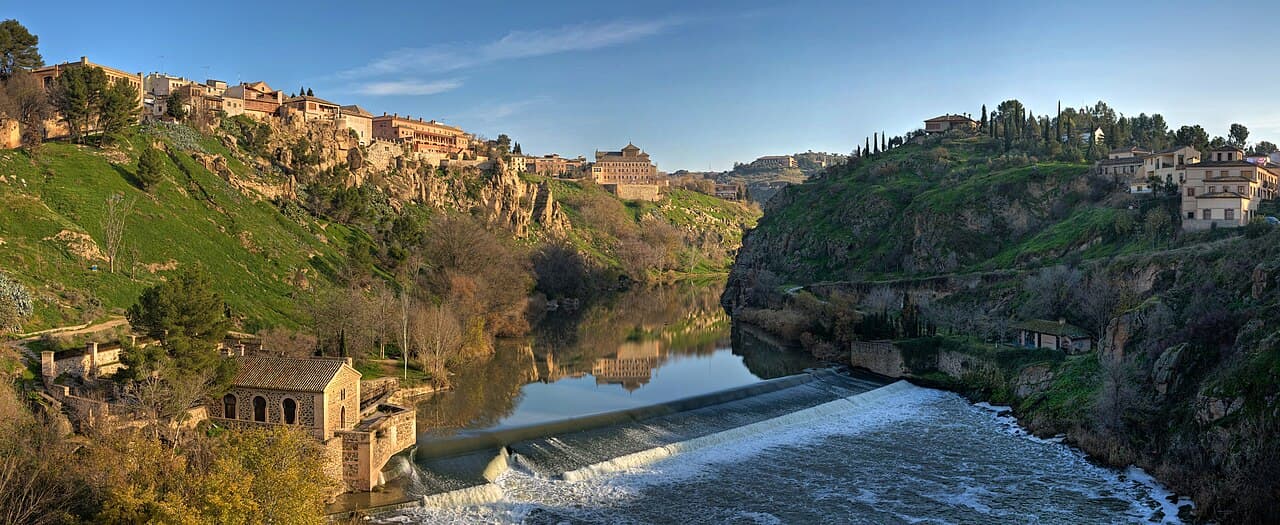
The river flows through Spain for 816 km (507 mi), passing through four autonomous communities (Aragón, Castilla-La Mancha, Madrid, and Extremadura) and a total of six provinces (Teruel, Guadalajara, Cuenca, Madrid, Toledo, and Cáceres). After forming a 47 km (29 mi) border between Spain and Portugal, it enters Portugal. In Portugal, it flows for 145 km (90 mi) through the traditional regions of Beira Baixa, Alto Alentejo, Ribatejo, and Estremadura, which include the districts of Castelo Branco, Portalegre, Santarém, Lisbon, and Setúbal.
The most important cities along its course are Aranjuez, Toledo, and Talavera de la Reina in Spain; and Abrantes, Santarém, and Lisbon in Portugal.
Basin
The Tagus basin has a total area of 80,600 km2 (31,100 sq mi). It is the most populated basin in the Iberian Peninsula, with more than ten million inhabitants. It includes the Madrid metropolitan area and the Lisbon region. The Tagus basin has a total reservoir capacity of around 14,500 hm3 (510 billion cu ft).