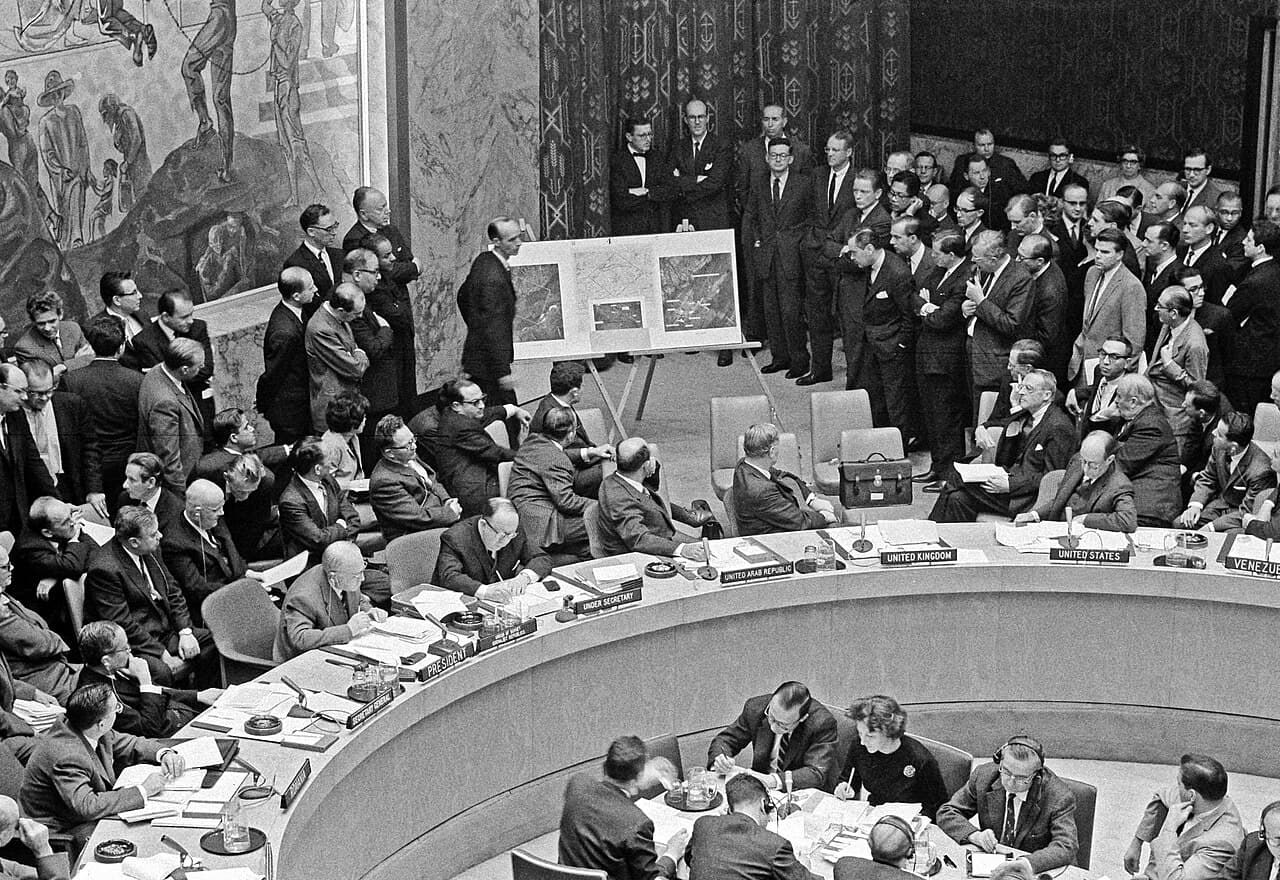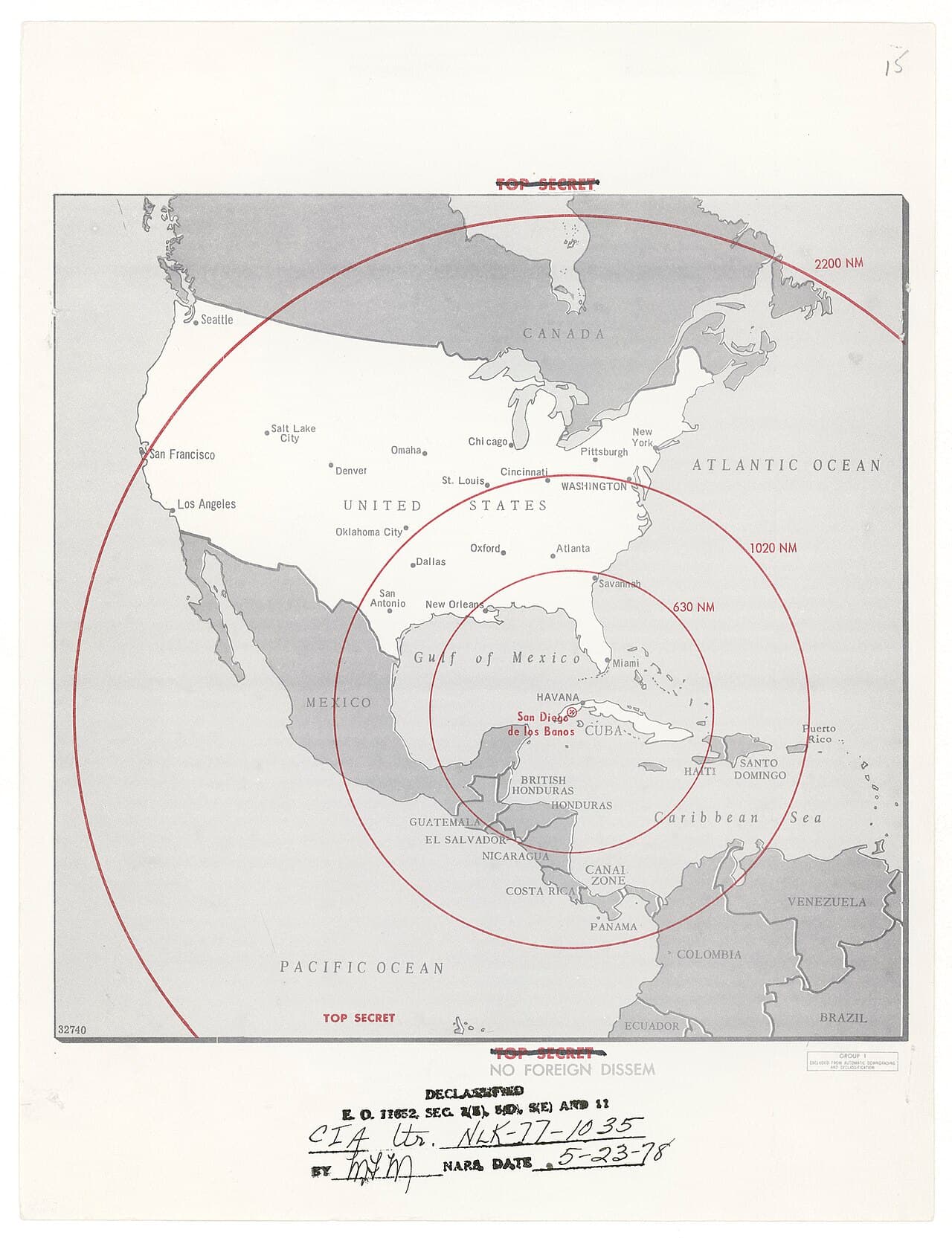
The Cuban Missile Crisis was a 13-day confrontation between the United States and the Soviet Union in October 1962, triggered when American U-2 spy planes photographed Soviet nuclear missile installations under construction in Cuba, just 90 miles from Florida. President John F. Kennedy demanded the missiles be removed, imposed a naval blockade around Cuba, and warned that any nuclear launch from the island would be treated as an attack by the USSR on the United States itself. The crisis ended on October 28, 1962, when Soviet Premier Nikita Khrushchev agreed to dismantle the missiles in exchange for a U.S. pledge not to invade Cuba and a secret agreement to remove American Jupiter missiles from Turkey.
What Was the Cold War Context That Led to the Cuban Missile Crisis?
By 1962, the Cold War had already produced a decade of dangerous rivalry between Washington and Moscow. The Soviet Union had tested its first atomic bomb in 1949 and its first hydrogen bomb in 1953, ending American nuclear monopoly. The space race, symbolised by Sputnik's launch in 1957, demonstrated Soviet technological capability. Meanwhile, Cuba had become a flashpoint after Fidel Castro overthrew U.S.-backed dictator Fulgencio Batista in January 1959 and aligned Havana with Moscow. The disastrous CIA-backed Bay of Pigs invasion in April 1961 — in which approximately 1,400 Cuban exiles failed to overthrow Castro — left Kennedy looking weak and convinced Castro that another U.S. invasion was inevitable. The Berlin Crisis of 1961, which culminated in the construction of the Berlin Wall in August of that year, further hardened Cold War divisions. Khrushchev, aware that the USSR was strategically inferior — the United States had roughly 170 ICBMs compared to fewer than 30 reliable Soviet ones — saw Cuba as an opportunity to rapidly redress the nuclear imbalance and deter another American strike on Havana.
Why Did the Soviet Union Place Nuclear Missiles in Cuba?
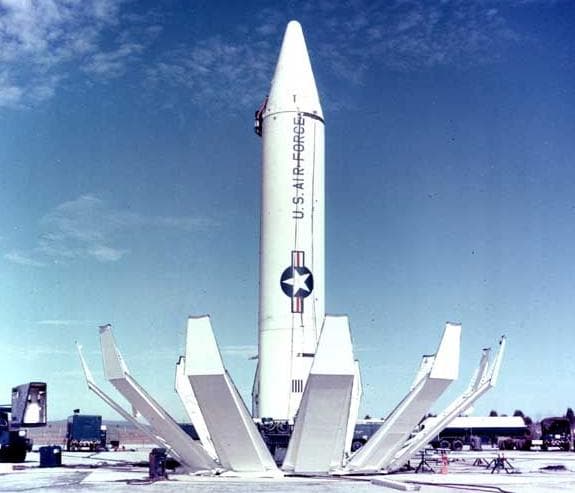
Khrushchev's decision to deploy missiles to Cuba, code-named Operation Anadyr, was driven by three interlocking strategic calculations. First, American Jupiter intermediate-range ballistic missiles (IRBMs) had been installed in Turkey and Italy by 1961, placing Soviet cities within a 15-minute strike window; Khrushchev viewed Cuban missiles as a legitimate counter-measure. Second, the nuclear imbalance was starkly real: U.S. intelligence estimated the Americans held a roughly 17-to-1 advantage in deliverable nuclear warheads. Third, Khrushchev wanted to protect Cuba and cement Soviet credibility in the developing world following the humiliation of the Berlin standoff. In May 1962, Khrushchev personally proposed the deployment to Castro, who accepted after initial hesitation. Between July and October 1962, the Soviet military secretly shipped 42 medium-range R-12 missiles (NATO designation: SS-4, range 1,380 miles) and 24 intermediate-range R-14 missiles (SS-5, range 2,800 miles) to the island, along with roughly 43,000 Soviet military personnel. The R-12s could reach Washington D.C. in under 13 minutes; the R-14s could threaten nearly the entire continental United States.
How Did the United States Discover the Soviet Missiles in Cuba?
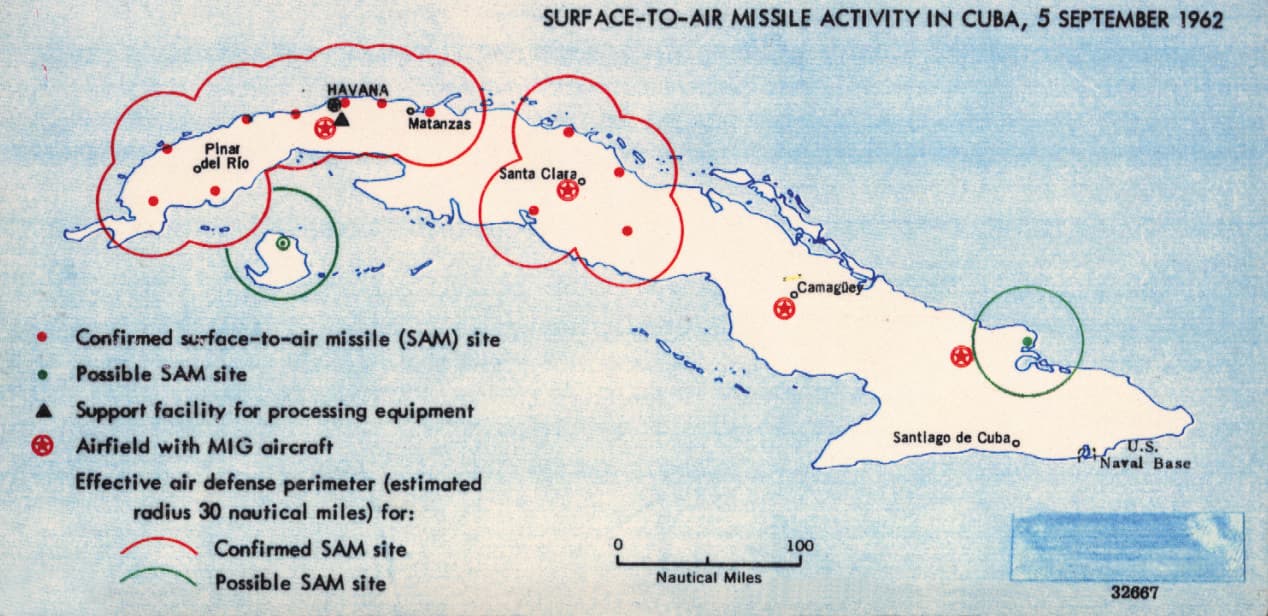
American intelligence had received scattered reports of unusual Soviet military activity in Cuba throughout the summer of 1962, but the Kennedy administration initially attributed these to defensive surface-to-air missile (SAM) installations. The breakthrough came on October 14, 1962, when a CIA U-2 reconnaissance aircraft piloted by Major Richard Heyser completed a high-altitude photographic pass over western Cuba. Analysts at the National Photographic Interpretation Center (NPIC) in Washington examined the images overnight and identified the unmistakable signature of SS-4 medium-range ballistic missile launch pads near the town of San Cristóbal. National Security Advisor McGeorge Bundy briefed Kennedy on the morning of October 16. Kennedy immediately convened a secret advisory group that became known as the Executive Committee of the National Security Council, or ExComm — 14 senior officials who would meet almost continuously for the next 13 days to craft America's response.
What Were the Key Decisions Made During the 13 Days of the Cuban Missile Crisis?
ExComm debated a spectrum of responses ranging from doing nothing to launching an immediate full-scale air strike and invasion of Cuba. The Joint Chiefs of Staff, led by General Maxwell Taylor, strongly advocated for airstrikes, arguing that a surgical strike could destroy the missile sites before they became operational. Secretary of Defense Robert McNamara and Attorney General Robert Kennedy pushed back, with Robert Kennedy famously arguing that a surprise attack on Cuba would be 'a Pearl Harbor in reverse' and would destroy America's moral standing globally. Kennedy ultimately chose a middle path: a naval 'quarantine' — the term 'blockade' was deliberately avoided as it constituted an act of war under international law — to intercept Soviet ships carrying additional military equipment. On October 22, Kennedy addressed the American public in a televised speech, publicly revealing the missiles for the first time and announcing the quarantine, which would take effect at 10:00 a.m. on October 24. He also placed U.S. nuclear forces on DEFCON 3, the highest peacetime alert level, subsequently raised to DEFCON 2 — one step below all-out nuclear war — for Strategic Air Command on October 24, the only time in history SAC reached that level.
How Close Did the World Come to Nuclear War During the Crisis?
The world came far closer to nuclear war than contemporary leaders or the public realised. On October 27, 1962 — known as 'Black Saturday' — multiple incidents nearly triggered catastrophe. A U-2 spy plane piloted by Major Rudolf Anderson was shot down over Cuba by a Soviet SA-2 missile, killing Anderson; the ExComm assumed Khrushchev had ordered the attack, but it was later revealed that local Soviet commanders had acted without authorisation. Simultaneously, another American U-2 accidentally strayed into Soviet airspace over Alaska, scrambling Soviet fighters. Most critically, the Soviet submarine B-59 — having lost contact with Moscow and erroneously believing war had already begun — was being depth-charged by U.S. Navy destroyers. B-59's captain, Valentin Savitsky, ordered the preparation of its nuclear torpedo. Under Soviet protocol, the launch required agreement from three officers; political officer Ivan Maslennikov agreed, but flotilla chief Vasili Arkhipov refused. Arkhipov's refusal almost certainly prevented a nuclear torpedo strike that could have triggered full-scale war. Arkhipov later received the informal title 'the man who saved the world.' Additionally, declassified documents revealed that Soviet forces in Cuba had tactical nuclear weapons — Luna battlefield rockets — pre-delegated for use by local commanders if the island were invaded, meaning a U.S. land invasion would almost certainly have triggered nuclear use.
What Was the Secret Deal That Ended the Cuban Missile Crisis?
The resolution of the crisis involved two tracks of diplomacy: a public agreement and a secret one. The public deal, announced on October 28, 1962, had Khrushchev agree to remove all Soviet offensive missiles from Cuba under UN inspection, in exchange for Kennedy's public pledge that the United States would not invade Cuba. However, a crucial secret component was negotiated through a back-channel between Robert Kennedy and Soviet Ambassador Anatoly Dobrynin on the evening of October 27: the United States would quietly remove its Jupiter IRBMs from Turkey within approximately four to five months. Kennedy insisted this be kept confidential, fearing it would appear he had capitulated under pressure and damaged NATO credibility. The missiles were indeed removed from Turkey by April 1963. Castro was furious at being excluded from the negotiations and never permitted UN inspections of Cuban territory; the Soviets instead verified removal from Soviet ships at sea. The settlement was widely perceived in the West as a Kennedy victory, though in strategic terms it was a genuine compromise that left both sides with face-saving gains.
| Key Actor | Role | Critical Decision |
|---|---|---|
| John F. Kennedy | U.S. President | Chose naval quarantine over immediate airstrikes; accepted secret Turkey missile trade |
| Nikita Khrushchev | Soviet Premier | Ordered missiles to Cuba; agreed to remove them on Oct 28 to avoid war |
| Robert F. Kennedy | U.S. Attorney General / ExComm | Opposed surprise airstrike; secretly negotiated Turkey missile removal with Dobrynin |
| Fidel Castro | Cuban Premier | Accepted Soviet missiles; urged Khrushchev to launch first strike on Oct 26 |
| Vasili Arkhipov | Soviet Submarine Officer | Refused to authorise nuclear torpedo launch aboard B-59, averting potential nuclear exchange |
| Anatoly Dobrynin | Soviet Ambassador to U.S. | Back-channel negotiator for secret Turkey deal with Robert Kennedy |
| Dean Rusk | U.S. Secretary of State | Coordinated diplomatic messaging; worked OAS support for quarantine |
| Robert McNamara | U.S. Secretary of Defense | Managed quarantine operations; opposed airstrikes as escalatory |
What Were the Immediate and Long-Term Consequences of the Cuban Missile Crisis?
The Cuban Missile Crisis reshaped global politics and nuclear strategy in profound ways. In its immediate aftermath, both superpowers were shaken enough to establish the Moscow–Washington hotline — the so-called 'red phone' — on August 30, 1963, providing a direct communication link to prevent future misunderstandings from escalating. The crisis catalysed the Partial Nuclear Test Ban Treaty, signed on August 5, 1963, by the U.S., USSR, and UK, prohibiting nuclear tests in the atmosphere, underwater, and in space. It accelerated the logic of détente: both Kennedy and Khrushchev had glimpsed the abyss and recoiled. Within the Soviet military and political establishment, the perception that Khrushchev had blinked contributed to his removal from power in October 1964, replaced by Leonid Brezhnev. In the United States, the crisis cemented Kennedy's reputation as a cool-headed statesman, though historians now note his administration's role in provoking the crisis through the Bay of Pigs and Operation Mongoose — a CIA sabotage program against Cuba. The crisis also established the doctrine of 'flexible response,' moving away from massive retaliation toward graduated military options, fundamentally changing how NATO planned for war in Europe.
Why Is the Cuban Missile Crisis Still Studied Today?
The Cuban Missile Crisis remains the definitive case study in nuclear brinkmanship, crisis management, and the role of individual human judgment in preventing catastrophe. It revealed how easily miscommunication, mechanical failure, and unauthorised local decisions can push rational actors toward irrational outcomes — a lesson that animates contemporary debates about nuclear deterrence involving states like North Korea, India, Pakistan, and an increasingly assertive Russia. Scholars at Harvard's Belfer Center have used it to develop theories of crisis decision-making that inform modern diplomatic training. The opening of Soviet, Cuban, and American archives since the 1990s — particularly through retrospective conferences where former adversaries like McNamara and Dobrynin met face-to-face — consistently reveals that the crisis was even more dangerous than leaders understood at the time. As McNamara later reflected after learning of the B-59 incident and the pre-delegated tactical nuclear weapons: 'We came this close to nuclear war — and it was luck that prevented it, not good management.'