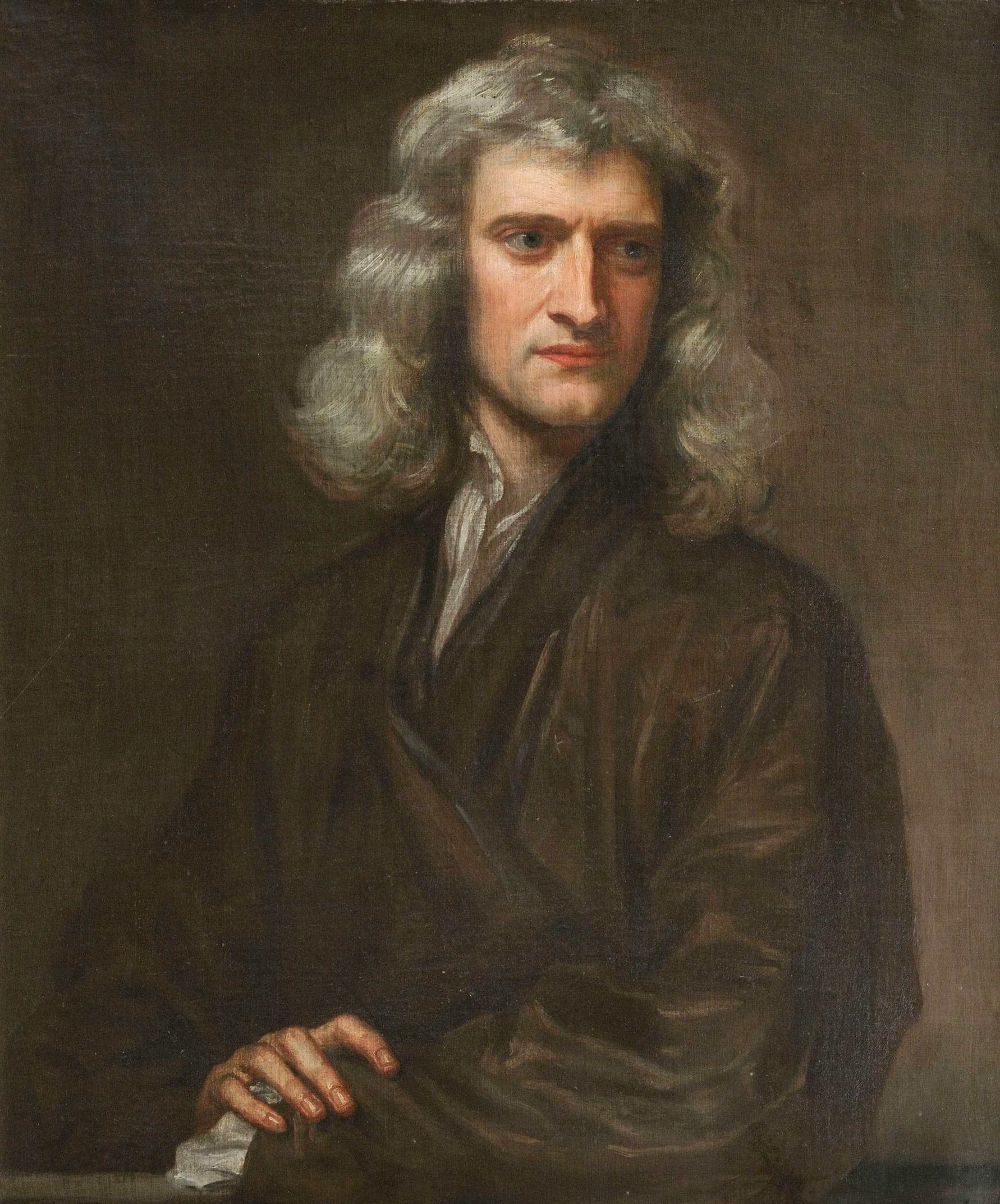
On Christmas Day 1642, in the small Lincolnshire village of Woolsthorpe, a premature and sickly infant was born who would grow up to become arguably the most consequential scientist in human history. Isaac Newton arrived in a world still governed by superstition and incomplete understanding of nature. He would leave it transformed. By the time of his death in 1727, Newton had formulated the laws of motion, explained gravity, invented calculus, decoded the nature of light, and laid the mathematical foundations upon which modern physics still rests. Few lives have altered the human story so profoundly.
A Difficult Beginning
Newton's early life offered little promise of greatness. His father, a farmer also named Isaac Newton, died three months before his birth. When his mother Hannah remarried a wealthy clergyman, the young Isaac was left in the care of his grandmother — a rejection that scarred him deeply and may have fuelled the fierce, solitary intensity that defined his intellectual life. He reportedly threatened to burn his stepfather's house down with him and his mother inside. Psychologists and historians have speculated that Newton showed traits consistent with what we today might recognize as autism spectrum disorder or severe anxiety, though such diagnoses across centuries are inherently speculative.
Despite an unremarkable early academic record, Newton won a place at Trinity College, Cambridge in 1661. He initially enrolled as a subsizar — a student who earned his keep by waiting on wealthier students — but his intellectual gifts quickly distinguished him. He voraciously read Descartes, Galileo, Kepler, and the ancient Greeks, building a private edifice of knowledge that far outstripped the official curriculum.
The Miracle Years
In 1665, an outbreak of bubonic plague forced Cambridge to close, and Newton retreated to his family home at Woolsthorpe Manor for roughly two years. What followed is one of the most extraordinary episodes in the history of science. Working largely alone, Newton used those enforced years of isolation to develop the foundational ideas of calculus — which he called 'the method of fluxions' — to conduct experiments on the nature of light using glass prisms, and to begin formulating his revolutionary theory of gravitation. This period, which Newton himself later called his 'annus mirabilis' or miracle year, saw one mind produce breakthroughs that would take other scientists generations to fully absorb and build upon.
The famous story of Newton and the apple — that the sight of an apple falling from a tree prompted his insight into gravity — is almost certainly a later embellishment, though Newton himself told versions of it in old age. What is historically documented is that he developed a mathematical framework to describe how objects attract one another across distance, work that culminated decades later in his masterwork, the Principia.
Principia Mathematica: A Book That Changed the World
Published in 1687, the Philosophiæ Naturalis Principia Mathematica — Mathematical Principles of Natural Philosophy — stands as perhaps the single most important scientific book ever written. In it, Newton presented his three laws of motion and his universal law of gravitation, demonstrating that the same force governing a falling apple also guided the orbits of the planets around the Sun. He showed that the cosmos operated according to precise, knowable mathematical laws — a revelation so sweeping that it fundamentally altered humanity's self-conception. The universe was not capricious or mystical; it was a grand machine operating on rational principles that the human mind could comprehend.
| Newton's Three Laws | Description |
|---|---|
| First Law (Inertia) | An object remains at rest or in uniform motion unless acted upon by an external force. |
| Second Law (F=ma) | The force on an object equals its mass multiplied by its acceleration. |
| Third Law (Action-Reaction) | For every action, there is an equal and opposite reaction. |
The Principia was produced partly at the urging — and financial backing — of the astronomer Edmond Halley, who recognised what Newton had achieved and pushed him to publish. Without Halley's intervention, the work might have languished indefinitely in Newton's private papers. The book was written in Latin, the academic lingua franca of the day, and was immediately recognised across Europe as something unprecedented in intellectual history.
Light, Colour, and the Reflecting Telescope
Newton's contributions extended well beyond mechanics and gravity. His experiments with prisms in the 1660s demonstrated that white light is not pure but is composed of a full spectrum of colours — red, orange, yellow, green, blue, indigo, and violet. By passing sunlight through a prism and then recombining the resulting spectrum through a second prism to produce white light again, he proved conclusively that colour is an intrinsic property of light itself, not something added to it by a lens or medium. This work was published in his second great book, Opticks, in 1704.
Newton also invented the reflecting telescope around 1668, using a curved mirror rather than a lens to gather and focus light. This design, known as the Newtonian telescope, eliminated the chromatic aberration that plagued refracting telescopes of the era and became the ancestor of virtually every large astronomical observatory telescope built since, including the Hubble Space Telescope.
The Darker Sides of Genius
Newton was not a simple hero of rational enlightenment. He devoted enormous private energy to alchemy, conducting thousands of experiments in pursuit of the philosopher's stone and the secrets of transmutation. He also wrote more than a million words of biblical commentary and theological speculation, believing that decoding scripture was as important as decoding nature. He was consumed for years by an attempt to derive a precise chronology of ancient civilizations from the Bible.
He was also capable of profound pettiness. His bitter priority dispute with German mathematician Gottfried Wilhelm Leibniz over who had invented calculus — a controversy Newton stoked with calculated ruthlessness, ultimately weaponizing the Royal Society against Leibniz — cast a long shadow over European mathematics and delayed the adoption in Britain of Leibniz's superior notation for a century. Newton never married, had few close friends, and suffered at least two serious nervous breakdowns, in 1677 and 1693.
Later Life and Legacy
In 1696, Newton left Cambridge to become Warden, and later Master, of the Royal Mint in London — a role he took with characteristic seriousness, personally pursuing counterfeiters and seeing several hanged. He was elected President of the Royal Society in 1703 and was knighted by Queen Anne in 1705, the first scientist to receive such an honour for scientific work. He died on 20 March 1727 at the age of 84 and was buried with great ceremony in Westminster Abbey.
The poet Alexander Pope captured the awe Newton inspired: 'Nature and Nature's laws lay hid in night; God said, Let Newton be! and all was light.' Three centuries on, that sense of wonder has not diminished. Newton's laws still guide spacecraft across the solar system. His method — rigorous mathematical description of observed phenomena — remains the template for all of modern science. Einstein's relativity eventually superseded Newtonian mechanics at extreme scales of speed and mass, but Einstein himself acknowledged the debt: 'If I have seen further, it is by standing on the shoulders of giants.' Newton, with characteristic modesty and competitive shrewdness, had used almost exactly the same phrase — lifted from medieval scholars — about his own predecessors. The giants, in the end, build on one another.