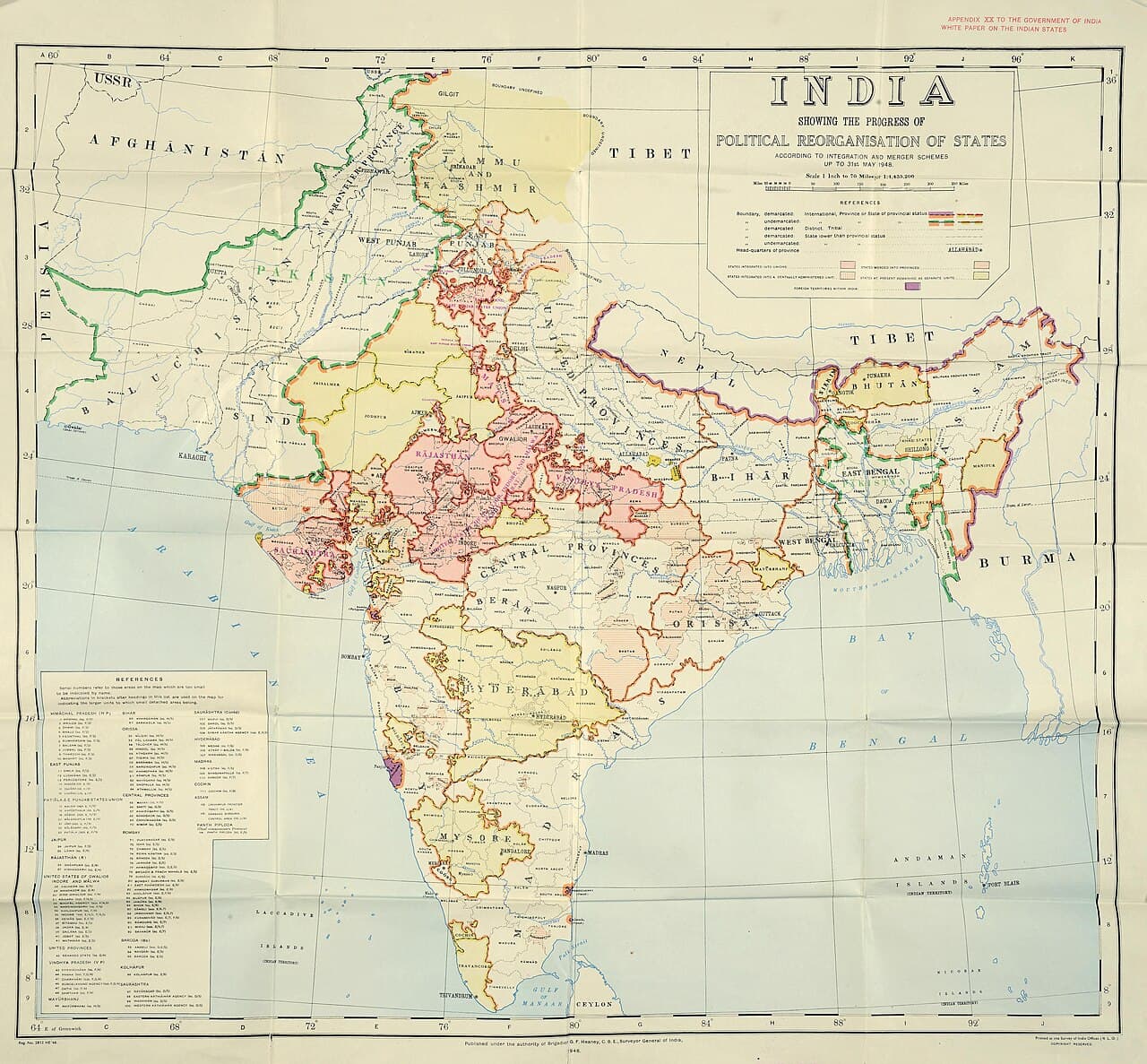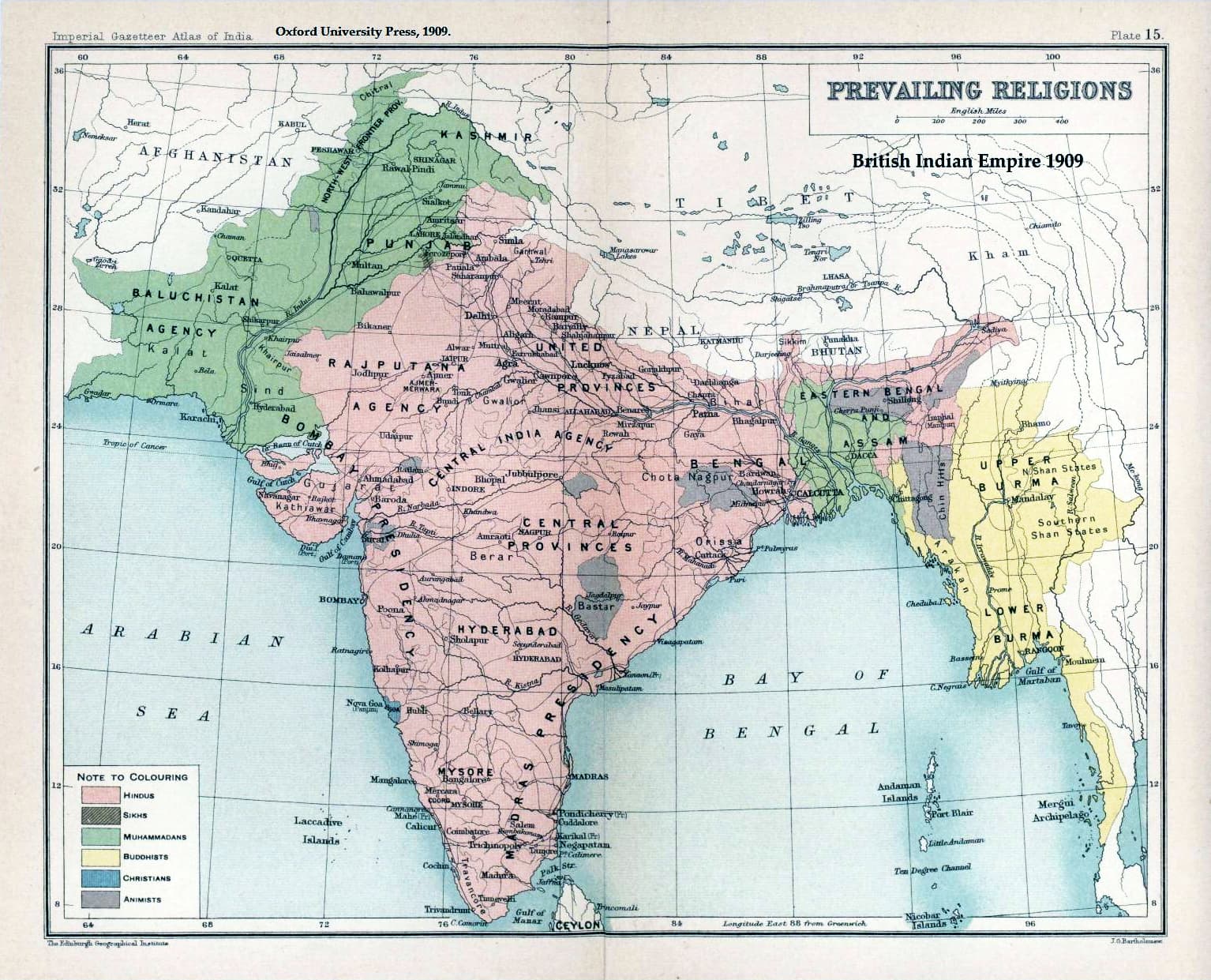
The Partition of India on August 14–15, 1947, divided British India into two independent nations — Pakistan and India — along religious lines, creating a Muslim-majority Pakistan and a Hindu-majority India. The division displaced between 14 and 18 million people in one of the largest forced migrations in human history and triggered communal violence that killed an estimated 200,000 to 2 million people within months. The event permanently reshaped the political, demographic, and cultural landscape of South Asia and left unresolved tensions whose consequences — including three wars and an ongoing Kashmir dispute — continue to define the region today.
What Was British India and Why Did Partition Happen?
British India was a vast colonial territory administered by the British Crown following the Government of India Act of 1858, which transferred power from the East India Company to the Crown after the 1857 Rebellion. At its height, British India encompassed modern-day India, Pakistan, Bangladesh, Myanmar, and parts of other neighbouring territories, governed through a combination of directly administered provinces and hundreds of princely states. By the early twentieth century, this territory was home to over 300 million people of diverse religions, languages, and ethnicities, with Hindus comprising roughly 65 percent of the population and Muslims approximately 25 percent, alongside Sikhs, Buddhists, Christians, and others. The seeds of partition were sown decades before 1947 through colonial policies of divide and rule, growing Hindu-Muslim political tensions, and the crystallisation of the two-nation theory — the idea, championed by Muhammad Ali Jinnah and the All-India Muslim League, that Hindus and Muslims were two distinct nations that could not coexist in a single state.
What Caused the Partition of India? Key Political Factors
Multiple interlocking causes drove partition. First, the British policy of communal electorates, introduced in the Morley-Minto Reforms of 1909, created separate Muslim voting rolls, institutionalising religious identity as a political category. This deepened the rift between the Indian National Congress — dominated by Hindu leadership despite its secular ideology — and the All-India Muslim League, founded in 1906. Second, the failure of the Cabinet Mission Plan of 1946, which had proposed a federated united India with substantial provincial autonomy, proved decisive. Jinnah's Muslim League accepted it conditionally; Congress's rejection of the plan's grouping clauses convinced Jinnah that Muslim interests could never be protected within a united India. Third, the Direct Action Day of August 16, 1946 — called by Jinnah to press the demand for Pakistan — ignited the Great Calcutta Killings, four days of sectarian carnage that left approximately 4,000 people dead and foreshadowed the wider violence to come. Fourth, the exhaustion of British imperial will following World War II, combined with mounting unrest in India, led Prime Minister Clement Attlee in February 1947 to announce that Britain would leave India by June 1948. The appointment of Lord Louis Mountbatten as the last Viceroy accelerated that timetable dramatically.
How Did Mountbatten and the Radcliffe Line Divide India?
Mountbatten arrived in New Delhi in March 1947 and quickly concluded that a unified transfer of power was impossible. He advanced the departure date to August 1947 — barely five months away — a decision many historians argue made the catastrophe worse by removing any chance for orderly planning. The actual boundary between India and Pakistan was drawn by Sir Cyril Radcliffe, a British lawyer who had never visited India before his appointment in June 1947. Leading two boundary commissions — one for Punjab and one for Bengal — Radcliffe had just five weeks to divide territories with mixed populations of tens of millions of people. He used census data, district boundaries, and irrigation networks to draw what became known as the Radcliffe Line, but the task was inherently impossible: no line could separate communities that had lived intermingled for centuries. Radcliffe submitted his maps on August 12, 1947, though Mountbatten withheld publication until August 17 — two days after independence — to avoid disrupting the independence celebrations. When the boundaries were finally announced, entire communities suddenly found themselves on the 'wrong' side of a new international border. Punjab, home to Sikhs, Hindus, and Muslims in close proximity, was cut in two. Lahore, with its large Hindu and Sikh population, went to Pakistan; Amritsar, with its Muslim quarters, went to India. The Bengal partition separated Calcutta — the region's commercial capital — from its agricultural hinterland in East Pakistan.
What Was the Scale of Violence and Migration During Partition?
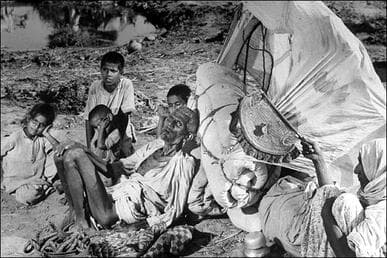
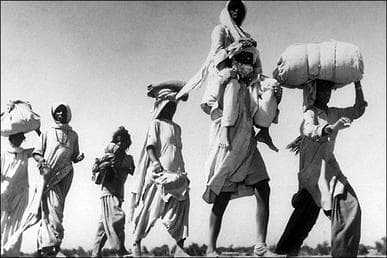
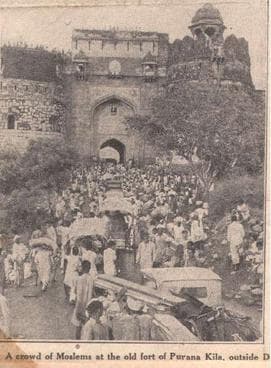
The violence that accompanied partition was staggering in scale and brutality. In Punjab alone, entire villages were massacred, women were abducted and raped by the tens of thousands, and trains carrying refugees arrived at their destinations filled with corpses — earning the grim name 'death trains.' Historians estimate that between 75,000 and 100,000 women were abducted or raped during the violence, a figure that spans both sides of the new border. The migration itself was unprecedented: approximately 7.2 million Muslims moved from India to West Pakistan, roughly 7.5 million Hindus and Sikhs moved from West Pakistan to India, and a further 3.5 million Hindus moved from East Pakistan (today's Bangladesh) to India over subsequent years. This two-way flow of 14–18 million people occurred largely within a period of a few months in late 1947, creating refugee crises in Lahore, Amritsar, Delhi, and Calcutta that overwhelmed nascent government infrastructure. Delhi alone absorbed around 500,000 refugees by October 1947, transforming the city's demographics permanently. Death toll estimates vary enormously — from 200,000 to 2 million — reflecting the chaos, the absence of centralised record-keeping, and the political sensitivity that has long surrounded the statistics.
| Category | India | Pakistan |
|---|---|---|
| Independence Date | August 15, 1947 | August 14, 1947 |
| First Leader | Jawaharlal Nehru (PM) | Muhammad Ali Jinnah (Governor-General) |
| Population at Partition (approx.) | 330 million | 70 million |
| Refugees Received (approx.) | 7.5–8 million (from West Pakistan) | 7–7.5 million (from India) |
| Punjab Provinces Divided | East Punjab (India) | West Punjab (Pakistan) |
| Bengal Provinces Divided | West Bengal (India) | East Bengal / East Pakistan |
What Happened to the Princely States — and Why Did Kashmir Become a Flashpoint?
At the time of partition, approximately 565 princely states — nominally sovereign territories under British paramountcy — had to choose accession to either India or Pakistan. Most acceded quickly, guided by geography and demographics. Two major exceptions ignited lasting conflicts. Hyderabad, a large Muslim-ruled state with a predominantly Hindu population at the heart of India, resisted accession until India's military 'Police Action' of September 1948 forcibly integrated it. Kashmir presented the reverse and far more enduring problem. The princely state of Jammu and Kashmir had a Muslim-majority population (approximately 77 percent) but was ruled by Maharaja Hari Singh, a Hindu. Singh initially sought independence from both nations. When Pakistani-backed Pashtun tribal fighters invaded Kashmir in October 1947, Hari Singh appealed to India for military assistance and signed the Instrument of Accession on October 26, 1947. Indian troops airlifted to Srinagar halted the invasion, but Pakistan never accepted the accession. The resulting First Indo-Pakistani War (1947–1948) ended with a UN-brokered ceasefire on January 1, 1949, leaving roughly one-third of Kashmir under Pakistani control (today's Azad Kashmir and Gilgit-Baltistan) and two-thirds under Indian administration. The Line of Control established by that ceasefire remains the de facto border today, and Kashmir has since been the trigger for two further wars (1965 and 1999's Kargil War) and near-constant low-level conflict.
How Did Partition Affect Bengal and What Became East Pakistan?
Bengal's partition mirrored Punjab's in devastation but followed a different long-term trajectory. East Bengal became East Pakistan, geographically separated from West Pakistan by over 1,600 kilometres of Indian territory. This geographic absurdity reflected the weakness of the two-nation theory as a state-building principle: the two halves of Pakistan shared religion but differed sharply in language, culture, and economic interests. Tensions between Urdu-speaking West Pakistani elites and Bengali-speaking East Pakistanis culminated in the Bangladesh Liberation War of 1971, during which the Pakistani military launched Operation Searchlight in March 1971, killing an estimated 300,000 to 3 million Bengalis in what many scholars classify as a genocide. India intervened militarily in December 1971, and East Pakistan became the independent nation of Bangladesh on December 16, 1971 — a second partition whose roots lay directly in the failures of the first.
Why Is the Partition of India Considered a Humanitarian Catastrophe?
Partition is classified as one of the twentieth century's worst humanitarian disasters for several converging reasons. The speed of the process — from Mountbatten's arrival in March 1947 to independence in August 1947 — meant no adequate administrative machinery existed to manage the transfer of millions of people. The communal violence was not merely spontaneous but was also organised by political actors, militias, and in some cases local officials on both sides. Women bore a disproportionate burden: the Indian and Pakistani governments later negotiated a Central Recovery Operation (1947–1954) to locate and repatriate abducted women, ultimately recovering approximately 30,000 women, though tens of thousands more were never found. Entire communities were erased: Lahore's Hindu and Sikh populations, which comprised roughly 36 percent of the city in 1941, had effectively vanished by 1951. The long-term psychological trauma was immense. Scholars estimate that, including the Bangladesh events of 1971, the wider partition process displaced more than 17 million people across two distinct episodes — making it, cumulatively, among the largest forced population movements in recorded history.
What Is the Legacy of the Partition of India Today?
The partition's legacy permeates every dimension of South Asian politics and society more than seven decades later. India and Pakistan have fought four wars (1947, 1965, 1971, 1999) and have come close to nuclear exchange — both nations tested nuclear weapons in May 1998, just weeks apart. The Kashmir dispute remains one of the world's most militarised territorial conflicts, with both countries stationing hundreds of thousands of troops along the Line of Control. Culturally, a rich tradition of partition literature has emerged — Saadat Hasan Manto's Urdu stories, Bhisham Sahni's novel Tamas, and Amrita Pritam's poetry are among the defining works — bearing witness to the human cost in ways that official histories long avoided. The 1947 Partition Archive, founded in 2010 by Guneeta Singh Bhalla, has collected over 10,000 eyewitness testimonies from survivors across twelve countries, ensuring the experience of ordinary people is not lost. India opened its first Partition Museum in Amritsar in August 2017, on the 70th anniversary. In Pakistan, the day of partition is celebrated as Independence Day with genuine national pride, yet the violence and displacement are rarely discussed publicly — a silence that mirrors suppression in India for decades. Increasingly, historians on both sides argue that honest reckoning with the events of 1947 is essential not just for historical understanding but for reducing contemporary hostility between two nuclear-armed neighbours.
How Do Historians Judge the Partition of India Today?
Scholarly debate over partition's causes, blame, and inevitability has evolved significantly. Early nationalist historiography in both India and Pakistan assigned primary blame to the opposing side or to British imperial machinations. Later scholarship, exemplified by Ayesha Jalal's 1985 work The Sole Spokesman and Yasmin Khan's 2007 The Great Partition, has produced more nuanced assessments. Jalal argues that Jinnah sought partition as a bargaining chip rather than a genuine goal, and that Congress's intransigence helped make it inevitable. Khan emphasises the grassroots experience of ordinary people and the failure of political leaders across the spectrum to anticipate or mitigate the violence. The role of Mountbatten has been heavily criticised: historians like Alex Von Tunzelmann, in Indian Summer (2007), document how his personal friendship with Nehru and haste in advancing the independence timetable contributed to catastrophe. There is now broad consensus among historians that the violence was neither inevitable nor simply spontaneous — it was the product of specific political decisions, colonial mismanagement, and the weaponisation of religious identity by actors on all sides.