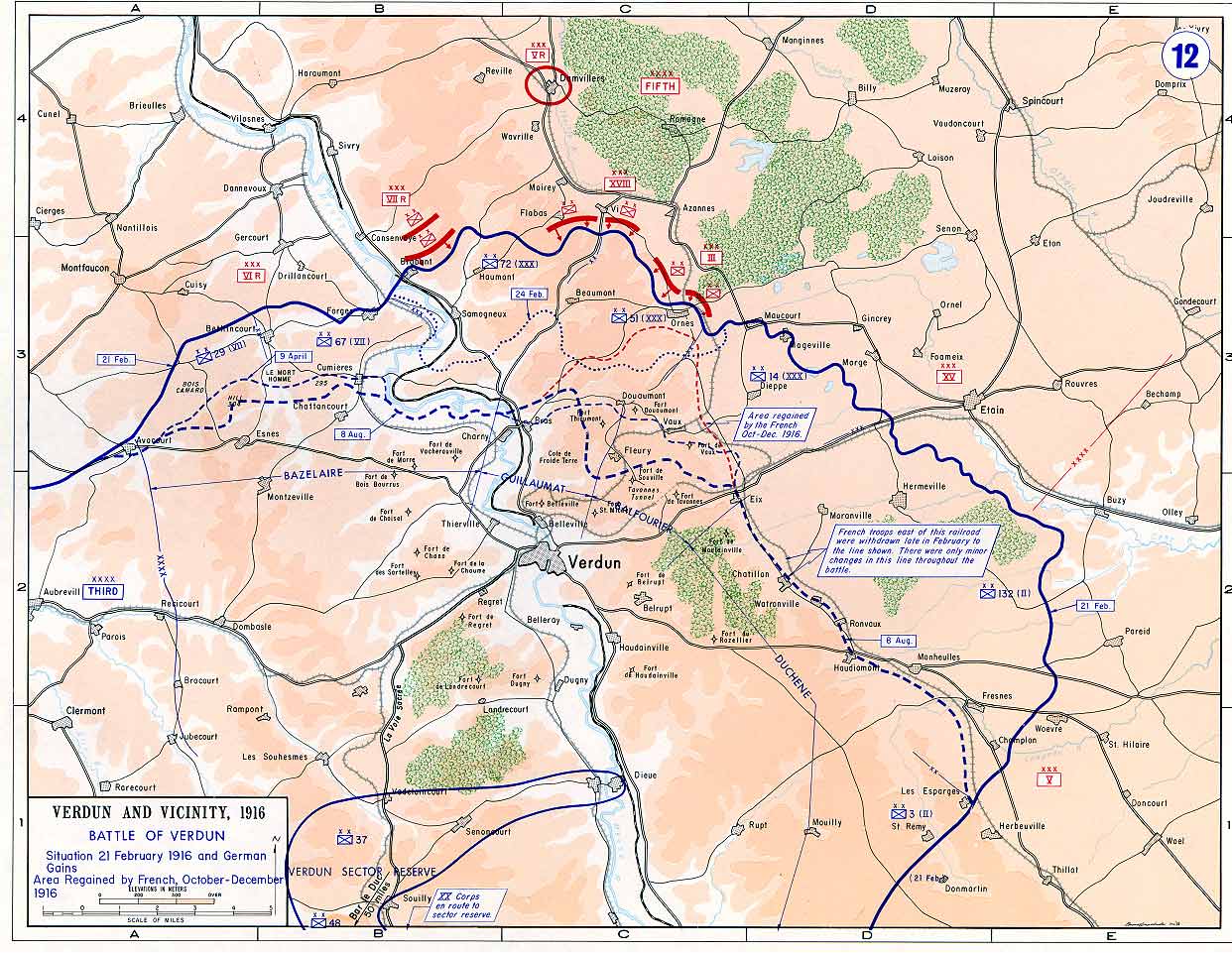
The Battle of Verdun, fought from 21 February to 18 December 1916 along the Meuse River in northeastern France, was the longest and one of the bloodiest battles of World War I, producing an estimated 700,000 casualties—dead, wounded, and missing—across ten months of near-continuous combat. Germany's Chief of Staff Erich von Falkenhayn deliberately targeted Verdun to 'bleed France white,' forcing the French Army into a meatgrinder defense of a site with enormous symbolic value. France held the line, but at a cost that scarred both nations for generations.
What Was the Strategic Purpose Behind the Battle of Verdun?
By late 1915 the Western Front had been locked in trench stalemate for over a year. Erich von Falkenhayn, commanding the German Imperial Army, concluded that outright breakthrough was impossible. In a memorandum to Kaiser Wilhelm II—later called the 'Christmas Memorandum,' though its authenticity remains debated—he outlined a strategy of attrition: launch a massive assault on Verdun, a fortress city the French could not politically or psychologically afford to surrender. Verdun had been French since 843 AD and was ringed by a chain of 19 interlocking forts built after the humiliation of 1870–71. Falkenhayn believed France would commit every available reserve to its defense, allowing German artillery to destroy the French Army in detail. The plan, codenamed Operation Gericht (meaning 'judgement' or 'place of execution'), was designed not primarily to capture territory but to destroy manpower. It was one of the first explicitly attritional strategies in modern warfare.
How Did the German Offensive Begin on 21 February 1916?
At 7:15 a.m. on 21 February 1916, roughly 1,200 German guns opened the largest artillery bombardment in history up to that point, pounding a 40-kilometre front for nine hours. Approximately 1 million shells fell in a single day. The French 30th Corps defending the right bank of the Meuse was devastated. German Crown Prince Wilhelm commanded Army Group Crown Prince, with the Fifth Army leading the assault. Storm troopers advanced behind a creeping barrage—a tactic still being refined—and within three days had pushed 8 kilometres into French lines. The critical blow came on 25 February when Fort Douaumont, the largest fort in the Verdun complex, fell to a small German raiding party almost without a fight; it had been stripped of its garrison months earlier. The psychological shock in France was immense. General Joffre, French Commander-in-Chief, immediately appointed General Philippe Pétain to command the Second Army at Verdun on 26 February, a decision that would prove decisive.
How Did Philippe Pétain Stabilise the French Defence?
Pétain acted with cool-headed organisational genius. Recognising that the single narrow road linking Verdun to the rear—the Bar-le-Duc road—was the lifeline of the entire operation, he militarised it into what became famous as La Voie Sacrée (The Sacred Way). Between late February and the end of June 1916, approximately 12,000 trucks carried 400,000 men and 1.35 million tonnes of supplies along that 56-kilometre road, with a truck passing every 14 seconds at peak operation. Pétain also introduced a rotation system (noria) in which divisions were cycled in and out of the front roughly every two weeks, ensuring fresh troops and preventing the collapse of morale. By contrast, Germany rotated its units far less frequently. Pétain's order of the day—'Courage, on les aura!' ('Courage, we will have them!')—became a rallying cry. Though promoted away from direct command in April 1916 in favour of General Robert Nivelle, Pétain's early stabilisation measures saved Verdun.
What Were the Key Turning Points in the Battle of Verdun?
Several pivotal moments defined the battle's arc. The fall of Fort Douaumont on 25 February 1916 was the lowest point for France. Germany's attempt to envelop both banks of the Meuse in March 1916 stalled on the western bank at Mort-Homme (Dead Man's Hill), where brutal fighting continued for weeks. On 22 May, France temporarily recaptured Douaumont before losing it again three days later. The opening of the Allied Somme Offensive on 1 July 1916 forced Germany to divert divisions northward, relieving pressure on Verdun significantly. France launched major counteroffensives in October and December 1916. General Charles Mangin's infantry, supported by innovative artillery coordination, recaptured Fort Douaumont on 24 October and Fort Vaux on 2 November. By 18 December, the French had regained virtually all the ground lost in February, pushing the front line back to near its original position. The French had bent but never broken.
What Role Did Artillery and New Weapons Play at Verdun?
Verdun was above all an artillery battle. Over the ten-month campaign, an estimated 40 million shells were fired by both sides across the Verdun salient—roughly 6,000 tons of metal per square kilometre. The landscape was so thoroughly churned that soldiers described moving through a 'lunar surface' devoid of vegetation or recognisable terrain. Germany deployed its fearsome 420mm 'Big Bertha' howitzers capable of penetrating fortress roofs 2 metres thick. Flamethrowers (Flammenwerfer) were used extensively by German assault units, first deployed in large scale at Verdun on 21 February. Phosgene gas, deadlier than chlorine, was introduced by Germany in December 1915 and used intermittently throughout the battle. The French developed the 75mm field gun into a devastating anti-infantry weapon, and both sides made increasing use of aircraft for reconnaissance and, increasingly, direct combat. The aerial battles over Verdun produced France's greatest ace, Georges Guynemer, and saw early organised dogfighting become a tactical fixture of the war.
How Many Casualties Did the Battle of Verdun Cause?
Casualty figures for Verdun vary by source and methodology, but most historians accept approximately 377,000 French casualties (dead, wounded, missing, and prisoners) and roughly 337,000 German casualties, for a combined total approaching 715,000. Of those, an estimated 163,000 French soldiers and 143,000 Germans were killed outright—over 300,000 dead in ten months. Because France rotated 70 of its 95 infantry divisions through Verdun at some point during the battle, the trauma was distributed across the entire French Army, fundamentally affecting its fighting spirit. The mutinies of 1917 that spread through 54 French divisions were in significant part a consequence of Verdun's psychological devastation. The battlefield today still yields human remains; the Douaumont Ossuary contains the unidentified bones of at least 130,000 soldiers of both nations.
| Metric | France | Germany |
|---|---|---|
| Total Casualties (dead/wounded/missing) | ~377,000 | ~337,000 |
| Estimated Killed | ~163,000 | ~143,000 |
| Divisions Committed | 70 of 95 | ~46 |
| Shells Fired (est.) | ~22 million | ~18 million |
| Duration of Engagement | 21 Feb – 18 Dec 1916 | 21 Feb – 18 Dec 1916 |
| Key Commander | Gen. Philippe Pétain | Crown Prince Wilhelm |
Why Did Germany Fail to Achieve Its Objectives at Verdun?
Falkenhayn's strategy of bleeding France white ultimately bled Germany nearly as badly. Several structural failures doomed the plan. First, the attritional logic required Germany to accept severe losses itself, which Falkenhayn had allegedly accounted for but which proved strategically unsustainable when combined with the Brusilov Offensive on the Eastern Front (launched June 1916) and the Somme Offensive in the west. The Brusilov Offensive alone cost Germany and Austria-Hungary over 1 million casualties between June and September 1916, making simultaneous attrition at Verdun impossible to sustain. Second, German tactical commanders—particularly Crown Prince Wilhelm and his chief of staff Knobelsdorf—pushed beyond the original limited-objective plan, seeking actual territorial gains and widening the battle in ways that increased German losses beyond the ratio Falkenhayn had calculated. Third, La Voie Sacrée ensured France could replace losses faster than Germany anticipated. Falkenhayn was dismissed on 29 August 1916, replaced by the partnership of Paul von Hindenburg and Erich Ludendorff.
What Was the Long-Term Legacy of the Battle of Verdun?
Verdun's legacy reshaped France politically, militarily, and psychologically for decades. Philippe Pétain emerged as the 'Lion of Verdun,' a heroic status that paradoxically enabled his catastrophic collaboration with Nazi Germany as head of the Vichy regime from 1940—a reputation built at Verdun gave him the political capital to surrender it. The French military's interwar defensive doctrine, embodied in the Maginot Line, was a direct institutional response to Verdun's lesson that fortified positions were the most economical use of French manpower. France's birth rate, already declining before 1914, was decimated by the war's losses, of which Verdun was the most emblematic. Diplomatically, Verdun became a powerful symbol of Franco-German reconciliation: in September 1984, French President François Mitterrand and German Chancellor Helmut Kohl held hands at the Douaumont Ossuary in one of the most photographed gestures of European unity. The battlefield is now a UNESCO-recognised site of memory, and the ossuary receives over 300,000 visitors annually. Verdun remains the defining symbol of industrial war's capacity for purposeless destruction—and of human endurance in the face of it.
How Is the Battle of Verdun Remembered Today?
The Verdun battlefield, known as the Zone Rouge (Red Zone), covers approximately 100 square kilometres of land so contaminated by unexploded ordnance, heavy metals, and human remains that it remains permanently closed to agriculture and habitation more than 100 years later. Beneath the forest that has reclaimed the shattered landscape lie an estimated 12 million unexploded shells. The Mémorial de Verdun museum, reopened after extensive renovation in 2016 to mark the battle's centenary, draws historians and tourists from across the world. Each year the French Army conducts controlled detonations of ordnance still unearthed by erosion and forestry. The battle is taught in every French school as a foundational moment of national identity, and the phrase 'esprit de Verdun' still appears in French political discourse to signify resilience and sacrifice. In Germany, Verdun occupies a more ambiguous place—a reminder of strategic miscalculation and the futility of a war the German leadership had promised would be swift.