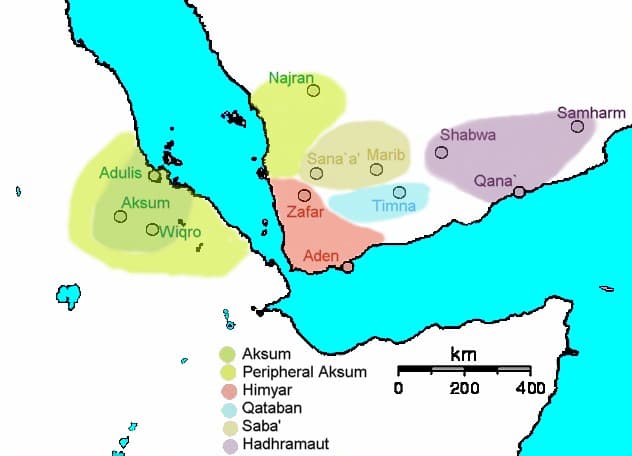
The Kingdom of Aksum was a powerful ancient state centred in what is now northern Ethiopia and Eritrea, flourishing from roughly the 1st century AD to the 9th century AD. At its height between the 3rd and 6th centuries, Aksum controlled trade routes linking the Roman Empire, Arabia, India, and sub-Saharan Africa, making it one of the wealthiest and most influential civilisations on earth. The Persian prophet Mani ranked Aksum alongside Rome, Persia, and China as one of the four greatest kingdoms of his age — a remarkable testament to its global standing.
What Were the Origins of the Kingdom of Aksum?
Aksum emerged from the earlier pre-Aksumite culture of the northern Ethiopian highlands, which itself drew heavily on South Arabian (Sabaean) influences dating back to at least the 5th century BC. South Arabian migrants crossed the Red Sea and intermarried with the indigenous Cushitic-speaking populations, producing a hybrid culture visible in the proto-Ethiopic script, religious iconography, and monumental stone architecture of sites like Yeha. By the 1st century AD, a centralised kingdom had consolidated around the city of Aksum, located at roughly 2,100 metres elevation in the Tigray region. The Periplus of the Erythraean Sea, a Greek merchant manual written around 60 AD, already describes Aksum as the seat of a powerful king named Zoskales — the earliest named ruler in Ethiopian history — who controlled the Red Sea port of Adulis (near modern Massawa in Eritrea). Adulis would become the commercial engine of the empire, the gateway through which ivory, gold, aromatic resins, slaves, and exotic animals poured into Mediterranean and Indian Ocean markets.
How Did Aksum Build Its Trading Empire?
Aksum's extraordinary wealth rested on its command of the most lucrative trade corridors of the ancient world. The port of Adulis on the Red Sea sat at a strategic chokepoint between the Mediterranean and the Indian Ocean, and Aksumite merchants sailed directly to India using the predictable monsoon winds. The kingdom exported rhinoceros horn, hippopotamus hides, tortoiseshell, live elephants, and above all ivory — raw material that was in insatiable demand across the Roman and Persian empires. Gold mined in the interior territories of modern Sudan and western Ethiopia passed through Aksumite hands, and Aksum became the exclusive broker between the gold-producing regions of Africa and the wider world. In return, the kingdom imported textiles, glassware, wine, olive oil, and copper from Rome and the Mediterranean. By the 3rd century AD, Aksum was minting its own gold, silver, and bronze coinage — an extremely rare achievement in sub-Saharan Africa and a mark of true imperial sophistication. The coins bore royal portraits and, later, Christian crosses, making them invaluable historical records. Over 100 individual Aksumite rulers can be identified from numismatic evidence alone. The kingdom also controlled the frankincense and myrrh trade emanating from the Horn of Africa and southern Arabia — commodities worth nearly their weight in gold in Roman religious and funerary practice.
Who Were the Greatest Kings of Aksum?
The most celebrated Aksumite ruler was King Ezana, who reigned from approximately 320 to 360 AD. Ezana was both a military conqueror and a transformative religious reformer. His early inscriptions invoke polytheistic deities, but around 340 AD he converted to Christianity — making Aksum the first kingdom in the world to adopt Christianity as an official state religion, predating even the Roman Empire's Edict of Thessalonica in 380 AD. Ezana's conversion was influenced by Frumentius, a Syrian Christian scholar who had been shipwrecked on the Aksumite coast as a youth, risen to become royal tutor, and was eventually consecrated as the first Bishop of Aksum by Athanasius of Alexandria around 328 AD. Ezana's military campaigns are documented in stone inscriptions found at Aksum itself. He crushed the rival Kushite kingdom of Meroe (in present-day Sudan) around 350 AD, an act that effectively ended one of Africa's other great ancient civilisations. Earlier, King Gadarat (around 200 AD) had extended Aksumite power across the Red Sea into southern Arabia (modern Yemen), making Aksum a truly bi-continental empire. In the 6th century, King Kaleb (reigned c. 514–540 AD) launched a famous military expedition against the Jewish Himyarite king Yusuf Asar Yathar (Dhu Nuwas) in Yemen, who had been persecuting Christians. Kaleb's army of roughly 120,000 men crossed the Red Sea and occupied Yemen for several decades, representing the furthest geographical reach of Aksumite power.
Why Was Aksum the First Christian Kingdom in the World?
Aksum's adoption of Christianity around 340 AD was a world-historical moment. King Ezana's conversion, facilitated by Frumentius and the deep commercial and cultural ties between Aksum and the Byzantine world, established an unbroken tradition of Ethiopian Christianity that endures today in the Ethiopian Orthodox Tewahedo Church. Aksum's Christianity was distinctive: it followed the Miaphysite theological position (affirming the single united nature of Christ) adopted at the Council of Alexandria, rather than the Chalcedonian formula accepted by Rome and Constantinople after 451 AD. This theological divergence actually insulated Ethiopia from later attempts at religious domination. The Nine Saints — a group of Eastern Roman missionaries who arrived in Ethiopia around 480–500 AD — were instrumental in spreading Christianity into rural areas, translating the Bible into Ge'ez (classical Ethiopic), and founding monasteries that became centres of literacy and culture. The Ge'ez language, developed from the proto-Ethiopic script of the pre-Aksumite period, became one of the oldest continuously used written languages on earth, employed in liturgical contexts to this day.
What Are the Famous Obelisks of Aksum and What Do They Represent?
Perhaps the most visually dramatic legacy of Aksum is its collection of enormous granite stelae (obelisks), quarried from the hills south of the city and erected as grave markers over elite underground tombs. The stelae are decorated with carved false windows and doors representing multi-storey buildings — the tallest in the field known as Stele 1 originally stood approximately 33 metres high and weighed an estimated 520 tonnes, making it the largest single stone object ever successfully quarried and transported in the ancient world before it fell. Today, the Great Stele lies toppled and broken. The standing Obelisk of Aksum (Stele 2) is 24 metres tall and weighs around 160 tonnes; it was looted by Mussolini's Italian forces in 1937 and transported to Rome, where it stood in the Piazza di Porta Capena for decades before being dismantled and returned to Ethiopia in 2008 following sustained diplomatic pressure. The stelae fields contain over 120 monuments, the largest concentration of such structures in the world. The underground tombs they mark — particularly the Tomb of the False Door and the Mausoleum beneath the stelae field — were richly furnished, though most were plundered in antiquity. The Church of Our Lady Mary of Zion, rebuilt by Emperor Fasilides in 1665 on an Aksumite foundation, stands near the stelae and is believed by Ethiopian Orthodox Christians to house the original Ark of the Covenant — a tradition that is central to Ethiopian religious identity, though unverified by outside scholars.
| Feature | Detail |
|---|---|
| Period of dominance | c. 100–700 AD |
| Capital city | Aksum (modern Tigray, Ethiopia) |
| Main port | Adulis (near modern Massawa, Eritrea) |
| Official religion (from c. 340 AD) | Christianity (Miaphysite/Ethiopian Orthodox) |
| Currency | Gold, silver, and bronze coins — 3rd century AD onward |
| Tallest stele (Stele 1) | ~33 metres, ~520 tonnes (now fallen) |
| Greatest military extent | Northern Ethiopia, Eritrea, parts of Sudan, Yemen (6th century) |
| Script/language | Ge'ez (Ethiopic) |
| Population of Aksum at peak | Estimated 20,000–30,000 inhabitants |
| Persian prophet Mani's ranking | One of four great kingdoms of the world (c. 240 AD) |
How Did Aksum's Economy and Agriculture Support an Empire?
Behind Aksum's commercial brilliance lay a sophisticated agricultural system. The Aksumites were skilled hydraulic engineers, constructing dam systems, terraced hillside fields, and underground cisterns that captured the seasonal rainfall of the Ethiopian highlands. One notable example is the Dam of Anbessa (Lion's Dam), a large earthwork reservoir near Aksum. This agricultural infrastructure allowed the highlands to support dense populations and generate surplus food that provisioned armies and fed urban centres. Aksumite farmers grew wheat, barley, teff, sorghum, and cotton, and the kingdom may have been among the first to domesticate the coffee plant, though cultivated coffee production is associated with later periods. The terraced agriculture visible across the Tigray highlands today preserves architectural elements that date to the Aksumite era. The state collected taxes in agricultural produce as well as in gold and ivory, creating a redistributive economy that funded monumental construction, military campaigns, and royal patronage of the church.
What Caused the Decline and Fall of the Kingdom of Aksum?
Aksum's decline, which began in the late 6th century and accelerated through the 7th and 8th centuries, resulted from a convergence of external shocks and internal stresses. The most decisive external blow was the rise of Islam after 622 AD. As Arab Muslim forces conquered Egypt (641 AD), the Levant, and ultimately much of Arabia, they gradually supplanted Aksumite commercial dominance over the Red Sea. Arab merchants took over the trade networks Aksum had controlled, and the kingdom's vital revenue streams withered. The port of Adulis was destroyed — possibly by Dahlak Arab raiders — around 640 AD, cutting Aksum off from maritime trade. Simultaneously, the internal agricultural base was showing signs of severe stress. Pollen studies and soil analysis in the region indicate significant deforestation and soil degradation beginning around the 6th century, consistent with agricultural overextension and possibly a prolonged period of drought. Overgrazing and woodland clearance for fuel and farmland eroded the highland soils, reducing agricultural productivity. A legendary figure named Gudit (or Yodit), a queen or military leader, is said in Ethiopian tradition to have invaded Aksum around 960 AD, destroying churches and killing the royal dynasty — though the historical details remain debated. By the 10th century, the political centre of Ethiopian civilisation had shifted southward to the Zagwe dynasty at Lalibela, effectively ending Aksum as a political entity, though it retained religious prestige as a holy city.
What Is the Legacy of the Kingdom of Aksum Today?
Aksum's legacy is profound and enduring. The Ethiopian Orthodox Tewahedo Church, with over 50 million adherents, descends directly from the Aksumite conversion of the 4th century and preserves Ge'ez liturgy, architectural traditions, and manuscript culture rooted in the Aksumite era. Ethiopian national identity draws heavily on Aksumite heritage: the Lion of Judah symbol, the claim of descent from King Solomon through the Queen of Sheba (a narrative enshrined in the 14th-century royal chronicle Kebra Nagast), and the veneration of Aksum itself as a holy city are all central to Ethiopian statehood. The UNESCO World Heritage Site designation granted to the Archaeological Site of Aksum in 1980 recognised the global significance of the stelae, palaces, and tombs. Numismatically, Aksumite coinage provides one of the richest royal portrait series of late antiquity. Linguistically, Ge'ez influenced Tigrinya, Tigre, and Amharic — languages spoken today by tens of millions of people. Perhaps most symbolically, Ethiopia's resistance to Italian colonialism in the 20th century (including the decisive Battle of Adwa in 1896) was partly framed in terms of defending the ancient Aksumite heritage of an independent African civilisation, giving Aksum a living political resonance unique among ancient states.