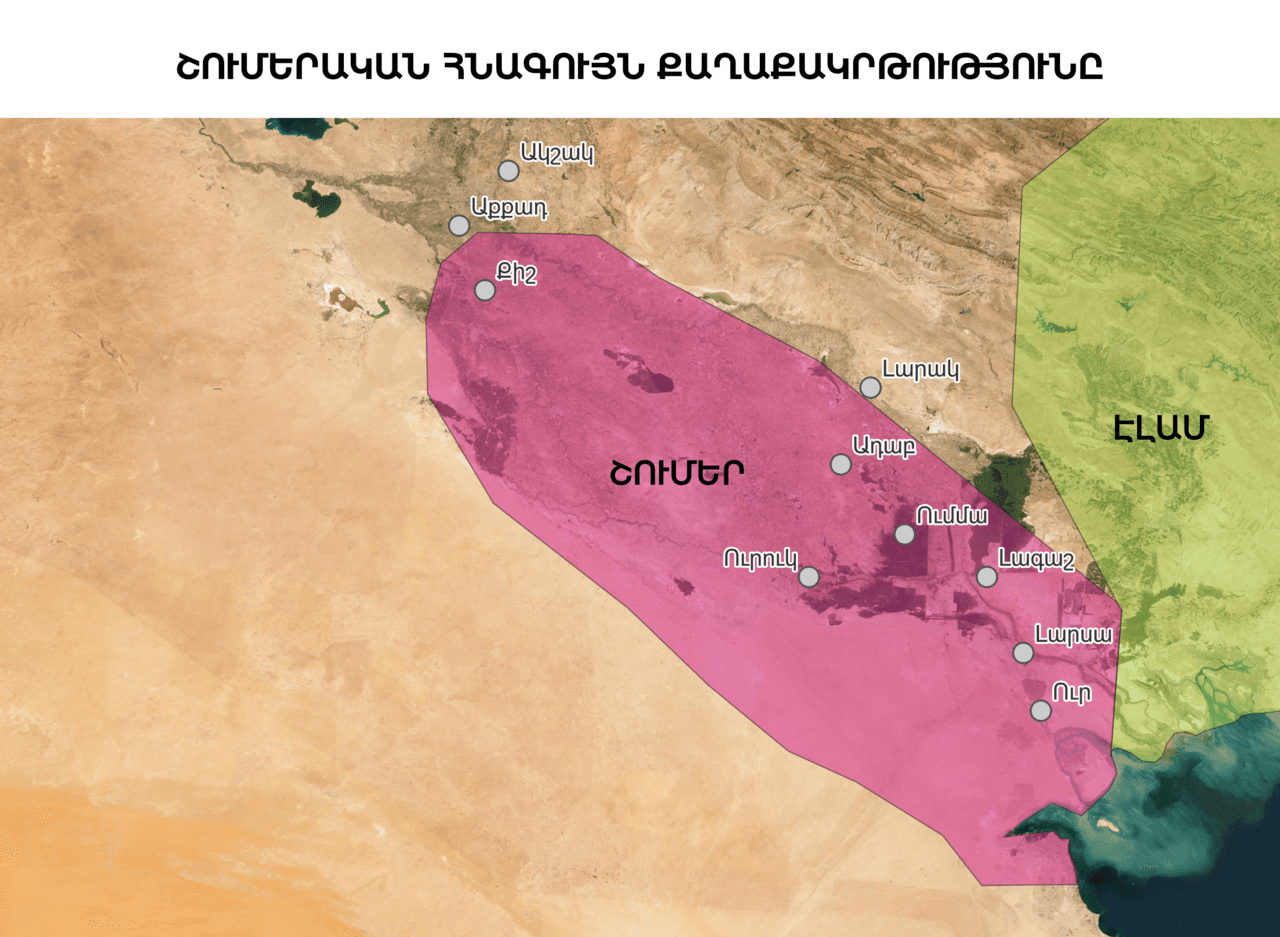
Sumerian civilization, which flourished in southern Mesopotamia (modern-day Iraq) from approximately 4500 to 1900 BCE, is widely regarded as the world's first advanced urban civilization. The Sumerians built the earliest known cities, developed the first writing system (cuneiform), codified the first legal codes, and laid intellectual foundations that influenced every subsequent culture from ancient Egypt to classical Greece. Their innovations in agriculture, astronomy, mathematics, and governance make them, in the words of scholar Samuel Noah Kramer, the people who gave civilization its essential vocabulary.
Who Were the Sumerians and Where Did They Come From?
The Sumerians occupied the alluvial plains between the Tigris and Euphrates rivers in what is today southern Iraq—a region the ancient Greeks called Mesopotamia, meaning 'land between the rivers.' Their ethnic and linguistic origins remain one of archaeology's enduring mysteries. The Sumerian language is a language isolate: it bears no proven relationship to any other known language family, including the Semitic languages spoken by neighboring Akkadians and Babylonians. Scholars have proposed origins ranging from Central Asia to the Persian Gulf coast, but no consensus has emerged. What is clear is that by 3500 BCE, a culturally and linguistically distinct people were building monumental temples and administering complex economies in cities like Uruk, Eridu, and Nippur. The earliest recognizable Sumerian culture—the Ubaid period—dates to around 6500 BCE, but the hallmark achievements of cities and writing emerged during the subsequent Uruk period (4000–3100 BCE).
What Did the Sumerians Invent? Their Most Important Contributions
The Sumerians' list of firsts is staggering. Around 3200 BCE, scribes in Uruk developed cuneiform—the world's earliest writing system—initially to track grain, livestock, and trade goods. Over centuries it evolved to record literature, law, hymns, and astronomy. The Epic of Gilgamesh, written down around 2100 BCE, is the world's oldest surviving narrative poem and predates Homer by more than 1,500 years. In mathematics, the Sumerians used a sexagesimal (base-60) counting system that survives today in our 60-minute hours, 360-degree circles, and 60-second minutes. They developed multiplication tables, calculated square roots, and divided the night sky into constellations, producing astronomical records accurate enough to predict lunar eclipses. Technologically, Sumerians are credited with the first practical use of the wheel (around 3500 BCE, initially for pottery, then for transport), the potter's wheel, bronze metallurgy, the arch, the plow, and the sailboat. They also brewed beer—one of the world's first manufactured beverages—and left behind the earliest known recipe, inscribed on a clay tablet around 1800 BCE.
How Did Sumerian City-States Work? Politics and Government
Sumerian society was organized into rival city-states, each centered on a massive stepped temple called a ziggurat, which served as the administrative and religious heart of the community. Major city-states included Uruk (population estimated at 50,000–80,000 by 3000 BCE, making it the world's largest city at the time), Ur, Lagash, Nippur, Kish, Umma, and Eridu. Each city-state was theoretically governed by a god, with the king (lugal, meaning 'great man') or city governor (ensi) acting as the deity's earthly steward. Early government was quasi-democratic: assemblies of citizens and elders debated decisions during crises, a system documented in the Gilgamesh epic itself. By the Early Dynastic Period (2900–2350 BCE), hereditary kingship had solidified. Warfare between city-states was endemic: the Stele of the Vultures (circa 2450 BCE) records Lagash's King Eannatum defeating the rival city of Umma in history's first documented military campaign, deploying infantry formations remarkably similar to the later Greek phalanx. The economy was managed by temple institutions that redistributed grain, wool, and fish through elaborate bureaucracies tracked—of course—in cuneiform records.
What Was Sumerian Religion and Mythology?
Religion permeated every aspect of Sumerian life. The Sumerians were polytheists who believed the universe was governed by a pantheon of powerful, anthropomorphic gods. The four chief deities were An (sky god), Enlil (god of wind and storms, lord of the earth), Enki (god of wisdom and water), and Ninhursag (earth mother goddess). Beneath these were hundreds of lesser divine figures governing everything from the Moon (Nanna/Sin) to the planet Venus (Inanna/Ishtar), who became one of the ancient world's most complex divine figures—goddess of love, war, and fertility. The Sumerians believed humans were created from clay mixed with the blood of a slain god, specifically to serve the gods and relieve them of labor—a theology recorded in texts like the Atrahasis Epic and Enuma Elish, which directly influenced later Babylonian and Hebrew creation narratives including Genesis. Sumerian temples housed divine statues, and priests performed daily rituals of feeding, clothing, and 'waking' the gods. The Descent of Inanna, one of the world's oldest religious texts, describes the goddess's journey to the underworld and resurrection—a mythological template echoed in later cultures from Egypt (Osiris) to Greece (Persephone).
What Were the Major Periods of Sumerian History?
Sumerian history spans roughly 2,500 years across several distinct periods. The Ubaid Period (6500–4000 BCE) saw the construction of the first mud-brick temples and the earliest agricultural communities in the south. The Uruk Period (4000–3100 BCE) was the era of explosive urbanization and the invention of writing and the cylinder seal. The Early Dynastic Period (2900–2350 BCE) was the classic age of warring city-states and legendary kings like Gilgamesh of Uruk (if historical, reigned circa 2700 BCE) and Enmebaragesi of Kish, the earliest king confirmed by archaeological evidence. The Akkadian Empire (2334–2154 BCE) saw Sargon of Akkad conquer all of Mesopotamia in 2334 BCE, creating the world's first multi-ethnic empire and reducing Sumerian cities to provincial status—though Sumerian culture, language, and religion continued to dominate intellectual life. The Third Dynasty of Ur (Ur III, 2112–2004 BCE) represented a remarkable Sumerian renaissance: King Ur-Nammu built the famous Great Ziggurat of Ur, promulgated the world's oldest surviving law code (predating Hammurabi's Code by 300 years), and presided over a highly centralized bureaucratic state. The period ended when the Amorites invaded from the west and the Elamites sacked Ur around 2004 BCE, ending political Sumerian independence forever.
| Period | Dates (BCE) | Key Development | Notable Site/Figure |
|---|---|---|---|
| Ubaid Period | 6500–4000 | First temples, early agriculture | Eridu (oldest city) |
| Uruk Period | 4000–3100 | Invention of writing, rapid urbanization | Uruk (world's largest city, c.3000) |
| Early Dynastic | 2900–2350 | City-state rivalry, bronze warfare | Gilgamesh of Uruk, Eannatum |
| Akkadian Empire | 2334–2154 | First empire; Sumerian culture preserved | Sargon of Akkad |
| Gutian Interlude | 2154–2112 | Akkadian collapse, decentralization | Gudea of Lagash |
| Ur III (Neo-Sumerian) | 2112–2004 | Sumerian renaissance, first law code | Ur-Nammu, Great Ziggurat of Ur |
| Decline | 2004–1900 | Amorite invasions, Elamite sack of Ur | Fall of Ur, end of Sumerian state |
What Was Sumerian Society and Daily Life Like?
Sumerian society was hierarchical but not rigidly caste-based. At the top sat the king, priests, and high administrators; below them were merchants, craftsmen, and scribes; at the base were agricultural laborers and slaves, the latter typically prisoners of war or debt defaulters. Women enjoyed considerably more legal rights in Sumer than in many later ancient societies: they could own property, conduct business, testify in court, and serve as priestesses of high rank. The most famous example is Enheduanna (circa 2285–2250 BCE), daughter of Sargon of Akkad, who served as high priestess of the Moon god in Ur and composed hymns to Inanna that are the world's first attributed literary works—making her history's earliest known named author. Sumerian homes were mud-brick structures built around central courtyards. The staple diet consisted of barley bread, fish, onions, dates, and beer. Schools called edubba ('tablet houses') trained scribes in cuneiform, mathematics, and literature; school tablets recording students' exercises survive by the thousands. Medical texts catalogued hundreds of prescriptions using plant, animal, and mineral ingredients, demonstrating empirical approaches to healthcare as early as 2100 BCE.
Why Did Sumerian Civilization Decline and Fall?
The decline of Sumerian civilization was a gradual process driven by multiple converging forces. Militarily, waves of external invaders—Gutians (circa 2154 BCE), Amorites (circa 2000 BCE), and Elamites (2004 BCE)—repeatedly disrupted Mesopotamian political structures. Ecologically, centuries of intensive irrigation caused catastrophic salt buildup in the soil (salinization), reducing crop yields by an estimated 40–65 percent between 2400 and 1700 BCE according to analyses by Thorkild Jacobsen and Robert Adams. As the agricultural base weakened, the economic and demographic power of southern Mesopotamian cities declined relative to the north. Linguistically, Sumerian was already a dead spoken language by approximately 2000 BCE, replaced by Akkadian and later Babylonian in everyday speech, though it survived as a prestigious written language for religious and scholarly purposes—much like Latin in medieval Europe—until at least the 1st century CE. When the Amorite ruler Hammurabi of Babylon unified Mesopotamia around 1760 BCE, Sumerian identity as a political force was extinguished. Yet Sumerian culture was not erased: Babylonian religion, mathematics, astronomy, and literature were direct inheritances from Sumer, transmitted through Assyrian, Persian, Greek, and ultimately Western civilizations.
What Is the Legacy of Sumerian Civilization Today?
The Sumerian legacy is embedded in the foundations of modern civilization in ways often invisible precisely because they are so fundamental. Every time a person checks the time (60 minutes, 60 seconds), measures an angle (360 degrees), reads a story, follows a law, or looks at a zodiac chart, they are drawing on Sumerian intellectual heritage. The concept of the seven-day week likely has Sumerian and Babylonian roots tied to the seven celestial bodies they identified. Sumerian flood narratives—preserved in the Epic of Gilgamesh—are among the most direct antecedents of the biblical story of Noah's Ark, with striking parallels in detail. Their administrative practices—standardized weights and measures, written contracts, receipts—are the direct ancestors of modern commercial law. The ziggurat architecture influenced later temple design across the ancient Near East. Modern archaeology owes its own origins partly to Sumer: excavations at Nippur beginning in 1888 and at Ur by Leonard Woolley between 1922 and 1934 established systematic stratigraphic excavation methods still in use. Today, over 500,000 cuneiform tablets have been recovered and only a fraction fully translated, meaning the Sumerian record continues to yield new discoveries. In 2019, a tablet from the Yale Babylonian Collection was identified as containing a previously unknown portion of the Gilgamesh epic, confirming that Sumer still has secrets to reveal.