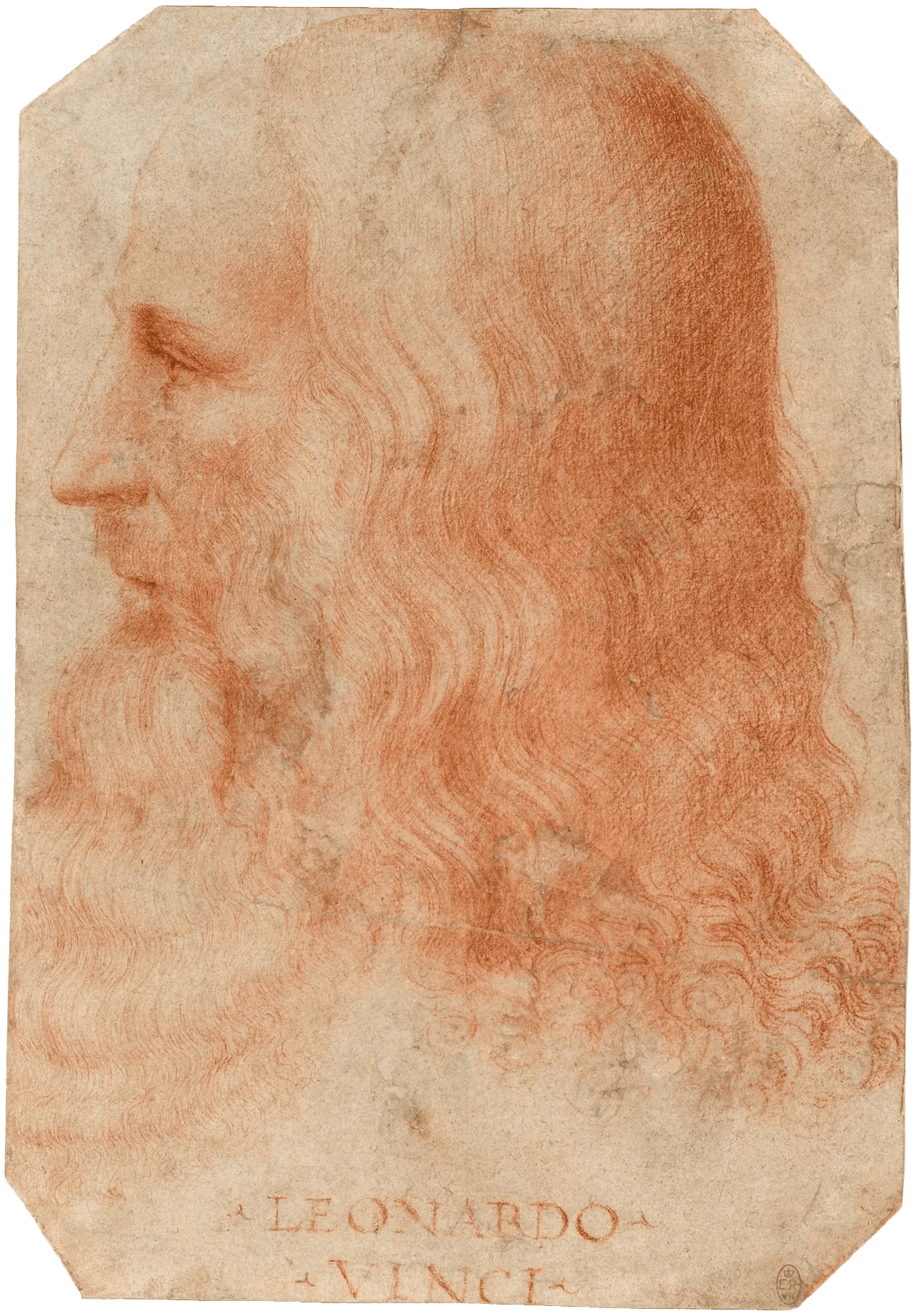
On a spring morning in 1519, a 67-year-old man died in the Château du Clos Lucé in Amboise, France, reportedly in the arms of King Francis I of France. He left behind fewer than 20 surviving paintings, roughly 7,200 pages of notebooks, and a reputation so vast that five centuries of scholarship have barely scratched its surface. Leonardo da Vinci was not merely a Renaissance man — he was the Renaissance man, a figure so polymathic that historians still struggle to classify him: painter, sculptor, architect, engineer, anatomist, botanist, geologist, musician, and visionary.
An Illegitimate Beginning
Leonardo was born on April 15, 1452, in Anchiano, a hamlet near the town of Vinci in the Republic of Florence. He was the illegitimate son of Ser Piero da Vinci, a prosperous notary, and Caterina, a peasant woman whose precise identity remained debated for centuries. His illegitimacy barred him from many professions — including his father's — but it also freed him from the rigid guild expectations that constrained legitimate sons. Raised partly by his father and partly by his uncle Francesco, Leonardo displayed an extraordinary curiosity about the natural world from childhood. At around 14, he was apprenticed to the renowned Florentine artist Andrea del Verrocchio, whose workshop in Florence was one of the most prestigious in Italy. It was here that Leonardo's genius first announced itself publicly: according to Giorgio Vasari, when Verrocchio saw Leonardo's contribution to their collaborative painting 'The Baptism of Christ,' he reportedly put down his brush and never painted again.
The Florentine Years and the Court of Milan
After qualifying as a master in the Guild of Saint Luke in 1472, Leonardo spent his early career in Florence under the patronage of Lorenzo de' Medici. Yet he was notoriously slow to complete commissions, leaving behind a trail of unfinished masterpieces that would frustrate patrons throughout his life. In 1482, he moved to Milan to serve Ludovico Sforza, 'Il Moro,' the Duke of Milan. In his famous letter of introduction to Sforza, Leonardo barely mentioned painting — instead listing his abilities as a military engineer, bridge builder, cannon designer, and architect. It was a calculated pitch, and it worked. He spent nearly 17 years in Milan, during which time he produced some of his most celebrated works, including 'The Virgin of the Rocks' and, most famously, 'The Last Supper,' painted between approximately 1495 and 1498 on a refectory wall in Santa Maria delle Grazie.
The Last Supper and the Mona Lisa
'The Last Supper' depicts the moment Christ announces that one of his apostles will betray him, capturing a cascade of human emotion across twelve faces with revolutionary psychological depth. Though deteriorating almost from the moment it was finished — Leonardo experimented with tempera and oil on plaster rather than true fresco — it remains one of the most reproduced artworks in history. His other iconic painting, the 'Mona Lisa,' was begun around 1503 and may never have been formally delivered to its commissioner, Francesco del Giocondo. Leonardo apparently carried it with him for years, continuing to refine it. Today it hangs in the Louvre in Paris, behind bulletproof glass, greeting approximately 9 million visitors a year. Its subject's enigmatic smile and the revolutionary sfumato technique — a subtle blurring of outlines that creates an almost photographic depth — made it unlike anything painted before.
Scientist and Engineer Before His Time
Perhaps more startling than Leonardo's paintings are his notebooks. Written in his famous mirror script — possibly to deter casual readers, or simply because he was left-handed — they reveal a mind relentlessly probing the mechanics of the universe. He dissected more than 30 human corpses to produce anatomical drawings of the heart, brain, musculature, and fetus that would not be surpassed in accuracy for centuries. He designed a rudimentary helicopter (the 'aerial screw'), a hang glider, an armored vehicle resembling a tank, a solar power concentrator, and a robotic knight. He studied the flow of water with the precision of a hydraulic engineer, mapped geological strata, and correctly theorized that the moon reflected rather than generated light. Most of these ideas were never published in his lifetime, meaning their influence on subsequent science was negligible — a historical tragedy of enormous proportions. Had his notebooks been widely circulated, the history of technology might look dramatically different.
| Domain | Key Contribution | Modern Relevance |
|---|---|---|
| Painting | Sfumato technique, psychological realism | Foundation of Western portraiture |
| Anatomy | Detailed dissection drawings of human body | Precursor to modern medical illustration |
| Engineering | Designs for flying machines, armored vehicle | Anticipates aviation and military vehicles |
| Hydrology | Studies of water flow and wave motion | Early fluid dynamics |
| Geology | Recognition of fossil evidence and rock strata | Precursor to stratigraphic geology |
| Optics | Studies of light, shadow, and the eye | Advances in understanding human vision |
The Wandering Final Years
When French forces invaded Milan in 1499, Leonardo's world collapsed. He spent the following years moving across Italy — Venice, Florence, Cesena (where he briefly served the ruthless Cesare Borgia as a military engineer), Rome — never quite settling. In Rome, under the patronage of Giuliano de' Medici, he found himself overshadowed by the rising stars of Michelangelo and Raphael. Pope Leo X reportedly remarked that Leonardo would never finish anything. In 1516, at the invitation of King Francis I of France, Leonardo made his final journey, traveling over the Alps to Amboise with his most cherished paintings — including the Mona Lisa — rolled in his luggage. The French king gave him the Château du Clos Lucé, a salary, and the title 'First Painter, Engineer, and Architect to the King.' He died there on May 2, 1519.
A Legacy That Defies Categories
Leonardo da Vinci left no school of followers in the way Raphael or Michelangelo did, and he published nothing in his lifetime. His notebooks were scattered after his death and only gradually reassembled over subsequent centuries; some pages are still being discovered in archives. Yet his influence is immeasurable. His paintings set a standard for artistic achievement that shaped Western art for generations. His anatomical drawings informed medical science. His engineering sketches have inspired engineers, inventors, and entrepreneurs from the Renaissance to Silicon Valley. In an age of increasing specialization, Leonardo remains the supreme argument for the power of connecting disciplines — of seeing, as he put it, how 'everything is connected to everything else.' He was, as Walter Isaacson observed in his landmark 2017 biography, not a genius who descended from the heavens, but a self-made genius — the product of insatiable curiosity, relentless observation, and a refusal to stop asking why.