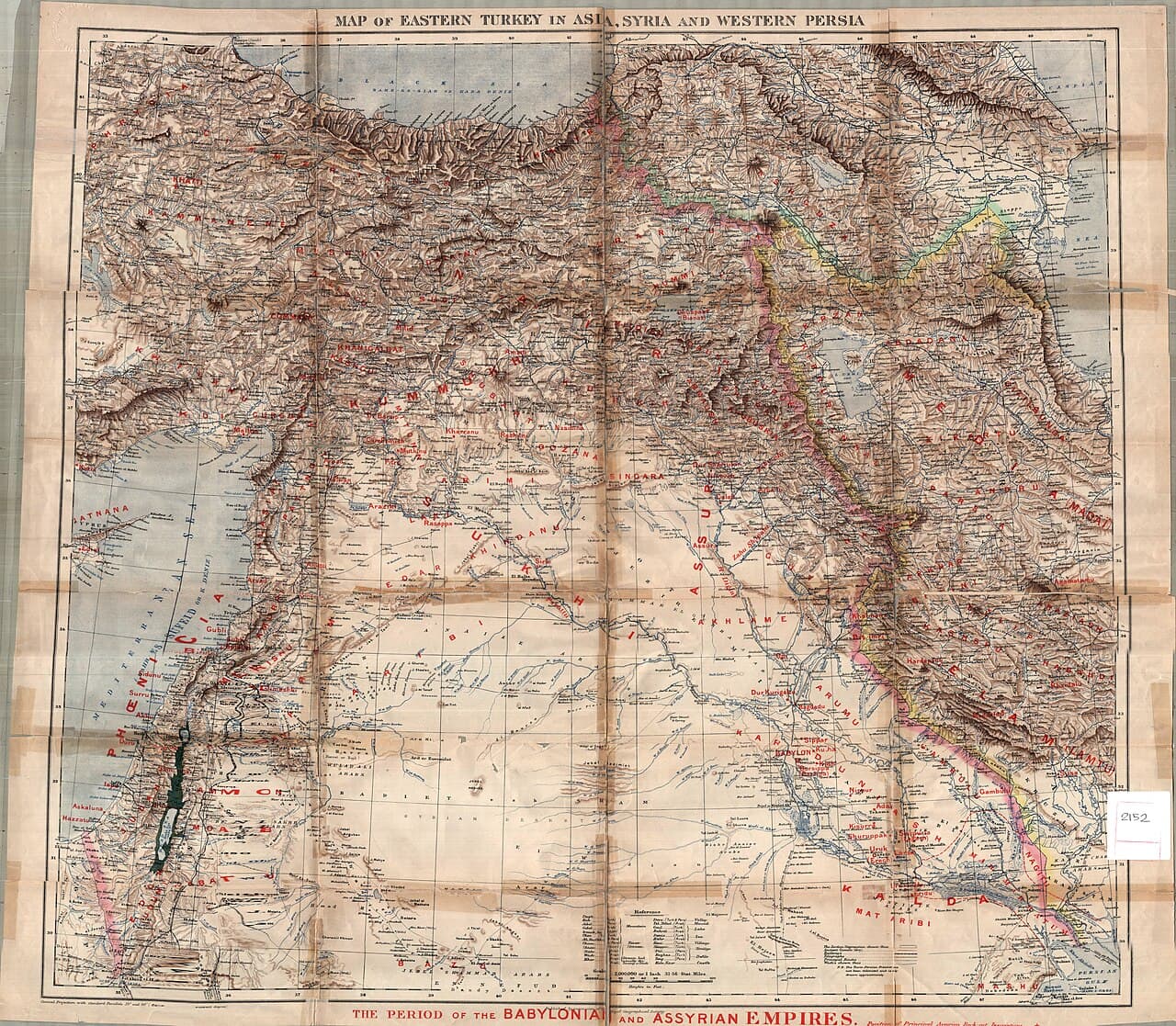
The Babylonian Empire was one of the most powerful and culturally influential civilizations in the ancient world, dominating Mesopotamia — modern-day Iraq — from roughly 1894 BC to 539 BC across two distinct periods. Founded by the Amorite king Sumuabum and reaching its first peak under the legendary lawgiver Hammurabi (r. 1792–1750 BC), Babylon grew from a minor city-state on the Euphrates River into the political, commercial, and intellectual capital of the Near East. Its contributions to law, astronomy, mathematics, and architecture permanently shaped the trajectory of human civilization.
What Were the Origins of the Babylonian Empire?
Babylon — whose Akkadian name, Bab-ilim, means 'Gate of the Gods' — was a settlement of modest significance until the early second millennium BC. The city occupied a strategic position on the Euphrates River, roughly 85 kilometres south of modern Baghdad, placing it at the crossroads of Sumerian civilization to the south and Akkadian-speaking populations to the north. Around 1894 BC, the Amorite chieftain Sumuabum established an independent dynasty there, breaking away from the crumbling Third Dynasty of Ur. For the next century, Babylon's kings steadily expanded their territory through a combination of diplomacy and war, absorbing rival city-states such as Kish, Sippar, and Marad. The city was still relatively small, however — it would take the sixth king of this dynasty, Hammurabi, to transform Babylon into an empire.
How Did Hammurabi Build the First Babylonian Empire?
Hammurabi, who reigned from approximately 1792 to 1750 BC, is universally regarded as the architect of the Old Babylonian Empire. He began his reign inheriting a kingdom of modest size, surrounded by powerful rivals including Larsa to the south, Eshnunna to the east, Assyria to the north, and Mari to the northwest. His genius lay in playing these powers against one another. For nearly three decades he cultivated alliances and maintained peace while strengthening Babylon's military and administrative infrastructure. Then, in a rapid sequence of campaigns between 1763 and 1755 BC, he struck decisively: he defeated Rim-Sin I of Larsa in 1763 BC, conquered Eshnunna around 1762 BC, destroyed Mari in 1761 BC, and subdued Assyria. By the end of his reign, Hammurabi controlled virtually all of Mesopotamia from the Persian Gulf to the upper Euphrates — an empire of perhaps 500,000 square kilometres. He organized this vast territory into an efficient administrative state, appointing governors, standardizing weights and measures, and centralizing tax collection in Babylon.
What Was the Code of Hammurabi and Why Does It Matter?
Among Hammurabi's most enduring achievements is the Code of Hammurabi, a collection of 282 laws inscribed on a 2.25-metre-tall black diorite stele, discovered at Susa by French archaeologists in 1901 and now housed in the Louvre, Paris. Composed around 1754 BC, it is one of the oldest and most complete written legal codes in world history. The code regulated commerce, property rights, inheritance, marriage, professional conduct, and punishments for crimes. Its guiding principle — often summarized as 'an eye for an eye' (lex talionis) — actually reflected a sophisticated graduated justice system in which punishments varied according to the social status of both perpetrator and victim. Freeborn citizens, freed persons, and slaves faced different penalties for the same offence. The prologue explicitly states that Hammurabi acted on divine authority from the sun god Shamash, framing royal law as cosmic order. Scholars identify the Code as a foundational document in the history of jurisprudence, influencing later legal traditions including those of the Hebrew Bible and, indirectly, Roman law.
Why Did the Old Babylonian Empire Collapse?
The empire Hammurabi built proved difficult to sustain. His son Samsu-iluna (r. 1749–1712 BC) faced an almost immediate crisis: a massive revolt by the Sealand Dynasty in southern Mesopotamia succeeded in breaking away from Babylonian control and was never fully recovered. Subsequent kings managed to hold the core of the empire but with diminishing authority. The coup de grâce came around 1595 BC when the Hittite king Mursili I launched a spectacular raid from Anatolia, sacking Babylon and carrying off the cult statue of the god Marduk. This catastrophic blow did not immediately end Babylon's existence, but it ended the Amorite dynasty. The power vacuum was quickly filled by the Kassites, a people of uncertain origin from the Zagros Mountains, who ruled Babylon for approximately 400 years (c. 1595–1155 BC) — the longest dynasty in Babylonian history. Under Kassite rule, Babylon remained a cultural center and the Kassite kings adopted Babylonian religion, language, and administrative practices, but the empire never regained the expansionist power of Hammurabi's era.
How Did the Neo-Babylonian Empire Rise to Power?
Following the Kassite period, Babylon passed through centuries of Assyrian domination. In 689 BC, the Assyrian king Sennacherib destroyed Babylon almost entirely — a sacrilege so shocking that his own son Esarhaddon rebuilt the city as an act of expiation. But Assyrian power was not invincible. In 626 BC, a Chaldean chieftain named Nabopolassar seized the Babylonian throne and founded what historians call the Neo-Babylonian (or Chaldean) Empire. He allied with the Medes under Cyaxares and launched a coordinated assault on Assyria. In 612 BC, their combined forces sacked and destroyed Nineveh, the Assyrian capital, effectively ending the Neo-Assyrian Empire — one of the ancient world's most feared military powers. Babylon suddenly found itself the dominant state of the Near East, controlling Mesopotamia, the Levant, and access to lucrative trade routes connecting Egypt, Arabia, and the Persian Gulf.
Who Was Nebuchadnezzar II and What Did He Accomplish?
Nebuchadnezzar II (r. 605–562 BC) was the Neo-Babylonian Empire's greatest ruler and one of antiquity's most celebrated monarchs. The son of Nabopolassar, he consolidated Babylon's dominance of the Near East through relentless military campaigning. In 605 BC he defeated the Egyptians at the Battle of Carchemish on the Euphrates, effectively ending Egyptian influence in the Levant. He besieged Jerusalem twice — in 597 BC and again in 587/586 BC — destroying Solomon's Temple, demolishing Jerusalem's walls, and deporting large portions of Judah's population to Babylon in events the Hebrew Bible commemorates as the Babylonian Captivity (or Exile). These deportees, numbering perhaps 10,000 to 20,000 in the first wave alone, became a foundational episode in Jewish history and theology. Nebuchadnezzar channeled the empire's enormous wealth into rebuilding Babylon on a monumental scale. Ancient sources describe a city of perhaps 200,000 inhabitants enclosed within massive double walls — the outer wall reportedly wide enough for a four-horse chariot to turn on. He constructed the Ishtar Gate, a magnificent entryway faced with glazed blue bricks depicting dragons and bulls, portions of which are now reconstructed in the Pergamon Museum in Berlin. He also built or expanded the great ziggurat Etemenanki — possibly the inspiration for the biblical Tower of Babel — which rose in seven stages to an estimated height of 90 metres.
Did the Hanging Gardens of Babylon Really Exist?
The Hanging Gardens of Babylon, counted among the Seven Wonders of the Ancient World, are traditionally attributed to Nebuchadnezzar II, who supposedly built them to comfort his Median wife Amytis, who missed the green hills of her homeland. Ancient Greek and Roman writers including Diodorus Siculus, Strabo, and Quintus Curtius described terraced gardens rising high above the Euphrates plain, irrigated by an elaborate hydraulic system that lifted water from the river. Despite extensive archaeological excavation of Babylon since the late 19th century, no definitive physical evidence for the gardens has been found within the city. Some scholars, notably the classicist Stephanie Dalley of Oxford University, have proposed that the gardens were actually located in Nineveh and were misattributed to Babylon by later writers. Others maintain they existed in Babylon but have not yet been located. The debate remains unresolved, making the Hanging Gardens the most mysterious of the Seven Wonders — and possibly the only one whose location is genuinely uncertain.
What Were Babylon's Intellectual and Scientific Achievements?
Babylon's legacy extends far beyond politics and architecture. Babylonian scholars made extraordinary advances in mathematics and astronomy that directly influenced Greek science and, through it, the modern world. Babylonian mathematicians, working in a base-60 (sexagesimal) number system, could solve quadratic equations, calculate square roots, and work with what we now call the Pythagorean theorem more than a millennium before Pythagoras was born. Our division of the hour into 60 minutes and the minute into 60 seconds is a direct inheritance from Babylonian mathematics. In astronomy, Babylonian scribes maintained systematic records of celestial observations for centuries, enabling them to predict lunar eclipses with remarkable accuracy. They identified the five planets visible to the naked eye, developed the zodiac as a 12-constellation belt along the ecliptic, and created mathematical models to predict planetary positions — the earliest known example of mathematical astronomy. The Enuma Anu Enlil, a corpus of approximately 7,000 celestial omens compiled over centuries, represents one of the ancient world's most sophisticated scientific archives. These achievements were transmitted to Greek thinkers like Hipparchus and Ptolemy, forming a cornerstone of Western astronomy.
| Period | Dates | Dynasty/Rulers | Key Events |
|---|---|---|---|
| Old Babylonian | 1894–1595 BC | Amorite Dynasty (Sumuabum to Samsu-ditana) | Hammurabi's conquests; Code of Hammurabi (c. 1754 BC) |
| Kassite Period | 1595–1155 BC | Kassite Dynasty | Longest Babylonian dynasty; cultural continuity; no major expansion |
| Isin II Period | 1157–1026 BC | Second Dynasty of Isin | Nebuchadnezzar I briefly restores power; retrieves Marduk statue from Elam |
| Assyrian Dominance | 911–626 BC | Neo-Assyrian vassalage | Babylon repeatedly controlled, rebelled, and destroyed (689 BC) by Assyria |
| Neo-Babylonian | 626–539 BC | Chaldean Dynasty (Nabopolassar to Nabonidus) | Destruction of Nineveh (612 BC); Nebuchadnezzar II; Babylonian Captivity |
| Persian Conquest | 539 BC | Achaemenid Empire (Cyrus the Great) | Babylon falls without battle; Cyrus Cylinder issued |
How Did the Babylonian Empire Fall to Cyrus the Great in 539 BC?
The Neo-Babylonian Empire's final years were marked by internal instability. After Nebuchadnezzar II's death in 562 BC, four rulers followed in rapid succession through palace coups and assassinations. The last Babylonian king, Nabonidus (r. 556–539 BC), was an enigmatic figure who devoted himself to the moon god Sin rather than Babylon's patron deity Marduk, alienating the powerful priesthood. He spent nearly a decade absent from Babylon, residing at the oasis of Tayma in Arabia, leaving his son Belshazzar as regent — the prince of the biblical Book of Daniel. This religious and political dysfunction left Babylon internally divided when the Persian king Cyrus II ('the Great') of the Achaemenid Empire advanced from the east. In October 539 BC, Persian forces under the general Ugbaru defeated the Babylonian army at the Battle of Opis on the Tigris. Days later, Persian troops entered Babylon itself — reportedly without significant resistance, the gates opened by citizens and priests who welcomed Cyrus as a liberator. Cyrus issued the famous Cyrus Cylinder, a clay proclamation in which he presented himself as chosen by Marduk to restore order and allowed deported peoples, including the Jews, to return to their homelands. The Babylonian Empire was extinguished, absorbed into the vast Achaemenid Persian Empire.
What Is the Legacy of the Babylonian Empire Today?
The Babylonian Empire's influence permeates modern civilization in ways that are often invisible precisely because they are so foundational. The 60-minute hour, the 360-degree circle, the zodiac constellations, and the seven-day week all trace direct lineages to Babylonian scholarship. The Code of Hammurabi established the principle that a ruler's authority carries with it an obligation to provide justice — a concept that underlies every modern legal system. The Babylonian Captivity profoundly shaped Judaism, catalyzing the compilation of the Hebrew scriptures and the crystallization of monotheistic theology that would later birth Christianity and Islam. The very word 'Babel' entered global culture as a metaphor for linguistic diversity and human ambition. The ancient city of Babylon in Iraq — today a UNESCO World Heritage Site designated in 2019 — continues to be excavated and studied, and each new discovery refines our understanding of a civilization that, at its height, was the most sophisticated urban culture on Earth. Babylon was not merely an ancient empire; it was the template on which much of subsequent civilization was built.