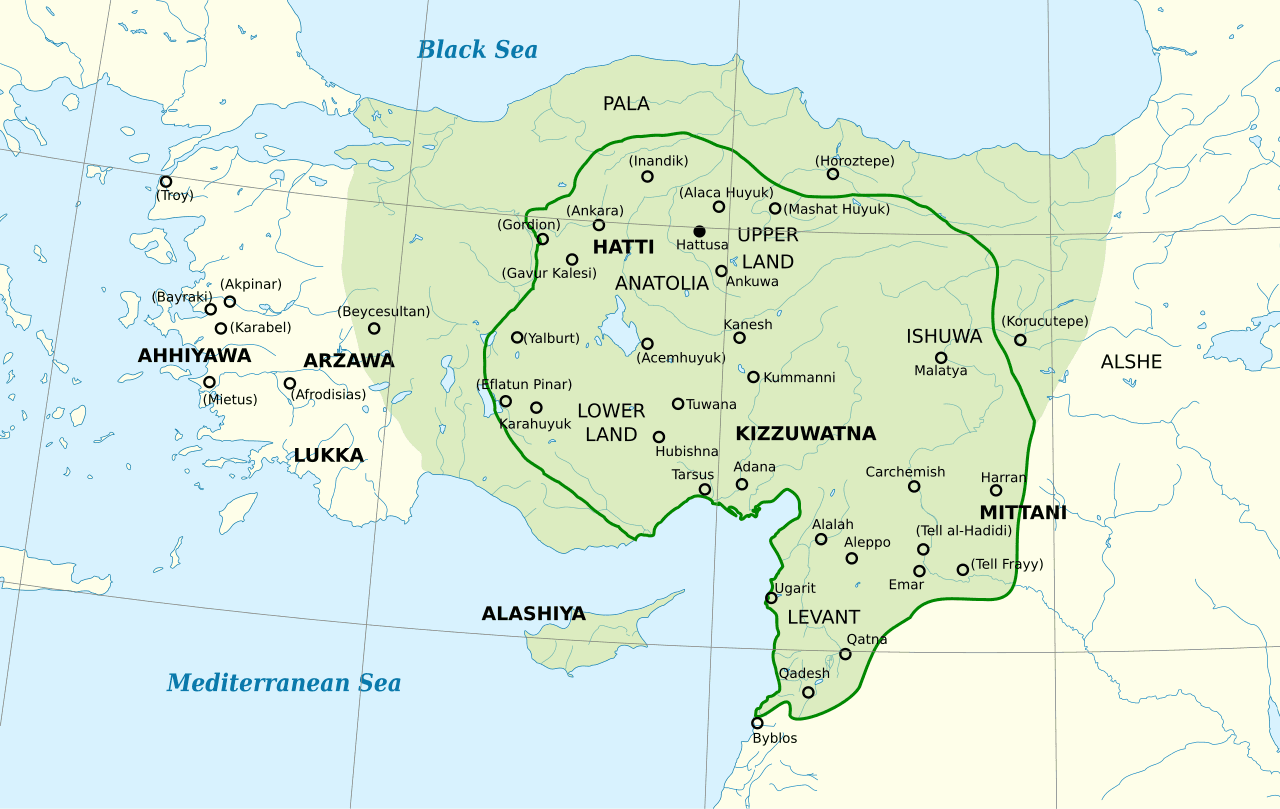
The Hittite Empire was one of the dominant superpowers of the ancient Bronze Age world, ruling from their capital Hattusa in central Anatolia (modern-day Turkey) from approximately 1650 BC to 1178 BC. At its height, the empire stretched from the Aegean coast to northern Syria, rivalling Egypt and Mesopotamia in military power, diplomatic sophistication, and cultural achievement. The Hittites are best known for fighting the Battle of Kadesh against Ramesses II in 1274 BC — the earliest recorded large-scale chariot battle in history — and for concluding what is arguably the world's first surviving written peace treaty.
Who Were the Hittites? Origins and Early History
The Hittites were an Indo-European people who migrated into Anatolia sometime around 2000 BC, blending with the indigenous Hattian population and adopting much of their religious culture and vocabulary. The name 'Hittite' itself derives from 'Hatti,' the older Hattian name for the region. Their own language, Nesili (or Nesian), is among the oldest known Indo-European languages, making Hittite texts of immense value to modern linguistics. The earliest Hittite political entity, known as the Old Kingdom, was established around 1700–1650 BC when King Pithana of Kussara and later his son Anitta began consolidating power across central Anatolia. Anitta famously destroyed the city of Hattusa and declared it cursed — yet within a century, Hattusa would become the empire's glittering capital. The Old Kingdom proper began around 1650 BC under King Hattusili I, who launched the first organized military campaigns southward into Syria, establishing a pattern of territorial expansion that would define Hittite strategy for centuries. His grandson Mursili I dramatically extended this ambition in approximately 1595 BC by leading a daring raid deep into Mesopotamia, sacking the city of Babylon and bringing the reign of the famous Hammurabi's dynasty to an end — a raid that shocked the ancient world.
How Did the Hittite Empire Reach Its Peak Power?
After a turbulent period of internal succession crises and assassinations during the Middle Kingdom (c. 1500–1430 BC), the Hittite Empire entered its most powerful phase, known as the New Kingdom or Hittite Imperial Period, beginning under Tudhaliya I around 1430 BC. The empire's greatest expansion came under Suppiluliuma I (reigned c. 1344–1322 BC), one of the most capable military commanders and diplomats of the ancient world. Suppiluliuma systematically dismantled the Mitanni Kingdom — the dominant power of the northern Levant — absorbing its territories and bringing Hittite control to the borders of Egypt's sphere of influence in Canaan. His campaigns gave the Hittites control of the vital trade routes linking Anatolia to Mesopotamia and the Mediterranean. So formidable was Suppiluliuma's reputation that when the Egyptian queen Ankhesenamun (widow of Tutankhamun) famously wrote to him around 1323 BC requesting one of his sons as a husband, acknowledging she had no wish to 'take a servant' for a king, it underscored just how far Hittite prestige had risen on the international stage. Tragically, the prince Zannanza was murdered en route to Egypt, sparking renewed conflict between the two empires. The empire at its territorial peak controlled roughly 500,000 square kilometres, encompassing most of modern Turkey, northern Syria, and parts of Lebanon.
What Was the Battle of Kadesh and Why Does It Matter?
The Battle of Kadesh, fought in 1274 BC near the Orontes River in modern Syria, stands as the defining military confrontation of the Bronze Age. Hittite King Muwatalli II assembled a force estimated at 3,500 chariots and 37,000 infantry to counter the advance of Egyptian Pharaoh Ramesses II, who led approximately 2,000 chariots and 20,000 soldiers. The battle began disastrously for Ramesses when Hittite forces ambushed and nearly destroyed one of his four divisions. Through a combination of personal bravery, the timely arrival of reinforcements, and tactical improvisation, Ramesses stabilized the Egyptian position, but neither side achieved a decisive victory. Both rulers returned home and declared victory in their own propaganda — Ramesses had his account carved in enormous reliefs across Egypt's temple walls, while Muwatalli II retained control of Kadesh. The strategic stalemate persisted for nearly two decades until Hattusili III (who had overthrown Muwatalli's successor) and Ramesses II signed the Egyptian–Hittite Peace Treaty in 1259 BC. This remarkable document, copies of which survive in both Egyptian hieroglyphics and Hittite cuneiform, established borders, guaranteed mutual military assistance, and included extradition clauses — making it a founding document of international diplomacy. A replica hangs today in the United Nations headquarters in New York.
| Feature | Hittite Empire | Egyptian Empire (New Kingdom) |
|---|---|---|
| Capital | Hattusa (modern Boğazkale, Turkey) | Thebes / Pi-Ramesses |
| Peak Territory | ~500,000 km² | ~1,000,000 km² |
| Primary Strength | Iron smelting, chariot warfare, diplomacy | Nile agriculture, monumental architecture, naval power |
| Key Ruler | Suppiluliuma I (c. 1344–1322 BC) | Ramesses II (c. 1279–1213 BC) |
| Writing System | Cuneiform + Hieroglyphic Luwian | Egyptian hieroglyphics |
| Collapse Date | c. 1178 BC | c. 1070 BC (New Kingdom end) |
| Legacy Document | Egyptian–Hittite Peace Treaty (1259 BC) | Egyptian–Hittite Peace Treaty (1259 BC) |
What Made Hittite Society and Culture Distinctive?
Hittite civilization was remarkable for its legal sophistication, religious tolerance, and technological innovation. The Hittite law code, preserved in cuneiform tablets, was notably more humane than contemporaneous Babylonian law: while Hammurabi's Code frequently prescribed death, Hittite law typically demanded compensation or fines, reflecting a pragmatic approach to social order. Hittite religion was extraordinarily syncretic — they worshipped a pantheon so vast that they were called 'the people of a thousand gods,' absorbing Hattian, Hurrian, Luwian, and Mesopotamian deities into their state cult. The storm god Teshub and the sun goddess Arinna were central figures. Women held relatively elevated legal status; queens (called Tawananna) wielded genuine political power and retained their titles even after a king's death. The Hittites are also credited as among the earliest systematic producers and users of iron. While the Iron Age proper began after the empire's collapse, archaeological evidence from Hattusa and Hittite texts confirm they were smelting and working iron as early as 1400 BC, and Hittite iron objects were prestigious diplomatic gifts traded across the Near East. Their capital Hattusa, excavated extensively since 1906 by German archaeologists, reveals a well-planned city of approximately 1.8 square kilometres enclosed by massive stone walls with five gates, including the famous Lion Gate and Sphinx Gate.
How Did the Hittites Govern Such a Large Empire?
The Hittite kings ruled as both supreme military commanders and chief priests, responsible for maintaining the favour of the gods through elaborate rituals. Governance was maintained through a system of vassal kingdoms — conquered rulers or appointed relatives who governed territories in exchange for tribute, military service, and loyalty oaths formalized through detailed treaties. The Hittites were prolific treaty-makers; the archives at Hattusa have yielded over 30,000 cuneiform tablets documenting treaties, royal decrees, religious rituals, mythological texts, and administrative records. International correspondence was conducted in Akkadian, the diplomatic lingua franca of the Bronze Age, with Hittite kings exchanging letters with rulers in Egypt, Babylon, Assyria, and Ugarit. The empire's bureaucracy included a council of nobles called the panku in the Old Kingdom period — an early form of institutional check on royal power, though it diminished in the New Kingdom as kings consolidated authority. Vassal states in Syria such as Aleppo (Halpa), Carchemish, and Ugarit were particularly important, serving as commercial and administrative hubs that channelled the wealth of Levantine trade back to Hattusa.
Why Did the Hittite Empire Collapse Around 1178 BC?
The collapse of the Hittite Empire around 1178 BC was swift, total, and remains one of the most debated mysteries in ancient history. Hattusa was violently destroyed — burned and abandoned — and never reoccupied as a major urban centre. The collapse was part of the broader Bronze Age Collapse, a catastrophic systems failure between approximately 1200 and 1150 BC that also destroyed the Mycenaean Greek palace civilizations, the Ugarit city-state, and severely weakened Egypt. Several interconnected factors are believed to have contributed. The 'Sea Peoples' — a confederation of maritime raiders of uncertain origin that included groups identified as Peleset, Tjeker, Shekelesh, Denyen, and Weshesh — launched devastating raids across the eastern Mediterranean beginning around 1207 BC. Hittite vassal states in Syria and the Levantine coast were overwhelmed, severing the empire's economic arteries. Climate-driven drought is increasingly supported by palaeoclimatological evidence: a severe multi-decade drought beginning around 1200 BC would have devastated the grain-dependent populations of Anatolia and the Levant. An internal letter discovered at Ugarit, written just before that city's destruction, describes the Hittite king desperately requesting emergency grain shipments, citing famine in his lands. Internal fragmentation and succession struggles further weakened the central government's ability to respond. The last known Hittite Great King, Suppiluliuma II, is attested in records around 1200 BC, after which the historical record goes silent. Some Hittite successor states, called the Neo-Hittite kingdoms, survived in northern Syria and southeastern Anatolia (at cities such as Carchemish, Malatya, and Sam'al) for several more centuries until their absorption by the Assyrian Empire between the 9th and 7th centuries BC.
What Is the Legacy of the Hittite Empire?
The Hittite Empire's legacy extends far beyond its 500-year lifespan. Their Egyptian–Hittite Peace Treaty of 1259 BC stands as the earliest surviving international peace agreement and is invoked as a prototype for modern diplomatic practice. The Hittite language, deciphered in 1915 by Czech linguist Bedřich Hrozný, revolutionized the study of Indo-European linguistics, confirming long-suspected connections between ancient Anatolian and European language families. Hittite iron-working techniques, disseminated through trade and conquest, contributed to the wider spread of iron technology across the Near East and Europe after the Bronze Age Collapse. The thousands of cuneiform tablets recovered from the Hattusa archives have provided historians with an unparalleled window into Bronze Age diplomacy, law, religion, and daily life. Hattusa itself was designated a UNESCO World Heritage Site in 1986 and continues to be excavated, with new discoveries regularly refining our understanding. In the Hebrew Bible, Hittites appear repeatedly — as inhabitants of Canaan, as trading partners of Solomon, and most famously in the story of Uriah the Hittite, husband of Bathsheba — suggesting that the Neo-Hittite successor states remained culturally prominent in the Levantine memory long after the empire's fall. The Hittites, largely forgotten after the ancient world until their rediscovery in the 19th century, have been fully restored to their rightful place as one of antiquity's most consequential civilizations.
How Was the Hittite Empire Rediscovered by Modern Scholars?
For nearly 2,500 years after their empire's collapse, the Hittites existed only in fragmentary biblical references and a handful of puzzling Egyptian inscriptions. The first modern clue came in 1834 when French traveller Charles Texier stumbled upon the ruins of Hattusa near the village of Boğazköy in central Turkey, though their significance was not immediately understood. Systematic excavation began in 1906 under German archaeologist Hugo Winckler, whose team unearthed over 10,000 cuneiform tablets in the first season alone — a discovery that transformed Bronze Age scholarship overnight. The decipherment of Hittite cuneiform by Bedřich Hrozný in 1915, published in his landmark paper demonstrating the language's Indo-European nature, opened the full archive to analysis. Further excavations through the 20th and 21st centuries by the German Archaeological Institute (Deutsches Archäologisches Institut) have uncovered city plans, temples, the massive royal archive building, and extensive fortification walls. Ongoing excavations continue to yield new information: a large reservoir system discovered in 2015 revealed sophisticated hydraulic engineering, and hieroglyphic Luwian inscriptions found in subsequent years have expanded knowledge of the empire's western frontier culture. The story of the Hittites' rediscovery is itself one of archaeology's greatest narratives — a superpower hidden in plain sight beneath the Anatolian plateau for millennia.