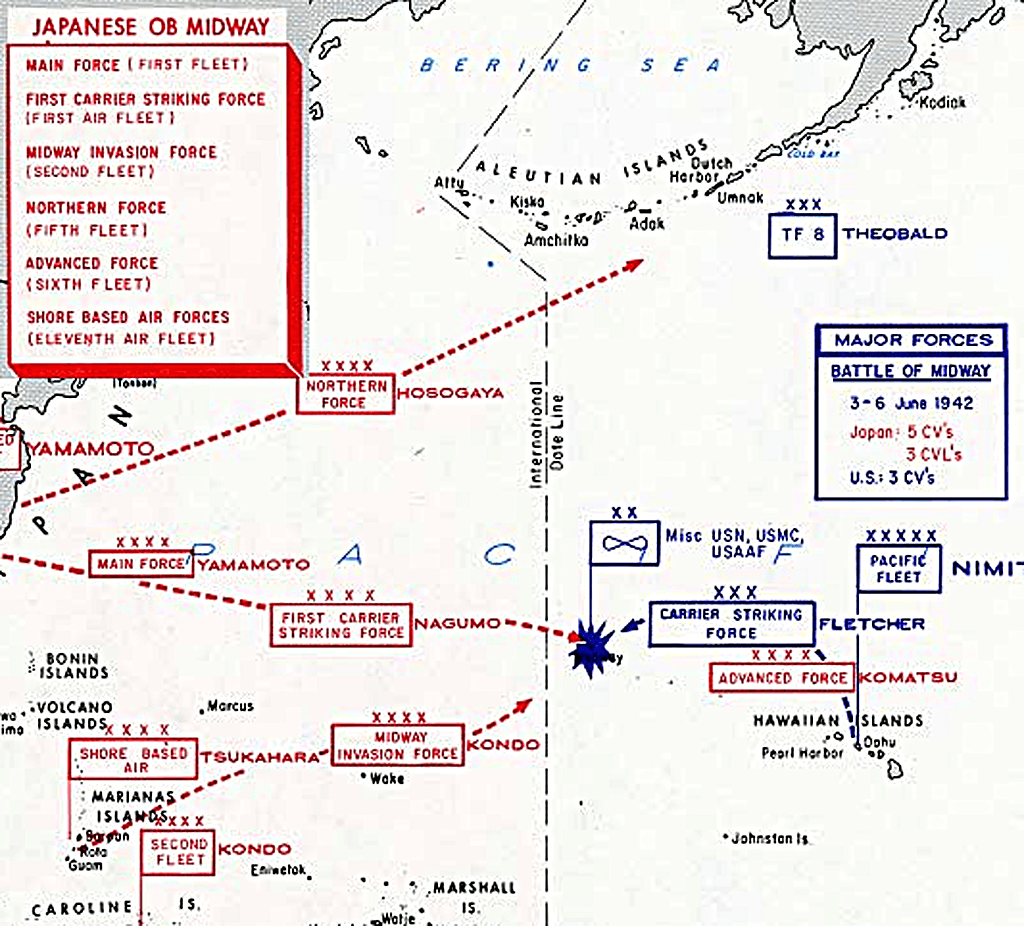
The Battle of Midway, fought June 4–7, 1942, was the most decisive naval engagement of World War II in the Pacific. In just four days, the United States Navy sank four Japanese fleet carriers — Akagi, Kaga, Sōryū, and Hiryū — destroying the core of Imperial Japan's striking power and killing approximately 3,057 Japanese sailors and airmen. The victory halted Japan's eastward expansion, ended its naval dominance established at Pearl Harbor, and handed the strategic initiative to the United States for the remainder of the war.
What Was the Strategic Situation Before Midway?
Six months after the surprise attack on Pearl Harbor on December 7, 1941, Japan controlled a vast arc of territory stretching from Burma to the central Pacific. Admiral Isoroku Yamamoto, Commander-in-Chief of the Combined Fleet, recognized that Japan's window of industrial and military advantage over the United States was narrow — perhaps 12 to 18 months before American shipbuilding and production overwhelmed Japanese capacity. His solution was a decisive fleet engagement that would annihilate what remained of U.S. Pacific naval power, particularly the three aircraft carriers that had escaped Pearl Harbor: USS Enterprise, USS Hornet, and USS Lexington's replacement, USS Yorktown. Yamamoto selected Midway Atoll, located 1,300 miles northwest of Honolulu, as the bait. He calculated that the Americans would have to defend it, sailing their weakened fleet into an ambush by Japan's numerically superior Combined Fleet.
How Did American Codebreakers Change the Outcome?
The most consequential factor before a single shot was fired was American signals intelligence. Station HYPO, the U.S. Navy's cryptanalysis unit at Pearl Harbor led by Commander Joseph Rochefort, had made significant inroads into cracking Japan's naval code, JN-25b. By late May 1942, Rochefort's team had determined that a major Japanese operation targeting a location designated 'AF' was imminent. To confirm AF was Midway, Rochefort arranged for the base to broadcast a false radio message in the clear reporting a fresh-water distillation plant breakdown. Within days, Japanese signals were intercepted reporting that 'AF is short of water' — positively identifying the target. This intelligence coup gave Admiral Chester Nimitz, Commander in Chief, Pacific Fleet, roughly two weeks of warning. Nimitz could position his three carriers in an ambush northeast of Midway, precisely where Yamamoto's plan did not expect them. The Japanese commander fatally assumed the U.S. carriers were still in the South Pacific following the Battle of the Coral Sea in early May.
What Forces Were Involved at the Battle of Midway?
Japan's Operation MI committed an overwhelming force of over 200 ships in multiple groups, including the First Carrier Striking Force (Kidō Butai) under Vice Admiral Chūichi Nagumo — the same force that had struck Pearl Harbor. Nagumo's core consisted of four fleet carriers: Akagi (flagship), Kaga, Sōryū, and Hiryū, carrying approximately 248 aircraft. The Japanese surface fleet included battleships, cruisers, submarines, and a separate invasion force of some 5,000 troops designated to occupy Midway. Against this armada, Nimitz fielded Task Force 16 (Enterprise and Hornet) under Rear Admiral Raymond Spruance and the hastily repaired Task Force 17 (Yorktown) under Rear Admiral Frank Jack Fletcher. USS Yorktown had been so severely damaged at Coral Sea that Japanese intelligence estimated it out of action for months; Pearl Harbor's repair crews worked 72-hour shifts and made it combat-ready in just 72 hours. The Americans had approximately 233 carrier aircraft plus 127 land-based planes on Midway itself.
| Factor | United States | Japan |
|---|---|---|
| Fleet Carriers | 3 (Enterprise, Hornet, Yorktown) | 4 (Akagi, Kaga, Sōryū, Hiryū) |
| Carrier Aircraft | ~233 | ~248 |
| Land-Based Aircraft | 127 (Midway) | 0 |
| Battleships Present | 0 | 11 |
| Foreknowledge of Enemy Plan | Yes (via codebreaking) | No |
| Element of Surprise | Americans (ambush position) | Lost |
| Carriers Lost | 1 (Yorktown) | 4 |
| Aircraft Lost | ~150 | ~292 |
| Personnel Killed | ~307 | ~3,057 |
How Did the Battle of Midway Unfold on June 4, 1942?
The battle's decisive action was compressed into a single catastrophic morning for Japan. At 4:30 a.m. on June 4, Nagumo launched 108 aircraft in a strike against Midway's installations. The raid damaged the atoll's facilities but failed to neutralize its defenses, and the strike leader radioed that a second attack was necessary. Meanwhile, Midway-based aircraft launched repeated counterattacks against the Japanese carriers, suffering devastating losses — six TBF Avengers, sixteen SBD Dauntlesses, eleven SB2U Vindicators, and all six of the attacking B-26 Marauders failed to score a single hit. However, these attacks forced Nagumo into a fateful dilemma. He had held back a second wave of aircraft armed with torpedoes in case U.S. naval forces appeared. With no sighting of American ships reported, at 7:15 a.m. he ordered those aircraft rearmed with bombs for another Midway strike — a process requiring 30 to 45 minutes and leaving the carrier decks cluttered with fuel lines and ordnance.
At 7:28 a.m., a Japanese floatplane finally reported an American surface force. Nagumo halted rearming and ordered the aircraft switched back to torpedoes, compounding the confusion on the hangar decks. Meanwhile, the carrier decks were also crowded with returning aircraft from the Midway strike, requiring recovery before any new launch. At 10:22 a.m., while the Japanese carriers were in their most vulnerable state — decks cluttered with armed and fueled aircraft, crews exhausted — the moment that defined the battle arrived. Thirty-seven SBD Dauntless dive-bombers from Enterprise (led by Lieutenant Commander Wade McClusky) and seventeen from Yorktown (led by Lieutenant Commander Maxwell Leslie) arrived almost simultaneously over the Kidō Butai. In approximately five minutes of high-angle bombing, Akagi, Kaga, and Sōryū were fatally hit. Burning aviation fuel and unsecured ordnance triggered catastrophic secondary explosions. By evening, all three carriers had sunk. The fourth carrier, Hiryū, survived long enough to launch two strike waves that badly damaged Yorktown, but American dive-bombers found and crippled Hiryū by late afternoon. She sank on June 5. Yorktown, abandoned and under tow, was sunk by the Japanese submarine I-168 on June 7.
Why Did Japan's Dive-Bomber Attacks Fail While America's Succeeded?
A critical tactical element was the sacrifice of American torpedo bomber squadrons that, though nearly annihilated, indirectly enabled the decisive dive-bomber strikes. Torpedo Squadron 8 (VT-8) from Hornet, led by Lieutenant Commander John C. Waldron, attacked without fighter escort and was wiped out — all 15 TBD Devastators were shot down, with only Ensign George Gay surviving. Similarly, torpedo squadrons from Enterprise and Yorktown suffered catastrophic losses, achieving no torpedo hits. However, these low-level attacks drew the Japanese Combat Air Patrol (Zero fighters) down to wave-top altitude and away from high altitude. When McClusky's and Leslie's dive-bombers arrived from 19,000 feet, the Zeros were too low and too slow to intercept in time. The timing was partly coincidental and partly a function of persistent courage; it produced one of history's most dramatic examples of a tactical sacrifice enabling strategic success. Equally significant was the Japanese failure to maintain adequate fighter direction and radar picket ships, leaving their Combat Air Patrol poorly coordinated.
What Role Did Admiral Nimitz and His Commanders Play?
Chester Nimitz's command decisions were critical at every level. He trusted Rochefort's intelligence assessment over skeptics in Washington who doubted AF was Midway, and he overruled those who counseled greater caution. His choice to send the freshly repaired Yorktown into battle — a calculated gamble — gave him a three-carrier force rather than two, a difference that proved decisive. Nimitz also selected Rear Admiral Raymond Spruance to command Task Force 16, replacing the hospitalized Vice Admiral William Halsey. Spruance, not originally an aviator, made the pivotal decision on the morning of June 4 to launch his air groups at extreme range — approximately 175 miles — to catch the Japanese carriers at their most vulnerable moment. His timing, combined with McClusky's crucial navigation decision to turn southwest when the Japanese fleet was not where expected, brought the dive-bombers over the Kidō Butai at the precise moment of maximum Japanese vulnerability. On the Japanese side, Nagumo's repeated rearming orders and failure to launch an immediate strike upon learning of U.S. carriers remain among the most studied command failures in naval history.
What Were the Immediate Consequences of the Battle?
The loss of four fleet carriers — Akagi, Kaga, Sōryū, and Hiryū — was an irreplaceable blow to Japan's offensive capability. These ships represented the core of the Kidō Butai that had struck Pearl Harbor, raided Ceylon, and dominated the Indian Ocean. Japan also lost 248 aircraft, and crucially, approximately 110 of its most experienced carrier aviators and hundreds of elite maintenance crew. Japan could eventually build new carriers, but it could not quickly replace the trained pilots lost at Midway and those already killed at Coral Sea. The United States, by contrast, had an enormous pilot training pipeline expanding rapidly under programs like the Navy's V-5 cadet program. After Midway, Japan completed construction of the carriers Shōkaku and Zuikaku's air groups on paper, but never again achieved carrier parity with the United States. The battle also validated American signals intelligence and codebreaking as a strategic weapon of the first order.
Why Is Midway Considered the Turning Point of the Pacific War?
Military historians consistently identify Midway as the decisive inflection point of the Pacific War for several interconnected reasons. Before Midway, Japan held the strategic initiative; after it, Japan was permanently on the defensive. The battle ended the era of Japanese expansion and forced Imperial planners into a reactive posture, stretching thin resources to defend an enormous perimeter from the Aleutians to the Solomons. Within two months of Midway, the United States launched its first major offensive of the Pacific War at Guadalcanal in August 1942. Yamamoto's grand plan — a decisive fleet battle followed by a negotiated peace — was shattered. Furthermore, Midway demonstrated that aircraft carriers, not battleships, were the capital ships of modern naval warfare, a lesson that shaped naval doctrine for decades. The battle's outcome rested on intelligence, technology, training, and a handful of fortuitous minutes in which American dive-bombers arrived at precisely the right moment — making it one of the most studied engagements in military history.
What Is the Legacy and Commemoration of the Battle of Midway?
The Battle of Midway entered American national memory almost immediately. President Franklin D. Roosevelt recognized its propaganda value and, departing from wartime secrecy, allowed the news of the victory to be released. Director John Ford, who was actually present at Midway filming from a power plant as Japanese bombs fell — and was wounded by shrapnel — produced a documentary, 'The Battle of Midway' (1942), which won the Academy Award for Best Documentary Feature. The date June 4 is observed in the United States as Battle of Midway Commemoration Day. The USS Midway, a supercarrier commissioned in 1945 and decommissioned in 1992, was named in honor of the battle; it is now preserved as the USS Midway Museum in San Diego, California, welcoming over one million visitors annually. Wreck exploration expeditions in 2019 located the remains of USS Yorktown and the Japanese carriers Kaga and Akagi at depths of approximately 17,000 feet in the Pacific, bringing renewed scholarly attention to the battle. For Japan, Midway remains a subject of intense historical examination, often discussed in terms of the overconfidence — 'victory disease' (shōri byō) — that led its commanders to underestimate American resilience and intelligence capabilities.