The Battle of Stalingrad, fought from August 23, 1942 to February 2, 1943, was the largest and deadliest battle in human history, killing an estimated 1.9 to 2 million soldiers and civilians combined. Germany's catastrophic defeat—ending with the surrender of Field Marshal Friedrich Paulus and his entire 6th Army—marked the definitive turning point of World War II on the Eastern Front and shattered the myth of Nazi invincibility. From that moment, the Wehrmacht never again launched a sustained strategic offensive in the East.
What Was the Strategic Importance of Stalingrad?
Stalingrad—named after Soviet leader Joseph Stalin—sat on the western bank of the Volga River in southern Russia, stretching roughly 30 miles along the waterway. Its industrial output was enormous: the Stalingrad Tractor Factory alone had been converted to produce T-34 tanks at scale, and the city's refineries and steel mills fed the Soviet war machine. Equally important were its transport links. Capturing Stalingrad would sever the critical Volga artery, cutting off oil shipments from the Caucasus to the rest of the USSR and, in Hitler's thinking, strangling Soviet industry. Beyond logistics, the city bore Stalin's name—making its capture a propaganda prize of the highest order for Hitler and its defense a matter of personal prestige for Stalin. Hitler's Directive No. 41 (Case Blue, or Fall Blau), issued April 5, 1942, explicitly targeted the Caucasus oil fields and Stalingrad simultaneously, overextending German forces across a massive front.
What Caused the German Advance on Stalingrad in 1942?
After the failure to take Moscow in the winter of 1941–42, Hitler restructured his strategy for the summer of 1942. He split Army Group South into Army Group A (targeting the Caucasus oil fields) and Army Group B (advancing toward Stalingrad), a fatal division of strength. General Friedrich Paulus's 6th Army, approximately 270,000 men, led the thrust toward the Volga. German forces initially made rapid progress across the open steppe, capturing Rostov-on-Don on July 23, 1942. By late August the Wehrmacht had reached the outskirts of Stalingrad, and on August 23, 1942, the Luftwaffe's 4th Air Fleet under General Wolfram von Richthofen launched a devastating firebombing campaign that reduced much of the city to rubble in a single day, killing roughly 40,000 civilians. Paradoxically, the ruins would prove far more defensible than intact buildings, as Soviet snipers and infantry turned every shattered factory and apartment block into a fortress.
How Did the Urban Fighting Inside Stalingrad Unfold?
Once German forces entered the city in mid-September 1942, the battle transformed into a new and horrifying kind of warfare the Germans called 'Rattenkrieg'—war of the rats. Combat shrank to individual buildings, floors, and even rooms. The average life expectancy of a newly arrived Soviet soldier fell to less than 24 hours in some sectors during peak fighting. Soviet General Vasily Chuikov, commanding the 62nd Army inside the city, adopted the tactic of 'hugging' German lines—keeping his troops so close to enemy positions that the Luftwaffe could not bomb them without risk of hitting their own men. Key strongpoints became legendary: the four-story Pavlov's House, defended by Sergeant Yakov Pavlov and roughly 25 soldiers for 58 consecutive days, was later said by Chuikov to have killed more Germans than the fall of Paris. The Mamayev Kurgan hill changed hands multiple times and was so saturated with metal fragments that even years later the soil would not freeze properly in winter. By November 1942, the Germans controlled roughly 90 percent of the city's surface area but could not dislodge Soviet defenders from a narrow strip along the Volga bank, sustained by a nightly trickle of reinforcements and supplies ferried across the river under fire.
What Was Operation Uranus and How Did It Encircle the German 6th Army?
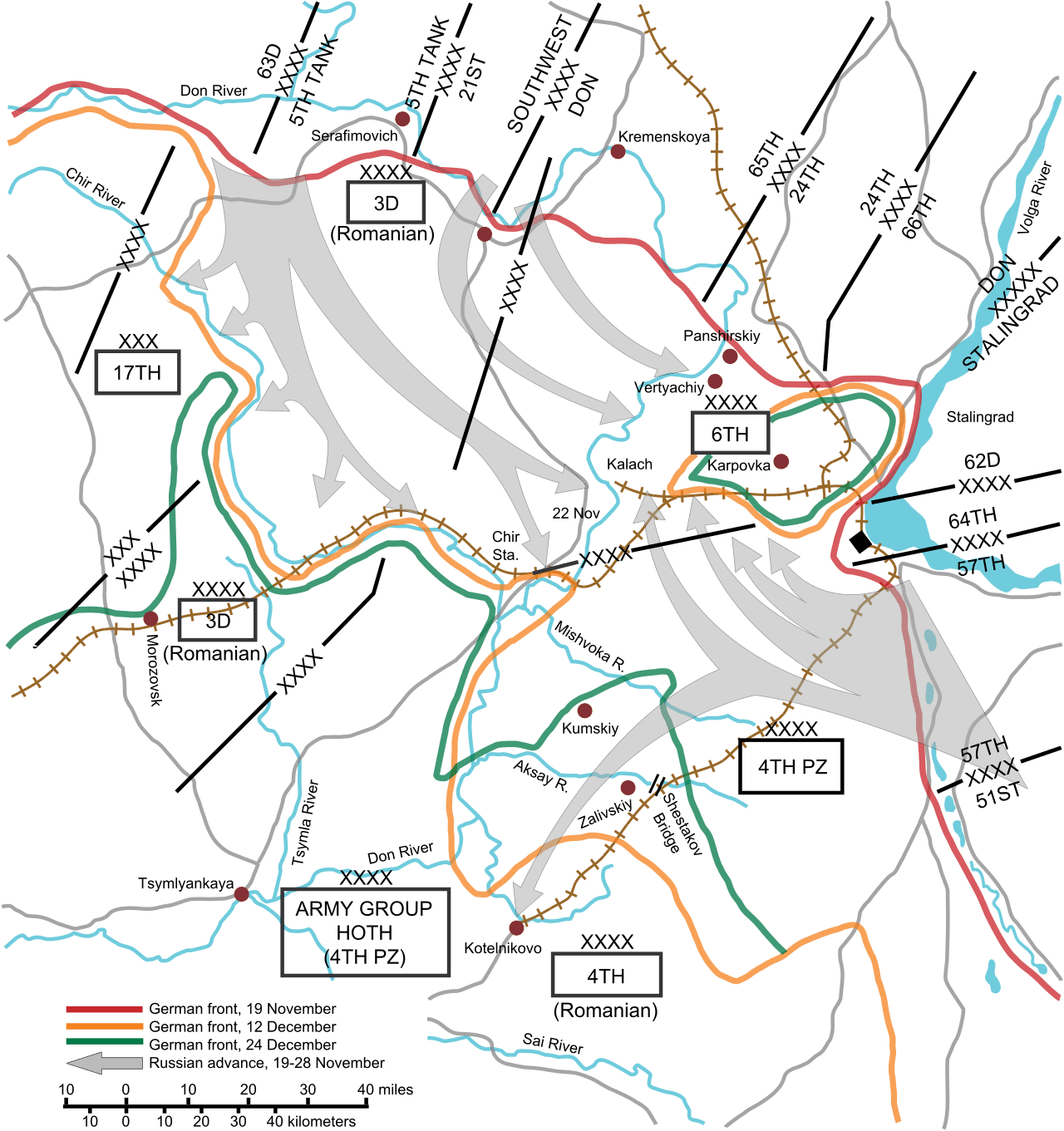
While Chuikov pinned the Germans inside the city, Soviet General Georgy Zhukov and Deputy Supreme Commander Alexander Vasilevsky secretly assembled a massive counteroffensive on the German flanks. Operation Uranus, launched on November 19, 1942, sent two converging armored thrusts—over one million Soviet troops, 1,400 tanks, and 1,350 aircraft—against the thinly stretched Romanian 3rd and 4th Armies protecting the German flanks. The Romanian forces, poorly equipped and over-extended across hundreds of miles of steppe, collapsed within days. The northern pincer crossed the Don at Serafimovich; the southern pincer broke out from the Sarpa Lakes area. On November 23, 1942, the two pincers met at Kalach-on-Don, encircling Paulus's entire 6th Army—approximately 290,000 men—in a pocket the Soviets called the 'Kessel' (cauldron). Hitler forbade any attempt to break out, insisting Paulus hold the 'Fortress Stalingrad.' Hermann Göring's reckless promise to supply the trapped army by air—requiring 700 tons of supplies per day—proved completely hollow; the Luftwaffe delivered an average of only 90 tons daily.
Why Did Operation Winter Storm Fail to Relieve Paulus?
Germany's relief attempt, Operation Winter Storm (Unternehmen Wintergewitter), launched December 12, 1942, sent Army Group Don under Field Marshal Erich von Manstein pushing northeast toward the Kessel from the Kotelnikovo area. At its closest point, on December 19, Manstein's spearhead—the 57th Panzer Corps—reached within approximately 48 kilometers (30 miles) of the encircled 6th Army's southern perimeter. However, a simultaneous Soviet offensive, Operation Little Saturn, launched December 16 against the Italian 8th Army on the middle Don, threatened to collapse the entire southern German front and forced Manstein to divert his armor. Paulus, under strict Hitler orders not to break out without permission that never came, could not advance to meet the relief force. By late December, Manstein's thrust had been halted and pushed back. The 6th Army's fate was sealed.
What Were the Conditions Inside the Stalingrad Pocket?
The suffering inside the Kessel during December 1942 and January 1943 was extreme by any measure. Temperatures plunged to minus 30 degrees Celsius (minus 22 Fahrenheit). The daily food ration fell to as little as 50 grams of bread per soldier. Horses were slaughtered for food; men burned furniture and their own equipment for warmth. Typhus, frostbite, and dysentery ravaged the garrison. By January 1943, the 6th Army had roughly 200,000 men still alive inside the pocket but fewer than half were combat-effective. Operation Ring (Operatsiya Koltso), the Soviet final assault launched January 10, 1943 under General Konstantin Rokossovsky, steadily compressed the pocket. The last functioning German airstrip at Gumrak fell on January 22, 1943, ending even the inadequate airlift. On January 31, 1943—one day after Hitler promoted him to Field Marshal, in the expectation that no German field marshal had ever surrendered—Friedrich Paulus surrendered himself and the southern pocket. The northern pocket held out until February 2, 1943, when the last German resistance ceased.
How Many People Died at Stalingrad?
The human cost of Stalingrad was staggering and remains difficult to calculate with precision. Soviet military losses (killed, wounded, and captured) totaled approximately 1.1 million, including roughly 480,000 dead. German, Romanian, Italian, and Hungarian losses across the broader Stalingrad campaign reached an estimated 800,000, of whom roughly 300,000 were killed or died of wounds and cold. Of the approximately 91,000 German prisoners taken after the final surrender—including 24 generals—fewer than 6,000 ever returned home to Germany, most dying in Soviet prison camps from starvation, disease, and cold over the following years. Civilian casualties inside the city itself, impossible to count with precision, likely numbered in the tens of thousands from bombing alone, with many more dying during the occupation and fighting.
| Faction | Forces Committed | Estimated Casualties (Killed/Wounded/Captured) | Outcome |
|---|---|---|---|
| Soviet Union (62nd & 64th Armies, Operation Uranus forces) | ~1,140,000 total | ~1,100,000 (480,000 dead) | Victory; strategic initiative gained |
| Germany (6th Army, 4th Panzer Army) | ~270,000–300,000 in city | ~300,000+ dead; 91,000 captured | Catastrophic defeat; 6th Army destroyed |
| Romania (3rd & 4th Armies) | ~150,000 | ~158,000 (killed, wounded, captured) | Flanks collapsed under Operation Uranus |
| Italy (8th Army) | ~235,000 | ~114,000 (killed, wounded, captured) | Routed during Operation Little Saturn |
| Hungary (2nd Army) | ~200,000 | ~120,000+ | Severely mauled; effectively destroyed |
Why Was Stalingrad the Turning Point of World War II?
Historians and military analysts consistently identify Stalingrad as the strategic inflection point of the entire Second World War for several interlocking reasons. First, it was the first time a complete German field army was destroyed and its commander captured—a psychological blow that shook German society to its core. Propaganda Minister Joseph Goebbels declared a national period of mourning on February 3, 1943, the first such acknowledgment of defeat in the war. Second, the battle consumed irreplaceable German reserves: the 6th Army had been one of the Wehrmacht's most experienced formations. Third, the success of Operation Uranus demonstrated that the Red Army could plan and execute large-scale multi-front encirclements—exactly the operational art the Germans had previously monopolized with their Blitzkrieg. After Stalingrad, Soviet strategic offensives grew progressively larger and more sophisticated, culminating in Operation Bagration in 1944, which destroyed Army Group Centre. Fourth, Germany's Axis allies—Italy, Romania, Hungary—had seen their armies effectively annihilated and lost confidence in German leadership, accelerating the political fracturing of the Axis. The combination of these factors shifted the war's strategic momentum irreversibly to the Soviet Union.
What Was the Long-Term Legacy of the Battle of Stalingrad?
The battle's legacy reshaped both military doctrine and global memory. On the Soviet side, Stalingrad became the foundational myth of the Great Patriotic War—proof that the USSR could endure the worst and prevail. Stalin awarded the city the title 'Hero City' in 1945, and in 1961, under Nikita Khrushchev's de-Stalinization, it was renamed Volgograd, though Russians still call the battle 'Stalingrad.' The Mamayev Kurgan memorial, completed in 1967 and dominated by the 85-meter (279-foot) statue 'The Motherland Calls'—the tallest statue in the world at the time—draws hundreds of thousands of visitors annually. In military doctrine, the battle validated deep battle theory and the operational encirclement techniques that the Red Army would refine through 1945. For Germany, the loss triggered an internal reassessment; several senior officers, including those later involved in the July 20, 1944 assassination plot against Hitler, cited Stalingrad as the moment they recognized the war was unwinnable. Globally, Stalingrad demonstrated the decisive importance of industrial capacity, logistical depth, and the willingness of a population to absorb catastrophic losses—lessons that continue to inform strategic studies today.