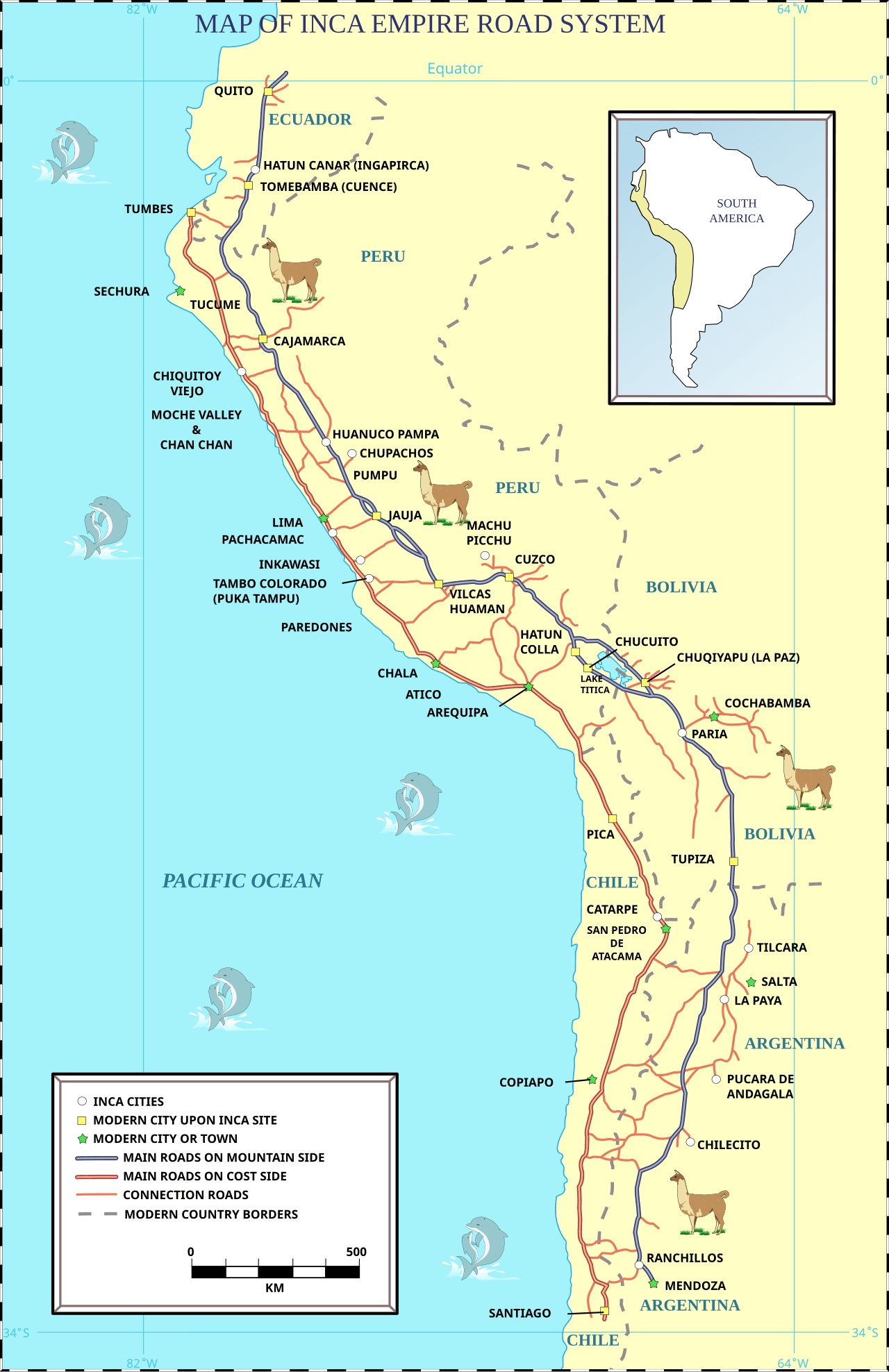
High in the folds of the Andes Mountains, where the air is thin and the terrain unforgiving, a civilization rose that would come to govern nearly 12 million people across an area stretching 4,300 miles from what is now southern Colombia to central Chile. The Inca Empire — known to its own people as Tawantinsuyu, meaning 'The Four Regions' — was the largest empire the Western Hemisphere had ever seen. It built roads without iron tools, fed its people without money, and organized a state without a written alphabet. Then, in the span of a single decade, it was gone.
Origins: From Tribe to Dynasty
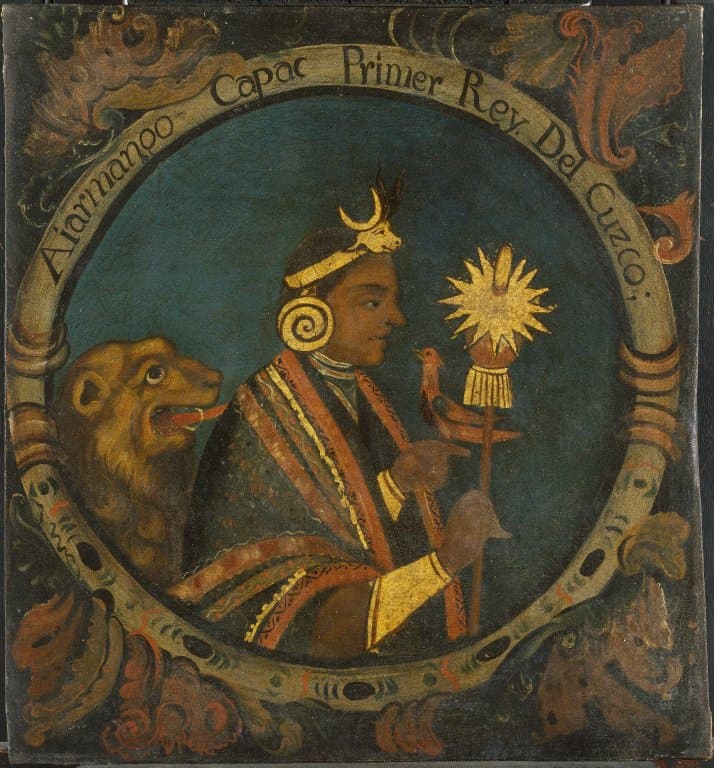
The Inca began as a small, relatively unremarkable ethnic group centered around the city of Cusco in the Peruvian highlands. According to their own origin myths, the first Inca ruler, Manco Cápac, was the son of Inti, the Sun god, and was sent to Earth to bring civilization to humanity. He and his sister-wife Mama Ocllo supposedly emerged from the waters of Lake Titicaca, guided by a golden staff that sank into the fertile soil of Cusco — a sign they had found their homeland. While historians treat these accounts as mythology, archaeological evidence confirms that the Inca were established around Cusco by at least the 13th century AD, coexisting and sometimes conflicting with other Andean peoples.
For roughly two centuries, the Inca remained a regional polity of modest importance. The dramatic transformation came under the ninth Sapa Inca, Pachacuti, who ascended to power around 1438. Faced with an invasion by the rival Chanka confederation, Pachacuti — whose name means 'Earthshaker' or 'He Who Transforms the World' — rallied his forces and delivered a stunning military victory. Emboldened, he launched a campaign of conquest that would, within a generation, multiply the empire's territory many times over. Pachacuti is often compared to Alexander the Great or Napoleon: a military genius who was also a visionary administrator, urban planner, and religious reformer.
Engineering a Civilization
The Inca Empire's most enduring legacy is arguably its infrastructure. The royal road network — Qhapaq Ñan — spanned over 40,000 kilometers, connecting the frigid peaks of the Andes, coastal deserts, and tropical rainforests. These roads were built with extraordinary precision, often paved with stone, and included suspension bridges made from twisted grass and fiber that could span hundreds of feet across canyon gorges. Professional runners called chasquis were stationed at relay posts every few miles, capable of transmitting messages across thousands of kilometers within days — a system that out-performed many early modern postal networks.
Agriculture was equally remarkable. The Inca terraced entire mountainsides with a system called andenes, creating flat growing platforms that prevented erosion, retained moisture, and allowed crops to be cultivated at altitudes otherwise too harsh for farming. They maintained a sophisticated irrigation network and stored food on a massive scale in storehouses called qollqas, strategically placed throughout the empire to supply armies, feed laborers, and cushion the population against famine. The empire operated not on money but on a system of labor tax called mit'a — citizens paid their taxes in work, building roads, temples, and cities.
Machu Picchu and the Architecture of Power
No symbol of the Inca is more iconic than Machu Picchu, the royal estate built by Pachacuti around 1450 at an elevation of 2,430 meters above sea level. Perched on a ridge between two mountain peaks, the site contains temples, palaces, agricultural terraces, and astronomical observation points — all constructed without mortar, using precisely fitted stones so tightly interlocked that not even a sheet of paper can be slipped between them. Machu Picchu was abandoned less than a century after its construction and remained unknown to the outside world until American historian Hiram Bingham brought it to international attention in 1911. It is now a UNESCO World Heritage Site and one of the most visited archaeological sites on Earth.
Society, Religion, and the Quipu
Inca society was rigidly hierarchical, with the Sapa Inca — the emperor — sitting at its apex as both a political and divine figure, believed to be the direct descendant of the Sun god Inti. Below him were nobles, priests, regional governors, and then commoners. Women had defined but meaningful roles; the Chosen Women (Acllakuna) were selected in childhood for their beauty and talent, trained in weaving and religious duties, and could rise to positions of influence. Religion permeated every aspect of life. The Inca worshipped a pantheon of gods, with Inti foremost among them, and practiced ritual sacrifice — most often of llamas, guinea pigs, and precious goods — though child sacrifice, known as capacocha, was reserved for extraordinary occasions such as the death of an emperor.
Remarkably, the Inca had no written language in the conventional sense. Instead, they used quipus — intricate systems of knotted cords in various colors and configurations — to record numerical data, census information, tribute records, and possibly narrative histories. Specialists called quipucamayocs could read these devices with expertise. Though scholars have decoded the numerical functions of quipus, their full communicative potential remains one of the great unsolved puzzles of ancient scholarship.
The Spanish Conquest: An Empire Undone
By 1527, the Inca Empire was at its territorial zenith — and already showing cracks. A devastating smallpox epidemic, which preceded the Spanish themselves, swept through the empire, killing Emperor Huayna Cápac and triggering a brutal civil war between his sons Huáscar and Atahualpa. It was into this fractured world that Francisco Pizarro arrived in 1532 with fewer than 200 soldiers. In one of history's most audacious gambits, Pizarro captured Atahualpa at the city of Cajamarca, killing thousands of his guards in a surprise attack. Though Atahualpa paid an enormous ransom — a room filled with gold and silver — Pizarro had him strangled in 1533. Without their divine ruler, the empire's ability to resist collapsed with startling speed. Cusco fell within the year, and while Inca resistance continued for decades — most notably in the Neo-Inca state of Vilcabamba — the empire as a functioning entity was finished.
Legacy: What the Inca Left Behind
The Inca were not erased — they were transformed. Quechua, the language of the Inca, is still spoken today by approximately 8 to 10 million people across the Andes. Inca agricultural techniques, terracing systems, and crop varieties — including the potato, now a global staple — continue to feed the world. Dozens of modern Andean cities, including Cusco itself, are built atop Inca foundations. Their roads, temples, and sky-scraping citadels endure as a testament to what human ingenuity can accomplish without iron, the wheel, or written language. The Inca Empire lasted less than 100 years at its full extent, yet its shadow stretches across centuries.
| Sapa Inca | Reign | Key Achievement |
|---|---|---|
| Manco Cápac | Legendary founder | Founded Cusco; established Inca dynasty |
| Pachacuti | c. 1438–1471 | Launched era of conquest; built Machu Picchu |
| Topa Inca Yupanqui | c. 1471–1493 | Expanded empire to its greatest territorial extent |
| Huayna Cápac | c. 1493–1527 | Consolidated northern territories; died in smallpox epidemic |
| Atahualpa | 1532–1533 | Won civil war; captured and killed by Pizarro |