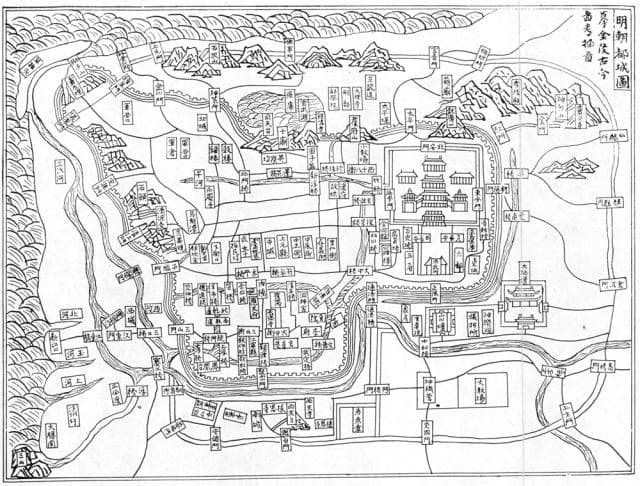
The Ming Dynasty (1368–1644) was the last ethnic Han Chinese imperial dynasty, ruling China for 276 years and governing up to 200 million people at its peak — roughly one-third of the entire global population. Founded by Zhu Yuanzhang, a peasant who rose to overthrow the Mongol Yuan Dynasty, the Ming era produced some of history's most enduring achievements: the reconstruction of the Great Wall, the construction of Beijing's Forbidden City, and the legendary maritime expeditions of Admiral Zheng He. Its fall in 1644, triggered by peasant rebellion, fiscal collapse, and Manchu invasion, ended China's last native imperial dynasty.
Who Founded the Ming Dynasty and How Did It Begin?
Zhu Yuanzhang was born in 1328 in Anhui Province into a desperately poor peasant family. By his mid-teens, plague and famine had killed most of his immediate relatives, forcing him to beg as a Buddhist monk. He joined the Red Turban Rebellion — a millenarian insurgency drawing on White Lotus Buddhist ideology — around 1352, quickly rising through military ranks due to his tactical brilliance and ruthless discipline. By 1356, he controlled Nanjing, which he made his base of operations. After eliminating rival rebel leaders Chen Youliang at the Battle of Lake Poyang (1363) — one of the largest naval battles in history, involving an estimated 850,000 combatants — and Zhang Shicheng by 1367, Zhu marched north and expelled the last Yuan emperor from Beijing in September 1368. He proclaimed himself the Hongwu Emperor, founding the Ming ('Brilliant') Dynasty with Nanjing as its capital. His reign (1368–1398) set the authoritarian template that would define Ming governance: he abolished the position of Prime Minister in 1380, executed tens of thousands of officials and nobles in purges, and centralised all power directly in the emperor's hands.
What Were the Major Political and Administrative Innovations of the Ming?
The Ming state was one of the most bureaucratically sophisticated governments in the pre-modern world. The Hongwu Emperor restructured the civil service examination system — rooted in Confucian classics — to produce a loyal, educated bureaucracy. By the 15th century, the system required candidates to pass examinations at county, provincial, and national levels, with the final palace examination presided over by the emperor himself. Only roughly 1 in 3,000 candidates who began the process earned the prestigious jinshi ('presented scholar') degree. The Ming also institutionalised the 'Six Ministries' (Revenue, Rites, Personnel, War, Justice, and Works) reporting directly to the emperor, a structure that outlasted the dynasty itself. The Yongle Emperor (r. 1402–1424) — Zhu Yuanzhang's fourth son, who seized the throne from his nephew in the Jingnan Campaign of 1399–1402 — moved the capital from Nanjing to Beijing in 1421, constructing the Forbidden City (Zijincheng) between 1406 and 1420. Covering 72 hectares with 980 buildings, it remains the world's largest surviving palace complex. The Yongle Emperor also compiled the Yongle Dadian, a massive encyclopaedia of approximately 22,877 volumes — among the largest encyclopaedias ever assembled.
How Did Zheng He's Voyages Change the World?
Between 1405 and 1433, Admiral Zheng He commanded seven extraordinary naval expeditions that projected Chinese power across Southeast Asia, India, Arabia, and the East African coast — reaching as far as Malindi in modern Kenya. Zheng He, a Muslim eunuch from Yunnan Province, commanded fleets of unprecedented scale: his first expedition in 1405 comprised approximately 317 vessels and 27,800 men. His flagship 'treasure ships' (bao chuan) were reportedly up to 137 metres long — compared to Columbus's Santa María at roughly 18 metres. The voyages were motivated by diplomatic prestige, the collection of exotic tribute (giraffes, lions, and zebras reached the Chinese court), and the projection of the Yongle Emperor's authority. They demonstrated that China possessed the technological capability to establish a global maritime empire decades before European powers. However, after the Yongle Emperor's death in 1424, Confucian officials who viewed overseas commerce as wasteful and destabilising gained influence. A series of court edicts between 1424 and 1436 progressively restricted maritime activity; by 1525, it was illegal to build multi-masted ocean-going ships. The decision to abandon maritime expansion is considered one of history's pivotal turning points — had China continued, the age of European colonialism might have unfolded very differently.
Why Was the Great Wall Rebuilt During the Ming Dynasty?
The Great Wall most tourists visit today is almost entirely Ming construction. Earlier walls, built by the Qin and Han dynasties, had largely crumbled into earthen mounds. Ming authorities rebuilt and massively extended the fortifications primarily in response to the ongoing Mongol threat. The catastrophic Battle of Tumu in 1449, in which Emperor Zhengtong was captured by the Oirat Mongol leader Esen Taishi — the first time a reigning Chinese emperor had been taken prisoner by a foreign power — demonstrated the vulnerability of China's northern frontier. Large-scale reconstruction began under the Longqing Emperor in the 1560s, overseen by the brilliant general Qi Jiguang. The Ming wall stretches approximately 8,850 kilometres from Jiayuguan in Gansu Province in the west to Shanhaiguan on the Bohai Sea in the east. Built from brick and granite rather than the earlier tamped earth, and studded with watchtowers every few hundred metres, it represented a colossal investment in defensive infrastructure — employing hundreds of thousands of soldiers, conscripts, and labourers over more than a century of construction.
What Was Life Like During the Ming Dynasty's Golden Age?
The mid-Ming period, roughly 1450–1580, represented a cultural and economic golden age. China's population, estimated at around 60–80 million in 1368, had grown to approximately 160–200 million by 1600, making it by far the world's most populous country. Agriculture was transformed by the introduction of New World crops — sweet potatoes, maize, and peanuts arrived via Spanish trade routes through the Philippines after the 1570s, dramatically increasing caloric yields on marginal land. The Wanli Emperor's reign (1572–1620) saw China produce an estimated 25–30% of global GDP. The 'Single Whip Reform' of 1581, engineered by Grand Secretary Zhang Juzheng, consolidated the complex tax system into a single silver payment, stimulating commerce and monetising the economy. Urban culture flourished: the novel form matured with masterpieces such as Journey to the West (c. 1592) by Wu Cheng'en and the erotic Dream of the Red Chamber's precursors. Porcelain production at Jingdezhen reached extraordinary refinement — Ming blue-and-white porcelain became the most sought-after luxury export in the world, from Ottoman Istanbul to Renaissance Florence. Woodblock printing made books widely accessible, and literacy rates rose significantly compared to earlier dynasties.
| Emperor | Reign | Key Achievement or Event |
|---|---|---|
| Hongwu (Zhu Yuanzhang) | 1368–1398 | Founded the dynasty; abolished the Prime Minister post; massive bureaucratic purges |
| Yongle (Zhu Di) | 1402–1424 | Moved capital to Beijing; built Forbidden City; commissioned Zheng He voyages |
| Xuande | 1425–1435 | Final Zheng He voyage (1433); relative prosperity; pottery arts flourished |
| Zhengtong | 1435–1449 / 1457–1464 | Captured by Mongols at Battle of Tumu (1449); only emperor to reign twice |
| Wanli | 1572–1620 | Single Whip tax reform; peak imperial GDP; 28-year withdrawal from court duties |
| Chongzhen | 1627–1644 | Last Ming emperor; faced peasant rebellions and Manchu invasions; died by suicide |
How Did Foreign Trade and Silver Shape the Ming Economy?
The Ming economy became inextricably linked to global silver flows after 1571, when Spanish Manila was founded and direct trade between China and the Americas began. China was the world's greatest consumer of silver, which its tax system demanded as payment. Between 1550 and 1650, an estimated one-third to one-half of all silver mined in the Americas — primarily from Potosí in modern Bolivia — flowed into China in exchange for silk, porcelain, and tea. This integration into the global economy brought immense wealth but also dangerous dependency. When global silver supplies contracted in the early 17th century due to Spanish fiscal crises and falling mine output, China's monetised economy was severely disrupted. Tax revenues collapsed precisely when the government faced the enormous costs of defending against the Manchu Jurchen confederation (Later Jin, founded 1616) in the northeast and suppressing domestic rebellions in the interior. The fiscal crisis became one of the dynasty's fatal structural weaknesses.
What Caused the Fall of the Ming Dynasty in 1644?
The Ming Dynasty's collapse between 1627 and 1644 resulted from the convergence of multiple catastrophic pressures. A prolonged climatic downturn — part of the broader 17th-century General Crisis linked to the Little Ice Age — caused a series of devastating droughts and famines across northern China beginning in the late 1620s. Shaanxi Province alone experienced near-continuous crop failure from 1627 to 1641. The resulting starvation fuelled massive peasant uprisings: rebel leader Li Zicheng, a former postal worker from Shaanxi, mobilised an army of hundreds of thousands of desperate refugees and deserters. After sacking Kaifeng in 1642, Li swept toward Beijing. Simultaneously, the Manchu Jurchen leader Nurhaci (d. 1626) and his successor Hong Taiji had built a formidable military state northeast of the Great Wall, repeatedly breaching Ming defences to raid deep into China's heartland — reaching Beijing itself in 1629. The last Ming emperor, Chongzhen, faced a hopelessly underfunded treasury, a demoralised army, and administrative paralysis. When Li Zicheng's rebel forces entered Beijing on April 25, 1644, Chongzhen hanged himself on Coal Hill (Jingshan) behind the Forbidden City — reportedly leaving a note blaming corrupt officials rather than his people. General Wu Sangui, commanding Ming forces at Shanhaiguan Pass, then made the fateful decision to invite the Manchu Qing forces through the Wall to suppress Li Zicheng. The Qing swiftly destroyed Li's forces at the Battle of Shanhaiguan in June 1644 and proclaimed the start of the Qing Dynasty, though Ming loyalist resistance in southern China (the Southern Ming) continued until 1683.
What Is the Legacy and Historical Significance of the Ming Dynasty?
The Ming Dynasty's legacy is woven into the fabric of modern China and global history. Physically, its most visible monuments — the Forbidden City, the reconstructed Great Wall, and the Ming Tombs outside Beijing — remain among the world's most visited heritage sites, collectively attracting tens of millions of tourists annually and inscribed on the UNESCO World Heritage List. The Beijing urban grid established by the Yongle Emperor in 1421 still defines the layout of China's capital today. Culturally, the Ming period consolidated a distinctly Han Chinese identity, Mandarin as the dominant language of administration, and Neo-Confucian philosophy as the governing ideology of the educated elite. The dynasty's Blue-and-White porcelain defined global ceramic aesthetics for centuries; its novels established literary genres that persist in Chinese popular culture. In terms of global economic history, Ming China's integration into the silver trade system of the 16th century constitutes one of the earliest episodes of genuine economic globalisation. For historians, the dynasty's fall poses enduring questions about the vulnerability of sophisticated states to the combined pressures of climate change, fiscal stress, and geopolitical competition — questions with obvious modern resonance.