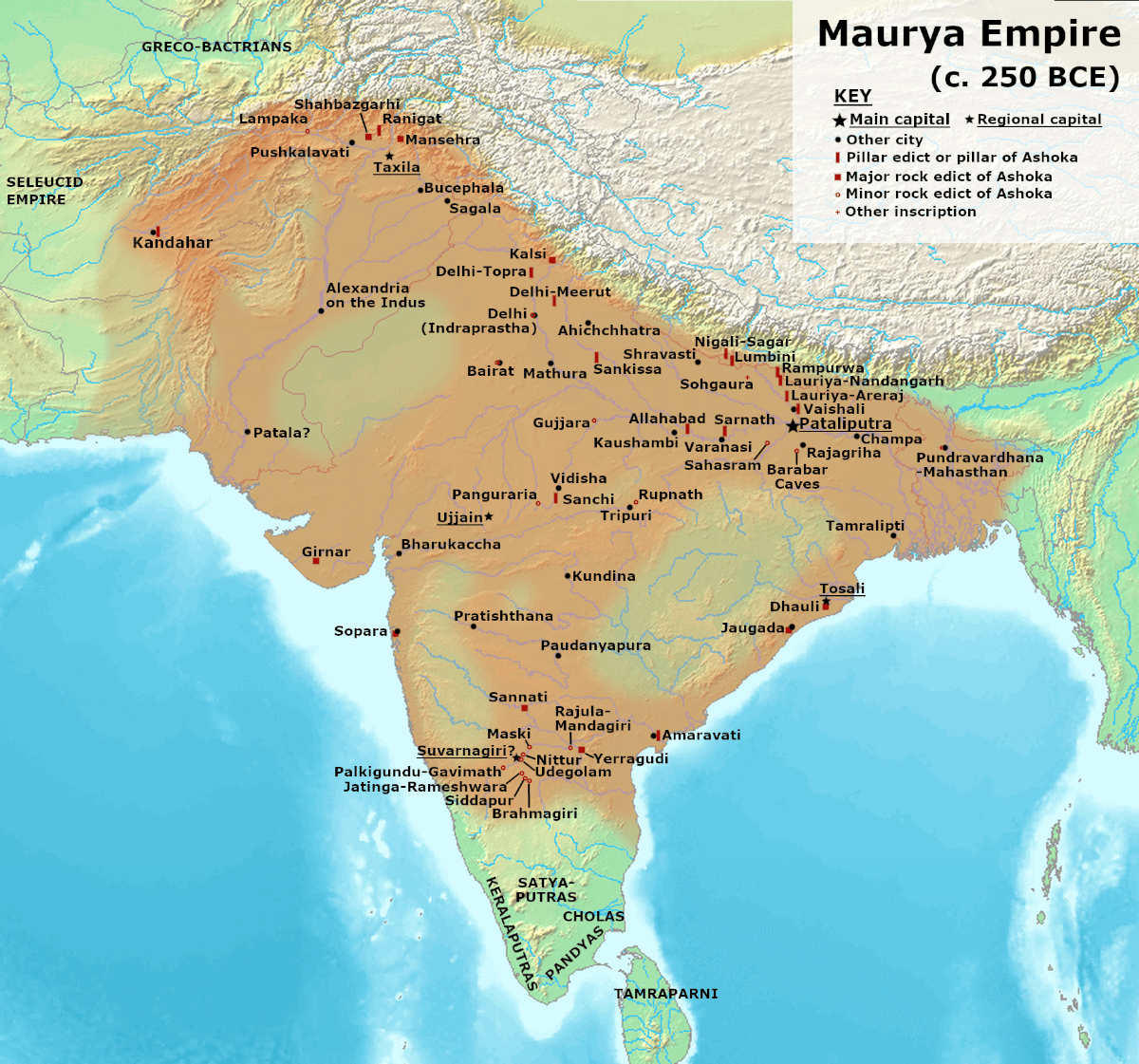
The Maurya Empire (322–185 BCE) was the largest and most powerful empire in ancient India, stretching from modern-day Afghanistan in the west to Bangladesh in the east and covering nearly 5 million square kilometres at its peak. Founded by Chandragupta Maurya after he overthrew the Nanda dynasty with the strategic counsel of his mentor Chanakya, the empire unified the Indian subcontinent under a single administration for the first time in history. Its third ruler, Ashoka the Great, transformed it into a moral and political force that influenced Buddhism, law, and governance across Asia for centuries.
How Did the Maurya Empire Rise to Power?
The Maurya Empire emerged from the political turmoil of northeastern India in the late 4th century BCE. The Nanda dynasty, ruling from Pataliputra (modern Patna, Bihar), controlled the Magadha kingdom but was widely resented for its heavy taxation and perceived low-caste origins. Around 321 BCE, a young Chandragupta Maurya—possibly of the Moriya clan from a small republic near the Himalayan foothills—allied with the brilliant Brahmin strategist Chanakya (also known as Kautilya). Chanakya had reportedly been humiliated at the Nanda court and nursed a burning ambition to see them dethroned. Together, they built a disciplined mercenary army, secured alliances with local chieftains, and launched a systematic campaign against the Nandas. By approximately 322–320 BCE, Chandragupta had captured Pataliputra and declared himself king of Magadha. This victory was not merely a palace coup; it was the foundation of an administrative state that would govern hundreds of millions of people. The timing was also geopolitically shrewd: Alexander the Great's death in 323 BCE had created a power vacuum in the northwest, allowing Chandragupta to fill the void by pushing back the Macedonian successor Seleucus I Nicator. A treaty signed around 305 BCE ceded the satrapies of Arachosia, Gedrosia, the Paropamisadae, and Aria to Chandragupta in exchange for 500 war elephants—a deal Seleucus acknowledged as securing his own eastern flank.
What Made Chandragupta Maurya Such an Effective Founder?
Chandragupta Maurya was an exceptional military commander and a remarkably capable state-builder who ruled from approximately 322 to 298 BCE. He maintained an army estimated by ancient sources—including the Greek ambassador Megasthenes—at 600,000 infantry, 30,000 cavalry, and 9,000 war elephants, though modern historians consider these figures rhetorical rather than precise. What is more significant is the administrative system he built under the guidance of Chanakya, whose political treatise the Arthashastra outlined principles of statecraft, espionage, economic policy, and military strategy that remain remarkable for their sophistication. The empire was divided into provinces, each governed by a royal prince as viceroy, and further subdivided into districts and villages with layers of appointed officials responsible for revenue collection, justice, and public works. Chandragupta also standardised weights, measures, and coinage, facilitating trade across the subcontinent. In the final years of his life, deeply influenced by Jain teacher Bhadrabahu, Chandragupta abdicated around 298 BCE, migrated south to Shravanabelagola in Karnataka, and, according to Jain tradition, died by the practice of Sallekhana—voluntary fasting unto death. His son Bindusara, nicknamed 'Slayer of Enemies,' inherited a vast, well-oiled empire and expanded it further south into the Deccan plateau.
Who Was Ashoka the Great and Why Did He Transform the Empire?
Ashoka (ruled c. 268–232 BCE) is arguably the most celebrated ruler in Indian history and ranks among the most remarkable monarchs of the ancient world. He came to power after a violent succession struggle that, according to Buddhist tradition, saw him eliminate numerous rival brothers, earning him the epithet 'Ashoka the Fierce' in his early years. He continued Mauryan expansionism, and around 261 BCE launched the Kalinga War against the coastal kingdom of Kalinga (modern Odisha). The conflict resulted in a Mauryan victory, but at a catastrophic human cost: Ashoka's own edicts record that approximately 100,000 people were killed, 150,000 were deported, and many more died from disease and famine. Ashoka was so profoundly disturbed by the carnage he had witnessed and caused that he underwent a complete moral transformation, embracing Buddhism and the principle of Dhamma—a code of righteous conduct emphasising non-violence, tolerance, compassion, and respect for all living beings and religions. He propagated this philosophy not through religious coercion but through an unprecedented public communications campaign: he had his edicts carved onto polished sandstone pillars and rock faces across his empire, from Kandahar in modern Afghanistan to Andhra Pradesh in southern India. These 33 Major Rock Edicts and 7 Pillar Edicts represent the oldest surviving substantial written inscriptions in India and are primary historical sources of immense value. Ashoka sent Buddhist missionaries to Sri Lanka, Central Asia, the Hellenistic kingdoms of the Middle East, and possibly Egypt and Macedonia, making Buddhism a world religion rather than a regional one.
How Was the Maurya Empire Administered and Governed?
The Maurya Empire operated one of the most sophisticated administrative systems of the ancient world. The emperor sat at the apex, advised by a council of ministers (the Mantriparishad) and a network of spies (the Gudhapurushas) who reported on officials, merchants, and potential rebels across the realm. The empire was divided into four major provinces—Uttarapatha (northwest), Avantirastra (west), Dakshinapatha (south), and Pracchi (east)—each administered by a royal viceroy. Below the provincial level, a hierarchy of district officers managed revenue, justice, and infrastructure. The capital Pataliputra, described by Megasthenes as a magnificent city surrounded by a wooden palisade with 570 towers and 64 gates, was administered by a municipal commission of 30 officials divided into six committees overseeing industries, foreigners, vital statistics, trade, manufactured goods, and sales taxes. The state maintained control over strategic industries including mining, arms production, and textiles. Roads were built and maintained across the empire, lined with shade trees and wells every half-mile according to Ashoka's edicts, facilitating both commerce and military movement. This infrastructure investment represents one of the earliest state-sponsored public works programmes in recorded history.
| Emperor | Reign (BCE) | Key Achievement | Religious Affiliation |
|---|---|---|---|
| Chandragupta Maurya | 322–298 | Founded the empire; defeated Seleucus I | Jainism (later in life) |
| Bindusara | 298–272 | Extended empire deep into Deccan plateau | Possibly Ajivika sect |
| Ashoka the Great | 268–232 | Kalinga War; spread Buddhism; Dhamma edicts | Buddhism |
| Dasharatha | 232–224 | Granted caves to Ajivika monks | Ajivika sect |
| Brihadratha | 187–185 | Last Mauryan emperor; assassinated by Pushyamitra Shunga | Unknown |
What Was the Economy and Culture of the Maurya Empire Like?
The Maurya Empire presided over one of the ancient world's most prosperous economies, benefiting from its control of major trade routes connecting Central Asia, the Persian Gulf, and peninsular India. Agriculture formed the backbone of the economy, and the state invested heavily in irrigation projects, land reclearance, and the settlement of new agricultural communities. The Arthashastra reveals a sophisticated understanding of economic regulation: the state fixed prices for certain goods, maintained granaries for famine relief, and taxed land at rates typically between one-quarter and one-sixth of the produce. The silver punch-mark coin—the Karshapana—served as the standard currency, facilitating long-distance trade. Pataliputra became a cosmopolitan cultural hub, attracting Greek ambassadors like Megasthenes and Deimachus, merchants from Persia and Central Asia, and scholars from across the subcontinent. Artistic production flourished under Ashoka's patronage: his polished sandstone pillars, topped by magnificent animal capitals—most famously the Lion Capital at Sarnath, now the national emblem of India—represent the first great tradition of Indian stone sculpture. The Mauryan period also saw the standardisation of the Brahmi script, in which Ashoka's edicts were written, making it the ancestor of virtually all South and Southeast Asian scripts in use today.
Why Did the Maurya Empire Decline and Fall?
The Maurya Empire began its decline almost immediately after Ashoka's death in 232 BCE and collapsed entirely by 185 BCE—a disintegration that historians attribute to multiple overlapping causes. First, the empire was simply too large to govern effectively without the extraordinary personal capacity of a ruler like Ashoka. Succession disputes fractured the empire into separate kingdoms almost immediately, with different princes controlling different regions. Second, Ashoka's embrace of non-violence and reduced military spending, while morally admirable, may have weakened the empire's capacity to defend its vast frontiers. The northwest, particularly the Bactrian Greek kingdoms, pressed into former Mauryan territory in modern Pakistan and Afghanistan during the 2nd century BCE. Third, the enormous cost of maintaining a standing army of hundreds of thousands, a vast bureaucracy, and ambitious public works programmes strained imperial revenues. Some historians, including Romila Thapar, argue that Ashoka's land grants to religious institutions reduced taxable agricultural land over time. Fourth, peripheral kingdoms that had been subjugated rather than fully integrated began asserting independence. The end came abruptly around 185 BCE when the last Mauryan emperor, Brihadratha, was assassinated during a military parade by his own commander-in-chief, Pushyamitra Shunga, who founded the subsequent Shunga dynasty. Despite its relatively short lifespan of 137 years, the Maurya Empire's administrative innovations, cultural achievements, and propagation of Buddhism constituted a legacy that shaped the Indian subcontinent and Asia for millennia.
What Is the Legacy of the Maurya Empire Today?
The Maurya Empire's legacy is embedded in the foundations of modern India and extends far beyond the subcontinent. Most visibly, the Lion Capital of Ashoka from Sarnath—depicting four lions standing back-to-back—became the State Emblem of the Republic of India in 1950, while the Dharma Chakra (Wheel of Law) from Ashokan pillars appears on the Indian national flag. Ashoka's concept of Dhamma, with its emphasis on religious tolerance, welfare of subjects, and moral governance, has been cited as an ancient precursor to modern concepts of statecraft and human rights. The Arthashastra of Chanakya, rediscovered and published in 1909 by R. Shamasastry after being lost for centuries, is now studied in political science and management courses worldwide as a treatise on statecraft comparable to Machiavelli's The Prince. Buddhism, spread globally by Ashoka's missions, today counts approximately 500 million practitioners worldwide, making the Mauryan emperor one of the most influential religious patrons in human history. The empire's administrative model—centralized authority combined with provincial governance—influenced subsequent Indian empires including the Gupta Empire, the Mughal Empire, and arguably the British Raj's own administrative templates. Archaeologically, ongoing excavations at Pataliputra, Taxila, and Sarnath continue to reveal new dimensions of Mauryan urban planning, art, and technology, ensuring that scholarly understanding of this foundational civilisation continues to deepen.
Key Primary Sources: What Do We Actually Know About the Maurya Empire?
Historical knowledge of the Maurya Empire rests on a combination of archaeological evidence and ancient textual sources. Ashoka's rock and pillar edicts, discovered and first deciphered by British scholar James Prinsep in 1837, are the most direct primary sources, written in Ashoka's own voice across multiple scripts including Brahmi, Kharosthi, Greek, and Aramaic. Megasthenes' Indica, written by the Greek ambassador to Chandragupta's court around 300 BCE, provides a detailed if sometimes fantastical account of Pataliputra and Mauryan society; the original is lost but survives through extensive quotations in later Greek and Roman authors including Diodorus Siculus, Strabo, and Arrian. The Arthashastra, attributed to Chanakya, offers detailed prescriptions for governance that align closely with Megasthenes' descriptions, lending both sources greater credibility. Indian literary sources including the Puranas provide king-lists and dynastic information but were composed centuries after the events they describe. The Dipavamsa and Mahavamsa, Sri Lankan Buddhist chronicles compiled in the 4th–5th centuries CE, preserve detailed accounts of Ashoka's conversion and missionary activities. Together, these sources allow historians to construct a reasonably detailed picture of the empire, though many specifics—including exact dates, population figures, and the precise nature of Chandragupta's origins—remain subjects of ongoing scholarly debate.