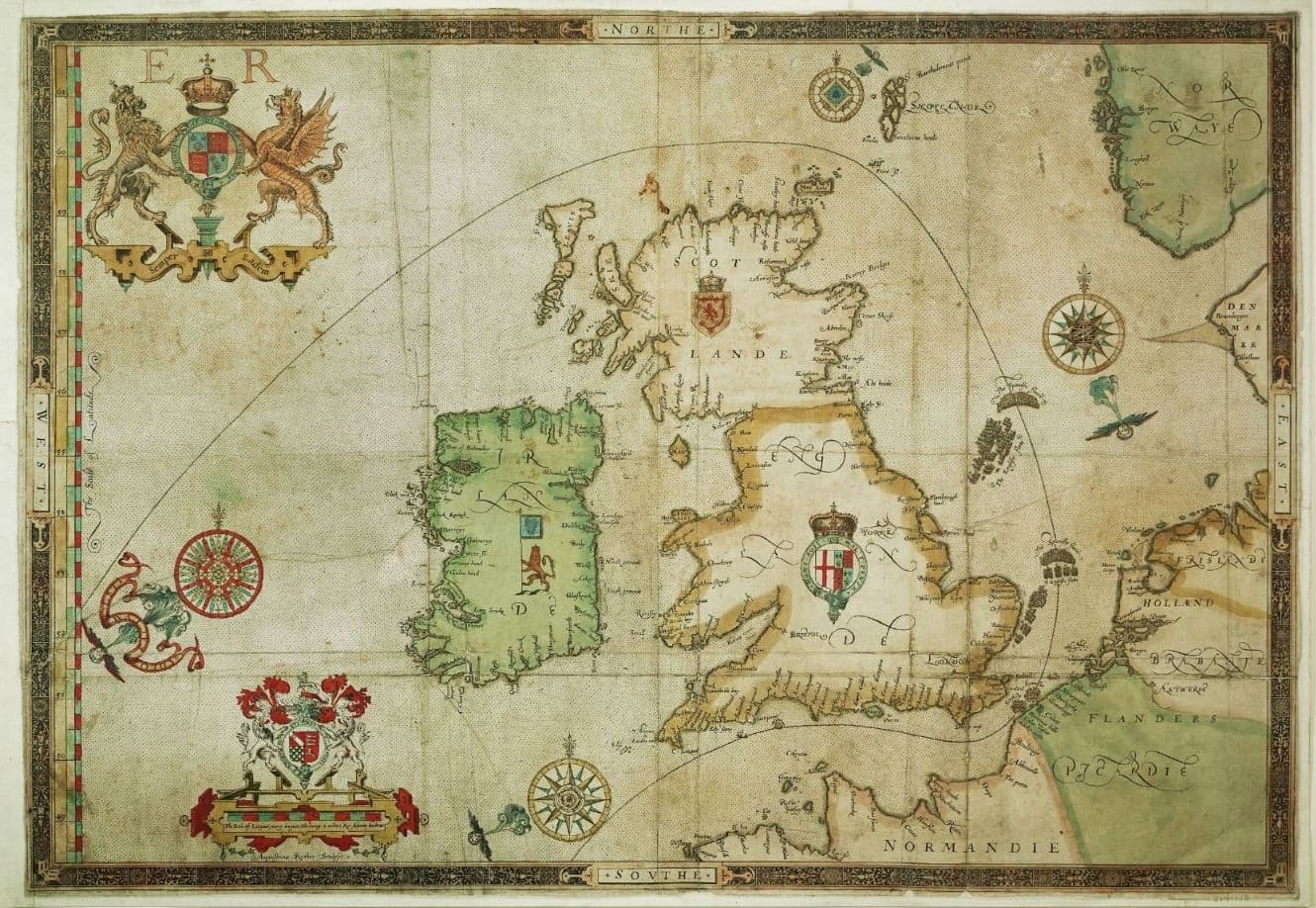
The Spanish Armada was a fleet of 130 warships sent by King Philip II of Spain in 1588 to invade Protestant England, overthrow Queen Elizabeth I, and restore Catholic rule. It failed catastrophically — defeated by a combination of English naval tactics, strategic errors by Spanish commanders, and devastating Atlantic storms that wrecked nearly half the fleet on the rocky coasts of Scotland and Ireland. The defeat is one of history's most consequential naval disasters, marking a decisive shift in European power away from Spain and toward England.
What Were the Causes of the Spanish Armada?
The roots of the Armada lay in decades of mounting political, religious, and economic rivalry between Spain and England. Philip II of Spain had once been married to England's Queen Mary I and briefly held the title of King of England. When Mary died in 1558 and the Protestant Elizabeth I took the throne, the religious alliance between the two crowns collapsed entirely. Elizabeth's England sheltered Protestant Dutch rebels fighting against Spanish rule in the Netherlands, and she covertly funded their resistance. English privateers — most notably Sir Francis Drake — raided Spanish treasure fleets and colonial ports in the Americas with quasi-official royal backing, stripping millions of ducats from the Spanish crown. Drake's audacious 1587 raid on Cádiz, which he famously called 'singeing the King of Spain's beard,' destroyed more than 30 supply ships and delayed the Armada by a full year. The execution of the Catholic Mary, Queen of Scots in February 1587 removed the last obstacle for Philip: with Mary gone, a successful invasion would place a Spanish-controlled Catholic monarch on the English throne rather than the imprisoned Scottish queen. Pope Sixtus V offered papal blessing and promised a subsidy of one million ducats if Spanish troops landed on English soil. Philip interpreted the invasion as a holy crusade and began planning in earnest.
How Was the Spanish Armada Assembled and Commanded?
Philip II's original choice to lead the Armada was the highly experienced Admiral Álvaro de Bazán, Marquis of Santa Cruz, the greatest Spanish naval commander of the age. Santa Cruz died in February 1588, just months before departure, throwing the entire operation into crisis. Philip replaced him with Alonso Pérez de Guzmán, the Duke of Medina Sidonia — a wealthy nobleman who was an able administrator but had no significant naval combat experience. Medina Sidonia himself wrote to Philip expressing doubts about his suitability, but the king insisted. The Armada that finally departed Lisbon on 28 May 1588 consisted of 130 ships carrying approximately 8,000 sailors and 18,000 soldiers, along with 1,500 brass guns and 1,000 iron guns. The plan was not for the Armada to fight a decisive sea battle but to act as a convoy escort: it would sail up the English Channel, rendezvous with the Duke of Parma's battle-hardened army of around 17,000 men waiting in Flanders, and ferry those troops across the Channel for the land invasion of England.
How Did England Prepare Its Defense Against the Armada?
England had been aware of Spanish invasion preparations for years and had built up its navy accordingly. Lord Howard of Effingham commanded the English fleet as Lord High Admiral, with Sir Francis Drake serving as his Vice Admiral. The English navy fielded roughly 200 vessels, though many were smaller than the great Spanish galleons. Crucially, English ships were faster, more maneuverable, and carried longer-range culverin cannons designed for accurate fire at distance — a stark contrast to the Spanish preference for shorter-range, heavier guns intended to sink ships at close range before boarding. The English strategy was explicitly to avoid the Spanish strength in close-quarters grappling and instead hammer the Armada from long range. On land, Elizabeth famously rode to Tilbury on 9 August 1588 to rally troops assembled there against the expected invasion, delivering her celebrated speech: 'I know I have the body of a weak, feeble woman; but I have the heart and stomach of a king.' Beacon fires were prepared along the southern English coast to relay warning of the Armada's approach — a chain of signals stretching from Cornwall to London.
What Happened During the English Channel Battle of 1588?
The Armada was first sighted off the Lizard Peninsula in Cornwall on 29 July 1588. The English fleet, caught in Plymouth harbour when the Armada appeared, executed a brilliant tactical withdrawal against the wind to emerge behind the Spanish formation — giving themselves the crucial weather gauge advantage. For the next nine days, the two fleets engaged in a running battle up the English Channel. The engagements at Plymouth, Portland Bill, and the Isle of Wight were fierce but inconclusive. Spanish gunnery was rapid but inaccurate; English gunnery was slower but more precise. Neither side managed to sink enemy ships in large numbers during these channel encounters. The Armada maintained its tight crescent formation — designed to protect vulnerable transport ships at its heart — with remarkable discipline despite constant English harassment. By 6 August, Medina Sidonia had anchored the fleet off Calais, waiting for word from Parma. There, communications broke down fatally: Parma's army could not board the flat-bottomed barges needed to cross the Channel because Dutch flyboats — shallow-drafted warships supporting the Dutch rebels — were blockading the Flemish ports. The rendezvous that was the entire strategic basis of the invasion was impossible to achieve.
How Did the Fireships Destroy the Armada's Formation?
On the night of 7–8 August 1588, Lord Howard ordered one of the most effective uses of fireships in naval history. Eight English vessels, totalling about 200 tons, were loaded with combustibles, set alight, and sent downwind into the anchored Spanish fleet off Gravelines. The Spanish had feared exactly this tactic and had stationed a fireship guard, but the burning vessels — some with loaded guns that fired randomly as the heat intensified — caused panic in the fleet. Medina Sidonia ordered his flagship to hold position and cut its anchor cable, but the rest of the Armada scattered in disorder, cutting or slipping their anchors to flee the flames. The loss of anchors would prove catastrophic in the storms to come. The following day, 8 August, saw the Battle of Gravelines — the most decisive engagement of the entire campaign. Without their protective formation, Spanish ships were isolated and attacked at close range. The galleon San Mateo and San Felipe were driven aground and captured. Several other ships were badly damaged. An estimated 600 Spanish sailors died at Gravelines. English ships fired some 2,000 cannonballs but lost not a single vessel.
Why Did Storms Complete the Armada's Destruction?
After Gravelines, Medina Sidonia faced an impossible choice. The prevailing southwesterly winds made a return down the English Channel almost impossible, and the English fleet still barred the way south. He ordered the Armada to sail north, circumnavigating the British Isles via Scotland and Ireland to return to Spain. This decision sealed the fleet's fate. The ships were already damaged, short of food and water, carrying wounded men, and — critically — without most of their anchors. As the Armada rounded Scotland and turned south into the Atlantic, a series of ferocious autumn gales struck. Between September and October 1588, at least 24 ships were wrecked on the coasts of Scotland and Ireland. The rocks of Sligo, Clare, and Donegal on Ireland's western coast claimed the largest toll. An estimated 5,000 Spanish soldiers and sailors drowned or were killed after reaching shore by English and loyalist Irish forces. The galleon La Trinidad Valencera sank off Donegal Bay. The Girona, carrying survivors from three other wrecked ships, struck rocks near the Giant's Causeway in County Antrim in October; of the roughly 1,300 men aboard, only 9 survived. Medina Sidonia himself reached Santander, Spain, in September, arriving gravely ill aboard a battered flagship. Only about 67 ships and fewer than 10,000 men returned to Spain.
| Factor | Spanish Armada | English Fleet |
|---|---|---|
| Ships | 130 | ~200 (inc. smaller vessels) |
| Sailors & Soldiers | ~26,000 | ~16,000 |
| Flagship Guns Strategy | Short-range, heavy — for boarding | Long-range culverins — for distance fire |
| Commander | Duke of Medina Sidonia | Lord Howard / Sir Francis Drake |
| Ships Lost (total campaign) | ~63 | 0 in battle |
| Men Lost (est.) | ~15,000-20,000 | ~7,000–8,000 (mostly disease) |
What Was the Legacy and Historical Significance of the Armada's Defeat?
The defeat of the Spanish Armada in 1588 did not instantly end Spanish dominance — Spain remained the most powerful empire in the world for decades afterward, and the war between England and Spain continued until 1604. England actually sent its own 'Counter Armada' to attack Spain in 1589, which also failed disastrously. But the symbolic and psychological impact of 1588 was immense. Elizabeth's propagandists celebrated the victory as divine Providence, minting medals inscribed 'He blew and they were scattered' — attributing the Armada's destruction to God-sent Protestant winds. The victory supercharged English nationalism, entrenched Protestant identity as a core element of Englishness, and gave tremendous momentum to England's ambitions as a naval and colonial power. The Armada's failure confirmed that the Dutch Republic would survive as an independent Protestant state, fatally weakening Spanish control of the Low Countries. England's maritime confidence surged: within two decades, the East India Company was founded (1600), and the first permanent English settlement in North America was established at Jamestown, Virginia (1607). The defeat demonstrated that sea power, superior gunnery technology, and tactical flexibility could overcome sheer numerical force — a lesson that would shape naval warfare for centuries. For Spain, the financial strain of rebuilding the fleet, combined with continuing wars in the Netherlands and France, accelerated the slow decline of Spanish imperial power that would unfold over the following century.
What Myths Surround the Spanish Armada?
Several popular myths have distorted the history of the Armada. The most persistent is the story of Sir Francis Drake calmly finishing his game of bowls on Plymouth Hoe upon hearing of the Armada's approach, replying that there was 'time to finish the game and beat the Spaniards.' This anecdote, though culturally beloved, first appeared in print only in 1736 — nearly 150 years after the event — and is almost certainly apocryphal. Another myth holds that the English victory was primarily due to storms, implying Spanish ships simply got unlucky. In reality, English naval tactics, superior ship design, and the catastrophic failure of the Parma rendezvous were the primary military causes of defeat; the storms delivered the final blow to a fleet already beaten strategically. The label 'Invincible Armada' was not used by the Spanish at the time — it was coined by English and Dutch propaganda to magnify the victory. Philip II never called his fleet invincible; he called it the 'Grand and Most Fortunate Navy,' a name that history made cruelly ironic. Finally, the idea that the defeat permanently ended Spanish sea power is overstated: Spain launched two further armadas against England in 1596 and 1597, both of which were also dispersed by storms.